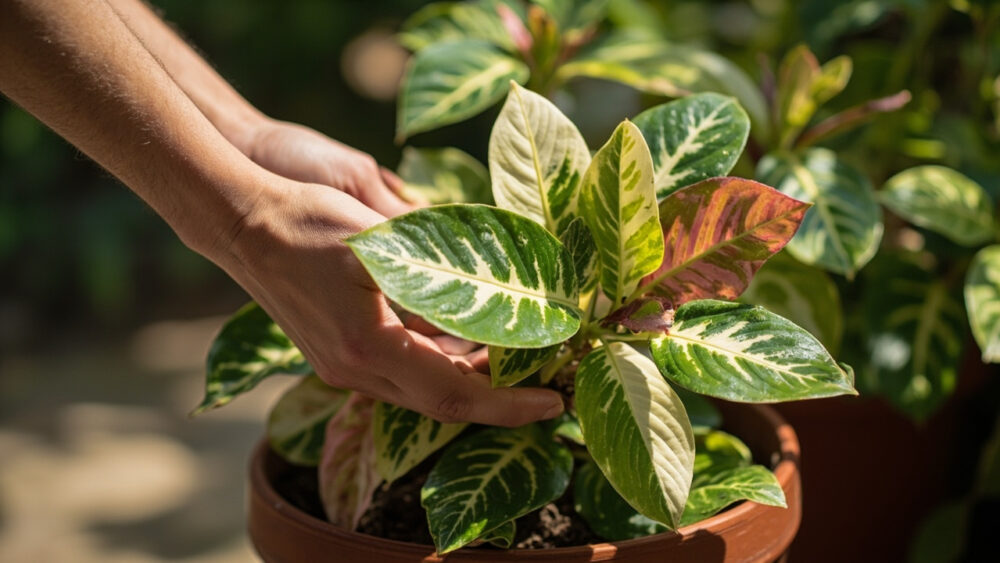
Ficus tineke care comes down to three things this plant will not compromise on: bright indirect light, water only when the top few inches of soil dry out, and zero tolerance for being moved around or sat in a draft. Get those right and the variegated leaves stay creamy white and green with almost no drama. Get them wrong and you get the two symptoms every tineke owner eventually googles in a panic: mass leaf drop and leaves that go solid green.
Here is the part nobody tells you upfront. That leaf drop after you bring it home is usually not disease and not a watering mistake, it is the plant sulking about its new address, and the fix is not more attention, it is less. There is also a mistake almost everyone makes with the watering schedule, and a specific light sign that tells you the variegation is about to disappear before it actually happens.
Stick with me through the sections below and you will know exactly what this plant wants, when, and why. At the bottom is a save-able Ficus Tineke at a Glance card with the numbers worth screenshotting before you forget them.
Light, Placement, and Temperature
Tineke wants bright, indirect light, ideally a few feet back from an east or south-facing window where the sun does not land directly on the leaves for hours at a time. Direct summer sun through glass will scorch those white patches first, since variegated tissue has less chlorophyll to protect it. Too little light and the plant starts converting new leaves back to solid green to maximize photosynthesis, which is the opposite of what you’re growing it for.
Keep the room between 65 and 80°F. Below 55°F for any length of time causes leaf drop, and so does a cold draft from a door, an AC vent, or a drafty winter window.
This brings us to the real reason your tineke dropped leaves the week you brought it home.
Why New Ficus Tineke Plants Drop Leaves (And What To Actually Do)
If you assumed the leaf drop meant you were underwatering or overwatering, that guess sends most people straight into a watering spiral that makes things worse. The real cause is almost always transplant shock from the move home, a change in light, or a draft, not the water at all.
The honest fix is patience, not intervention. Put the plant in a good bright spot, water on the schedule below, and leave it alone for four to six weeks.
Do not repot it, feed it, or move it to a “better” spot during that window. Ficus in general, and tineke is no exception, hates being fussed over right after a move.
Once it settles, watering becomes the next thing people get wrong.
Watering: How Much, How Often, How To Tell
Water when the top 2 inches of soil are dry to the touch, which usually lands somewhere between 7 and 10 days indoors, less often in winter. Stick a finger in before every watering rather than trusting the calendar, because light, pot size, and season all shift the actual interval.
When you do water, do it thoroughly until it runs from the drainage holes, then let the pot drain completely. Never let it sit in a saucer of standing water.
The mistake almost everyone makes is treating “weekly” as a fixed rule instead of a starting guess. A tineke in a bright warm spot dries out faster than one in a dim corner, and watering both on the same schedule overwaters one of them.
Droopy, curling leaves usually mean thirsty; soft, yellowing lower leaves with soggy soil mean the opposite problem entirely.
Soil and Feeding
Use a well-draining potting mix, something like a standard indoor potting soil cut with perlite or orchid bark at about a 3-to-1 ratio. Tineke roots resent sitting wet, and heavy garden soil or straight peat holds far too much water for this plant.
Feed monthly during spring and summer with a balanced liquid houseplant fertilizer diluted to half strength. Skip feeding in fall and winter when growth slows, since fertilizer the plant can’t use just builds up as salt in the soil.
Yellowing between the veins on older leaves, with the veins staying green, often points to a magnesium or nitrogen gap that a normal feeding schedule usually corrects within a few weeks.
Feeding keeps the engine running, but the routine tasks are what actually keep the plant in shape.
Pruning, Repotting, and Cleaning On Schedule
Prune in spring or early summer, cutting leggy stems back to a leaf node to encourage branching. Ficus sap can irritate skin, so wipe cuts with a cloth if you’re sensitive.
Repot every 2 years, or whenever roots start circling the pot’s edge or emerging from the drainage holes. Go up only one pot size, since a too-large pot holds excess moisture the roots can’t use fast enough.
Wipe the big glossy leaves down with a damp cloth every few weeks. This isn’t just tidiness, dust buildup blocks light and cuts down real photosynthesis.
- Spring: prune, repot if needed, resume monthly feeding.
- Summer: feed monthly, watch for fast growth and faster drying soil.
- Fall/winter: stop feeding, water less often, watch for cold drafts.
Even with a good routine, a few problems show up often enough that you should know them by sight.
The Problems Most Likely to Hit Your Tineke
Reversion to solid green leaves is common and it’s a light problem, not a disease. Move the plant somewhere brighter and new growth should come back variegated, though leaves that already reverted stay that way.
Brown, crispy leaf edges usually mean low humidity or a build-up of fertilizer salts. Run a humidifier nearby or flush the pot with plain water occasionally to clear excess salts.
Pests worth checking for are spider mites and scale, both visible as tiny specks or bumps on stems and leaf undersides. Wipe them off with a damp cloth or treat with insecticidal soap or neem oil, following the product label exactly.
Ficus tineke is mildly toxic to cats and dogs due to sap that can irritate the mouth and stomach. If your pet chews on it, call your veterinarian rather than waiting to see what happens.
Once you’ve ruled those out, the next question is simpler: is the plant actually happy?
How to Tell It’s Actually Thriving
A thriving tineke pushes out new leaves every few weeks during spring and summer, and those new leaves come in with visible cream and green variegation, not solid green. The stem should feel firm, not soft or wrinkled.
Leaves stay glossy and hold their shape rather than curling or drooping between waterings. A little leaf drop of one or two older leaves now and then is normal aging, not a crisis.
If you’re seeing steady new growth and the variegation is holding, you’re doing this right.
Here’s the whole thing distilled so you don’t have to reread any of it next time.
Ficus Tineke at a Glance
- Light: bright indirect light, a few feet from an east or south window, no direct midday sun on the leaves.
- Temperature: 65 to 80°F, no cold drafts, nothing below 55°F.
- Watering: when the top 2 inches of soil are dry, roughly every 7 to 10 days, adjusted by season.
- Soil: well-draining potting mix, standard soil cut with perlite or bark at about 3 to 1.
- Feeding: balanced liquid fertilizer at half strength, monthly in spring and summer only.
- Repotting: every 2 years or when roots circle the pot, one size up only.
- Toxicity: mildly toxic to pets and people, contact a veterinarian for any suspected ingestion.
Most tineke problems trace back to one of two things: too little light, or a watering schedule set by the calendar instead of the soil.
Fix those two and everything else on this list falls into place on its own.