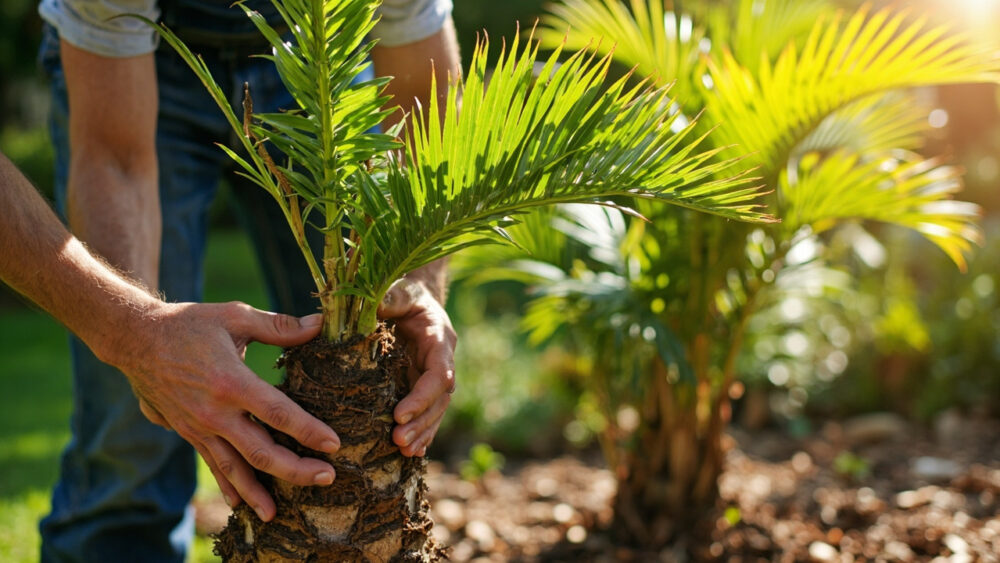
Most palm trees grow 6 to 24 inches of trunk height per year once established, though a happy palm in the right climate can occasionally push 36 inches in a single season. That is a wide range on purpose. How fast do palm trees grow depends less on the palm itself and more on the three things that actually run the show: species, root establishment, and heat.
Here is the part most people miss. A palm can look like it is doing nothing for two full years and then suddenly take off, and that is not a sign of a sick plant. It is normal palm behavior, and if you do not know that going in, you will convince yourself you killed it.
Below I will walk through what actually controls the speed, what a realistic year-by-year timeline looks like, how to legitimately speed things up, and how to tell a genuinely stalled palm from one that is just doing what palms do. Save-able quick-reference card is at the bottom.
The Honest Growth Range, Year by Year
Year one after planting is almost always the slowest, even for a fast species. The palm is building roots below ground before it puts energy into height above it. Expect little to no visible trunk growth in that first year, sometimes even a step backward in canopy size.
Years two through five are where establishment pays off, typically 1 to 2 feet of height gain per year for moderate growers in decent conditions. Slow species like king palms or many true fan palms may only manage 6 to 12 inches even once settled in.
Fast growers, queen palm and certain bamboo-type clumping palms among them, can hit 2 to 3 feet a year once roots are fully established and heat and water are consistent.
That range only holds if the conditions behind it are right, and that is the next thing worth understanding.
What Actually Controls the Speed
Species sets the ceiling, climate decides how close you get to it. A queen palm in coastal Florida might add 2 feet a year. The same species pushed into a marginal zone 8b winter will spend half its energy just surviving cold snaps and grow a fraction of that.
Soil temperature matters more than air temperature for root growth, and palm roots mostly stop working below about 65°F soil temp. That is why palms planted in spring, once soil has warmed, establish faster than those planted in fall in cooler climates.
Water consistency beats water volume. Palms want evenly moist soil, not a flood-and-drought cycle, and irregular watering is one of the most common reasons an otherwise healthy palm crawls along for years.
Nutrition is the other lever, and it is a very specific one for this plant family.
Container Palms vs. Ground-Planted: A Different Clock
A palm stuck in a container will grow noticeably slower than the same species in the ground, sometimes by half. Roots hit the pot wall, growth above ground slows to match, and the palm essentially waits for more room.
If your palm is indoors or in a pot on a patio, that slower pace is not a problem to fix. It is the deal you make for growing a palm somewhere it could not otherwise survive winter.
Indoor palms in particular might add only a few inches a year, and that is normal, healthy, permanent behavior, not a phase they grow out of.
Knowing which category your palm falls into changes what “normal” even means for it.
How to Speed It Up, and What Does Not Work
The legitimate levers are water, fertilizer, and heat retention, in that order of impact. Keep soil consistently moist through the first two growing seasons, use a fertilizer formulated for palms (they need more manganese, magnesium, and potassium than a generic all-purpose blend provides), and mulch to keep root zones warm and even.
Deficiency in those specific nutrients shows up as yellowing or frizzled new fronds, and it is one of the most common reasons an established palm slows down or looks unwell even with good watering.
What does not work: heavy pruning of green fronds to “encourage growth.” Palms pull nutrients from older fronds to feed new ones, and cutting green fronds early actually starves the plant and slows it down.
Bigger pots and bigger holes do not speed things up either. Oversized planting holes with loose fill soil can actually cause root rot before they cause faster growth.
Patience with the right inputs beats intervention almost every time with this plant.
When Slow Is Normal and When It Is a Problem
If you assumed no visible growth means something is wrong, that guess causes more unnecessary digging-up of perfectly fine palms than any pest ever has. A newly planted or transplanted palm can sit still above ground for a full year or two while it rebuilds roots. That is expected, not a symptom.
The real warning signs are different: fronds that are uniformly yellow rather than just the oldest ones, a trunk that feels soft or spongy near the base, or a crown that looks collapsed rather than simply not elongating.
New spear leaf failing to emerge over a full growing season, especially combined with a foul smell at the crown, points to bud rot, which is often fatal and worth a call to a local extension office or arborist rather than a wait-and-see approach.
Slow and steady is the palm’s normal pace, stalled and declining is a different animal entirely, and telling them apart is mostly about watching the newest growth, not the total height.
Palm Trees: Quick Reference
- Typical growth rate: 6 to 24 inches of height per year once established, up to 36 inches for fast species in ideal heat and water.
- Slowest phase: the first year after planting or transplanting, when root establishment takes priority over visible height.
- Fast species: queen palm and many clumping palms, often 2 to 3 feet a year established.
- Slow species: king palms and many true fan palms, often 6 to 12 inches a year even when healthy.
- Container palms: grow roughly half as fast as the same species in the ground, permanently, not just while young.
- Biggest speed levers: consistent soil moisture, palm-specific fertilizer with manganese and magnesium, warm soil above 65°F.
- Real warning signs: uniformly yellow fronds, a soft or spongy trunk base, or a missing new spear leaf, worth a call to an arborist rather than waiting it out.
Palms reward patience more than intervention, and the timeline above holds for almost every species you will find at a nursery.
Give it consistent water and the right fertilizer, then let the calendar do the rest.