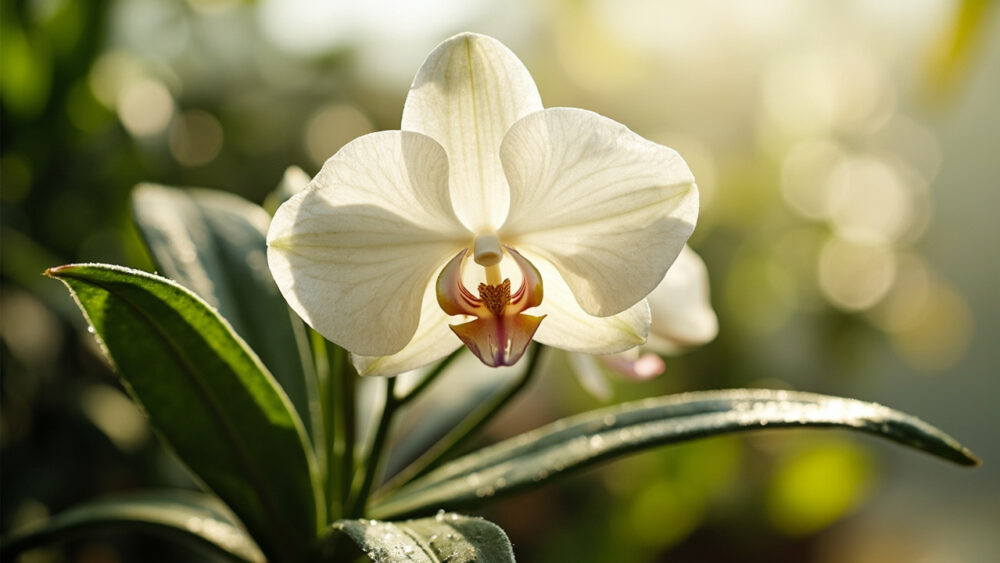
For a common moth orchid (Phalaenopsis) in a standard bark or moss mix, water about once a week, and cut back to every 10 to 14 days in winter. But that number is almost useless on its own, because how often to water orchid plants depends entirely on your pot, your mix, and your house, not a date on the calendar.
Most orchids that die from watering don’t die from too little. They die from too much, and the plant usually looks fine right up until the roots are already gone.
Before you touch the watering can again, there’s a mistake almost every beginner makes with ice cubes and misting that feels responsible but does almost nothing useful. There’s also a sign people read backwards, wrinkled leaves, that sends them straight into the exact habit that caused the wrinkling in the first place. Stick with me and you’ll get the honest schedule, the checks that replace guessing entirely, and the save-able Orchid at a Glance card at the very bottom of this page.
The Honest Watering Schedule, and What Actually Changes It
Once a week is the starting point, not the rule. A Phalaenopsis in a plastic pot with bark mix, sitting on a windowsill in normal room temperature, usually wants water every 6 to 8 days. A Cattleya or Dendrobium in a clay pot dries faster and may want water every 4 to 6 days. An orchid potted in sphagnum moss holds water far longer than bark and can go 10 to 14 days between waterings even in summer.
Pot material matters more than most people realize. Terra cotta and unglazed clay pull moisture out through the walls, so they dry faster than plastic or glazed ceramic. A bigger pot with more mix holds moisture longer than a snug one, even with the same plant.
Light and temperature move the number too. A warm, bright spot near 75°F dries the mix faster than a cooler room near 65°F. Air conditioning and heating vents both pull moisture out of bark mix faster than you’d expect.
None of that matters if you’re still watering by the calendar instead of the plant itself.
Stop Guessing: The Checks That Actually Tell You
If you’ve been counting days on a calendar, that’s the guessable move, and it’s the one that gets people into trouble either direction. The real answer isn’t a number of days, it’s three quick checks you do in under a minute.
The finger test works on bark mix better than anything else. Push a finger an inch down into the bark. If it feels damp or cool, wait. If it feels dry and slightly warm, water.
The pot weight test is even more reliable once you learn it. Lift the pot right after you water it, so you know what “wet” feels like. A dry pot feels noticeably lighter. Most experienced growers stop checking the bark at all and just lift the pot.
Roots tell you plenty too. Healthy orchid roots are firm and green or silvery white when moist, and they turn a lighter, papery silver-green when the plant needs water. Mushy brown roots mean trouble, and that’s not a watering-schedule problem anymore.
Once you trust your fingers and your hands more than the calendar, the next question is how to actually deliver the water without drowning the roots.
How to Water an Orchid Properly Once You’ve Decided It’s Time
Ice cubes and a light misting feel gentle and controlled, which is exactly why they’re the most common mistake. A few ice cubes melt into a tablespoon or two of water, nowhere near enough to reach the roots at the bottom of the pot, and misting the leaves does almost nothing for the root system that’s actually thirsty.
Take the plant to a sink instead. Run room-temperature water through the pot for a full 15 to 30 seconds, long enough to soak the entire mix, not just wet the top inch.
Let it drain completely for several minutes before setting it back in its decorative pot or saucer. Orchids left sitting in standing water will rot at the roots within days, and this single habit kills more orchids than underwatering ever does.
If your orchid sits in a decorative outer pot with no drainage hole, always lift the inner pot out to water it, then return it once it’s fully drained.
Getting the technique right solves half the problem, but you still need to know which symptoms mean which mistake.
Overwatered or Underwatered? Here’s the Tell
Wrinkled, slightly deflated leaves look like a plant that’s thirsty, and almost everyone’s first instinct is to water more. That guess is often exactly backwards, because wrinkled leaves are frequently a sign of root rot, where the roots have died and can no longer take up water at all, no matter how much you give them.
Underwatering shows up as leaves that are thinner and slightly wrinkled but still firm, with roots that are silvery and dry-looking but still solid when you press them. The fix is straightforward: water, and water a little more consistently.
Overwatering shows up as yellowing leaves that feel soft or mushy, a base that looks translucent or darkened, and roots that are brown, black, or slimy instead of firm. That’s not a watering-frequency problem anymore, that’s rot, and it means repotting into fresh mix and trimming away the dead roots with a clean blade.
The honest fix for true root rot is often a full repot and a long recovery, not a schedule tweak, so catching it early matters more than any watering chart.
Get the season wrong and you’ll recreate one of these two problems even after you’ve learned to spot them.
Adjusting the Schedule Through the Year
Summer heat and stronger light speed up how fast the mix dries, so a plant that needed water every 8 days in spring might need it every 5 to 6 days in the height of summer. Growth is active, roots are thirsty, and the plant can handle more frequent watering.
Winter slows everything down. Lower light, cooler rooms, and a slower growth rate mean the mix stays damp much longer. Stretch that same plant to every 10 to 14 days, and always check with your finger or the pot weight rather than trusting the old summer schedule out of habit.
Right after repotting, wait 3 to 5 days before the first watering to let any damaged roots start to callus over, which lowers the risk of rot setting into fresh cuts.
Once you’ve matched the season, you’re basically running on instinct, and that’s exactly the point where a quick-reference card pays for itself.
Orchid at a Glance
- Base schedule: water roughly once a week in a plastic pot with bark mix, adjusting up or down based on pot material and mix type.
- Winter adjustment: stretch to every 10 to 14 days when light and growth slow down.
- Summer adjustment: shorten to every 5 to 6 days in hot, bright conditions.
- How to check: press a finger an inch into the mix, or lift the pot to judge weight, rather than watering by the calendar.
- How to water: run room-temperature water through the pot for 15 to 30 seconds and let it drain fully before returning it to any saucer or outer pot.
- Underwatered signs: thin, slightly wrinkled but firm leaves, roots that are dry-looking but still solid.
- Overwatered signs: soft yellow leaves, a mushy or translucent base, and brown or slimy roots that call for repotting, not more water.
Water by feel and weight, not by the day of the week, and check the roots before you ever add more water.
Get that habit down and the schedule takes care of itself.