Strawberries in pots want a container at least 12 inches wide and deep with real drainage holes, a loose potting mix (not garden soil), one plant per 10 to 12 inches of pot width, and six or more hours of direct sun. Get those four things right and you will get fruit the same season, sometimes within eight to ten weeks of planting.
Most people who try this fail for one specific reason, and it is not watering or sun. It is cramming too many plants into a pot that looked big enough at the nursery but starves every root system by July.
There is also a sign almost everyone misreads in year two: a container full of leafy, vigorous growth and almost no fruit. That looks like a healthy plant. It is usually the opposite.
Stick with this and you will get the timing anchored to your actual frost dates, the exact planting depth that makes or breaks a strawberry crown, and the feeding schedule that fixes the leafy-no-fruit problem before it starts. The full save-it-to-your-phone rundown, Strawberries at a Glanceis waiting at the bottom once you have the reasoning behind it.
When to Plant Strawberries in Pots
Plant as soon as you can work the soil in springroughly two to four weeks before your last expected frost, once soil temperature is at least 40 F and ideally climbing toward 50 F. Strawberries tolerate a light frost on foliage once established, so you do not need to wait for frost-free nights the way you would for tomatoes.
In mild-winter climates, zones 7 and warmer, fall planting works too, giving roots a full season to establish before spring fruiting. In colder zones, stick to spring.
Bare-root crowns and potted starts both work in containers. Bare-root is cheaper and plants faster if you catch it at the right window; potted starts forgive a slower start.
Get the timing right and the next decision, the pot and the soil, decides whether that timing pays off.
Choosing the Pot and Preparing the Soil
Size is the real fight here. A single strawberry plant needs at least 8 inches of soil depth and 10 to 12 inches of width to itself.
Strawberry jars and hanging towers look charming but usually cram plants into pockets too small and too shallow, and the upper pockets dry out while the lower ones stay soggy. A wide, plain container, or a half whiskey barrel with several plants spaced 10 to 12 inches apart, outperforms a decorative jar almost every time.
Fill with a light, well-draining potting mix, not topsoil or garden dirt, which compacts in containers and suffocates roots. Mix in a slow-release balanced fertilizer at planting time if your mix does not already include one.
Drainage holes are non-negotiable. Strawberries rot fast in soil that stays wet at the bottom.
Once the container is right, the planting technique itself has one detail that ruins more crowns than any pest does.
Planting Step by Step
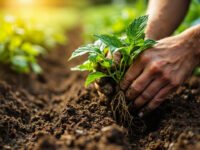
- Depth: the crown, the woody base where leaves emerge, must sit exactly at soil level. Bury it and it rots. Plant it too high and the roots dry out and the plant fails to establish.
- Spacing: one plant per 10 to 12 inches of container width. In a wide barrel or trough, stagger plants in a loose grid at that spacing rather than a tight row.
- Root spread: trim any roots longer than 5 to 6 inches, then fan them out in the planting hole rather than balling them up.
- Firm and water: settle soil gently around the crown, water in slowly until it runs from the drainage holes, and check the crown height again once the soil settles.
That crown-depth detail is the single most common mistake, and it is silent: a buried crown does not wilt dramatically, it just quietly declines over a few weeks while you wonder what you did wrong.
Get the crown right and watering becomes the next place strawberries separate winners from losers.
Watering and Feeding Through the Season
Containers dry out far faster than garden beds, often daily in hot weather. Check soil moisture by pressing a finger an inch down; water when it feels barely damp, not when the surface looks dry, since the surface dries first and lies to you.
Strawberries want consistent moisture, not swampy soil. Wide fluctuations between soaked and bone-dry cause small, misshapen fruit and split berries.
Now for the leafy-no-fruit problem promised earlier. If your plant looks lush and green with barely any flowers or berries, the usual cause is too much nitrogen, often from a general all-purpose fertilizer applied all season.
Feed with a fertilizer formulated for fruiting plantslower in nitrogen and higher in phosphorus and potassium, starting a few weeks after planting and then every three to four weeks through the growing season. Ease off nitrogen-heavy feeding once flowering starts.
Fix the feed and the flowers usually show up within a couple of weeks.
Watering and feeding keep the plant alive, but a few specific threats can undo a whole season fast.
Problems That Actually Take Down Container Strawberries
Gray mold (botrytis) is the most common fruit-ruiner, showing up as fuzzy gray coating on ripening berries, especially after humid or rainy stretches. Prevent it with good airflow between plants, mulch or a berry-safe barrier under fruit so it is not sitting on wet soil, and picking ripe berries promptly rather than letting overripe ones sit.
Slugs and birds both go straight for ripening fruit. Raised container height alone deters some slugs. Netting over the pot works well against birds without chemicals.
Root rot from waterlogged soil is the container-specific killer, showing up as wilting despite wet soil and a mushy, dark crown. There is no fixing an advanced case. Prevention through drainage and correct watering is the only real cure.
If you see webbing, stippled pale leaves, or fine white cottony patches, you are likely dealing with spider mites or aphids. Treat with an insecticidal soap or horticultural oil labeled for the pest, following the product label exactly.
Head off these four and most of what is left is just waiting for red.
When and How to Harvest
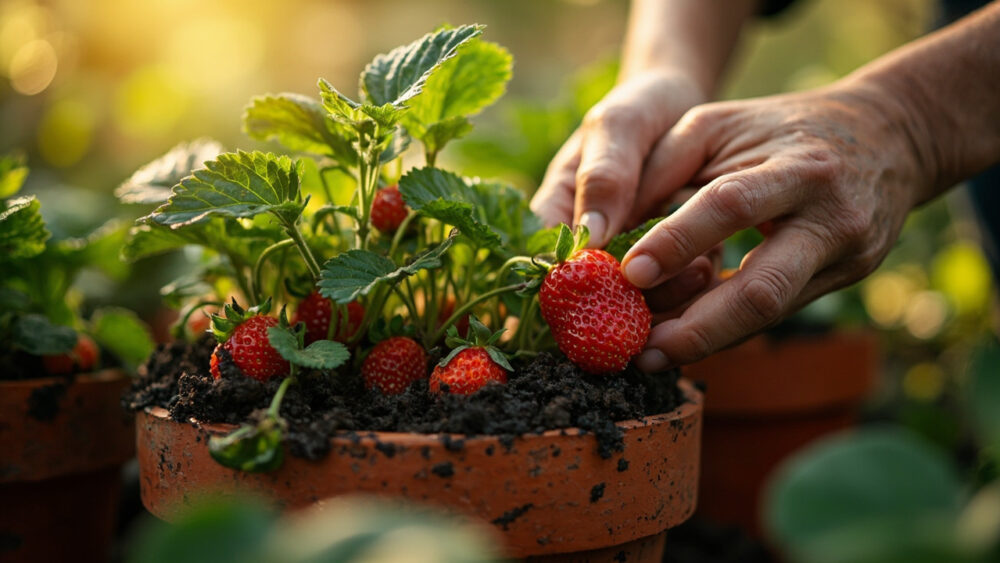
Pick strawberries only when they are fully red all the way to the shoulders near the stem, since unlike some fruits, strawberries do not ripen further once picked. A berry that is red at the tip but white or pale near the cap will stay that way.
June-bearing varieties give one concentrated harvest over two to three weeks, typically in late spring to early summer depending on climate. Everbearing and day-neutral types spread smaller harvests across the whole season, which suits container growing well since you get fruit spring through fall rather than one big flush.
From a spring planting, expect first ripe fruit in roughly eight to twelve weeks, sometimes longer for bare-root crowns establishing from scratch.
Twist or snip berries off with a bit of stem attached rather than yanking, which can damage the crown.
That is the whole cycle from crown to harvest, and everything you need to keep straight is right below.
Strawberries at a Glance
- When to plant: two to four weeks before last frost in spring, once soil hits about 40 to 50 F, or in fall in zones 7 and warmer.
- Pot size: at least 12 inches wide and 8 inches deep, one plant per 10 to 12 inches of width.
- Planting depth: crown level with the soil surface, never buried, never exposed.
- Soil: light, well-draining potting mix with a slow-release balanced fertilizer worked in at planting.
- Water: check an inch down daily in warm weather, water when barely damp, avoid soggy or bone-dry swings.
- Feed: fruiting-plant fertilizer, low nitrogen, every three to four weeks, ease off nitrogen once flowers appear.
- Harvest: pick only when fully red to the shoulders, first fruit in eight to twelve weeks from spring planting.
If you remember nothing else, remember the crown depth and the pot size. Everything else on this list just protects the plant you got right on day one.