The best companion plants for onions are carrots, brassicas like cabbage and broccoli, lettuce, strawberries, and most of the aromatic herbs (chamomile, dill, summer savory). They work because onions repel the pests that bother those crops most, while those crops fill space and soil niches onions don’t compete for. The plants to avoid are beans, peas, and asparagus, and putting them near onions doesn’t just underperform, it actively stunts one or both crops.
Here’s what most people get wrong before they even plant: they assume “companion planting” means scattering everything together in one bed and hoping for the best. That’s the mistake that quietly tanks half the pairings gardeners try. There’s also a sign in the bed, weeks in, that tells you a pairing failed, and almost nobody reads it correctly.
Stick with me through the layout section and the myth-busting below, because the honest answer to “does this actually work or is it garden folklore” is different for almost every plant on this list. And save the “Onions at a Glance” card at the bottom. It’s the kind of thing worth pulling up on your phone while you’re standing in the bed deciding what goes where.
Why Onions Are Such Good Neighbors
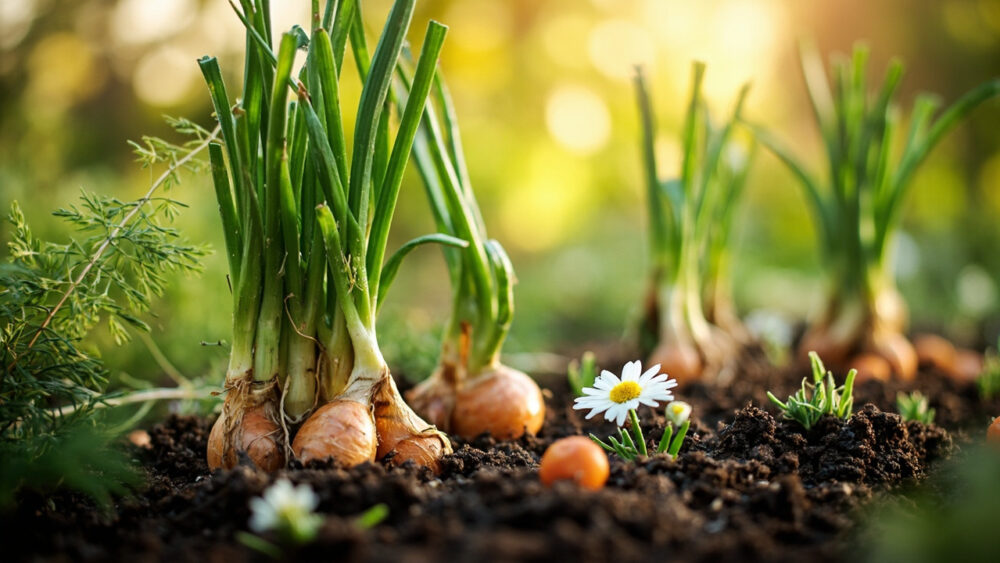
Onions bring something specific to a shared bed: sulfur compounds in their foliage that mask the scent signals pests use to find host plants. Carrot rust flies, cabbage moths, and aphids all hunt partly by smell, and a bed that smells like onion is harder for them to read.
Onions also grow narrow and upright, with roots that stay shallow and close to the bulb. That leaves horizontal room and soil depth free for neighbors with different root habits, which is the real mechanical reason these pairings work, not just the pest confusion.
None of that means onions are a magic pest shield.
The Companions Worth Planting
Carrots
Carrots and onions are the classic pairing for good reason. Onions confuse carrot rust flies and carrot root flies hunting by scent, while carrots’ deep, narrow taproot occupies soil the onion’s shallow roots never touch. Space carrots about 2 to 3 inches apart in rows 12 inches from your onion rows, and thin both as they size up so neither is starved for room.
The one catch: carrots germinate slower than onions and sulk if onion foliage shades them out early, so give carrot seed a head start by a week or two if you’re direct sowing both at once.
That timing detail matters more than the pairing itself.
Cabbage, Broccoli, and Other Brassicas
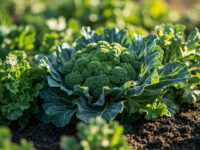
Onions planted in and around brassica beds cut down on cabbage moth and cabbage looper egg-laying, again through scent masking rather than any repellent chemistry. Brassicas are heavy feeders and heavy drinkers; onions are comparatively light on both, so they don’t compete hard for nitrogen or water.
Space onions in a border row 6 to 8 inches apart around a brassica block rather than interplanting them tightly, since brassica leaves get large enough to shade small onion bulbs and stall their growth.
Get the spacing wrong here and you’ll see it in the bulb size come harvest.
Lettuce and Other Shallow Greens
Lettuce, spinach, and similar greens share the shallow root zone with onions without much friction, and the onion’s upright habit doesn’t shade a low-growing green enough to matter. This is more about efficient space use than pest control.
Interplant lettuce between onion rows spaced at your normal onion spacing (4 to 6 inches for storage onions, wider for large sweet varieties) and harvest the lettuce well before the onion canopy fills in.
That harvest-order detail is the difference between a smart pairing and a shaded, bitter lettuce crop.
Strawberries
Onions interplanted at the edges of a strawberry bed can reduce fungal pressure slightly by improving airflow at ground level and by their sulfur compounds discouraging some soil-borne fungal spores from establishing. This is a modest benefit, not a cure for strawberry disease, and it works best as a border planting rather than mixed through the crowns.
Give strawberries the space they actually need first; treat onions as the edging, not the interplant.
Chamomile, Dill, and Summer Savory
These aromatic herbs draw in predatory insects like hoverflies and parasitic wasps that feed on aphids and other soft-bodied pests onions occasionally host. Chamomile in particular has a long-standing reputation for improving the vigor of nearby alliums, likely through the same beneficial-insect draw rather than any root-level chemistry.
Tuck herbs at row ends or bed corners rather than mixing them through the onion rows themselves, since most of these herbs get bushier than gardeners expect and will shade small bulbs if planted too close.
Now for the plants that undo all of that good work.
What to Never Plant Near Onions
Beans and Peas
This is the pairing to actively avoid, not just skip. Beans and peas are legumes that fix nitrogen in the soil through a symbiotic relationship with rhizobia bacteria in root nodules. Onions release sulfur compounds that suppress that same rhizobia activity, which shuts down the legume’s nitrogen fixation and stunts the beans or peas.
The damage runs both directions too. Gardeners who ignore this and interplant anyway typically see pale, slow-growing beans and smaller-than-normal onion bulbs, since the onion isn’t getting the soil nitrogen boost it would from a legume that’s actually fixing nitrogen properly.
If you’ve ever had a bean row that just never took off next to onions, this is almost certainly why.
Asparagus
Asparagus and onions compete hard for the same nutrients and don’t share space well over the multi-year life of an asparagus bed. Onions can also stunt young asparagus crowns, which are slow to establish in their first two to three years and don’t tolerate root competition the way an established stand does.
Since asparagus is a perennial bed you’re committing to for a decade or more, keep alliums out of it entirely rather than testing the theory.
That covers the hard no’s, but there’s a myth still worth clearing up.
The Companion Planting Myths That Don’t Hold Up
If you’ve read that onions repel every pest in the garden, that’s the guess that needs correcting. Onions mask scent for specific hunters like carrot rust fly and cabbage moth. They do nothing meaningful against Japanese beetles, squash bugs, or flea beetles, and treating onions as a general pest shield leads gardeners to skip real pest management on crops that actually need it.
The other myth is that tighter interplanting always means better results. Cramming onions, carrots, lettuce, and herbs into one dense block sounds efficient, but each of those plants still needs its own root room and light. Dense mixing without real spacing is the mistake that quietly ruins most companion beds, not a bad plant choice.
Layout, not plant selection, is usually where these beds succeed or fail.
How to Lay Out the Bed
Run onions in their own rows spaced 4 to 6 inches apart within the row and 12 to 18 inches between rows, planted 1 inch deep once soil has warmed past about 50°F, typically 2 to 4 weeks before your last frost for sets or transplants.
Put carrots and lettuce in the alleys between onion rows rather than mixed directly into them. Border the whole block with a single row of dill, chamomile, or summer savory at the ends, and keep brassicas and strawberries in their own adjacent beds rather than interplanted row for row.
That’s the whole system: dedicated rows, shared alleys, herb borders, and legumes kept well away.
Onions at a Glance
- When to plant: sets or transplants go in 2 to 4 weeks before your last frost, once soil hits about 50°F.
- Spacing and depth: 4 to 6 inches apart within the row, 12 to 18 inches between rows, planted about 1 inch deep.
- Best companions: carrots, cabbage and other brassicas, lettuce, strawberries, chamomile, dill, summer savory.
- Never plant nearby: beans, peas, or asparagus, since onions suppress the nitrogen fixation legumes rely on.
- Layout that works: onions in their own rows, shallow-rooted greens in the alleys, herbs bordering the ends.
- What onions actually repel: carrot rust fly and cabbage moth by scent masking, not a general pest shield.
- Harvest cue: tops yellow and fall over, and you pull within a week or two once half the bed has flopped.
Get the layout right and the plant list mostly takes care of itself.
Keep beans out, give carrots a head start, and onions will carry their weight in almost any bed you put them in.