Here’s how to care for bougainvillea in one breath: give it the brightest, hottest spot you have, water deeply and then let it go almost dry, skip the rich potting mix, and prune it hard once it settles into a rhythm. Get those four things right and bougainvillea forgives almost everything else. Get the watering wrong, and you can do everything else perfectly and still never see a bloom.
Most people kill this plant with kindness, not neglect. The one mistake that ruins more bougainvillea than cold weather ever does is treating it like a normal houseplant that wants steady moisture and rich soil. It doesn’t. It wants a little stress.
There’s also a sign almost everyone misreads: a bougainvillea that drops leaves and looks half dead right after you bring it home or move it outside isn’t dying, it’s adjusting, and panicking at that point is how good plants get overwatered into an early grave. Stick with this and by the bottom you’ll have the full Bougainvillea at a Glance card, the kind of thing worth saving to your phone before you walk away from this screen.
Light, Placement, and Temperature
Bougainvillea wants full sunat least 6 hours a day, and it actually blooms better with 8 or more. Less than that and you get a green, leafy plant with few or no flowers. This is the number one reason a bougainvillea “won’t bloom” indoors or on a shaded porch.
It loves heat and does not sulk in it the way many flowering plants do. It’s happy from roughly 65 to 95°F and stops growing well below 50°F.
Frost is the hard line. A light frost damages leaves and stems; a hard freeze can kill the plant to the ground or outright. If you’re anywhere that dips below 30°F, this is a container plant that comes indoors or into a garage or greenhouse for winter, not a permanent landscape shrub. USDA zones 9 through 11 are where it can live outside year round.
Placement solved, but placement alone won’t make it bloom if the watering habit is wrong, and that’s where most people trip.
Watering: How Much, How Often, and How to Tell
If you assumed more water means more flowers, that guess is exactly backwards with bougainvillea. This plant blooms hardest when it’s kept on the dry side and allowed to dry out between waterings, not when it’s kept evenly moist.
Water deeply, then wait. Soak the root zone until water runs from the drainage holes, then don’t water again until the top 1 to 2 inches of soil are dry to the touch. In containers during hot summer weather that might mean every 3 to 5 days. In cooler weather or in the ground once established, it can stretch to a week or more.
The honest tell isn’t a calendar, it’s the leaves. Slightly wilted, slightly dull leaves that perk back up an hour after watering are normal and even useful, that mild stress is part of what triggers bloom. Leaves that turn yellow and drop while the soil is still wet mean you’re overwatering, and that’s the single fastest way to lose flowers and eventually the plant.
Get the dry-then-soak rhythm down and the next question, what to actually feed it, gets a lot simpler.
Soil, Potting Mix, and Feeding
Bougainvillea wants soil that drains fast and doesn’t hold much fertility on its own. A cactus or citrus potting mixor regular potting soil cut with extra perlite or coarse sand, works well in containers. In the ground, it wants a well-drained bed and actively resents heavy clay that stays wet.
Rich, heavily amended soil is a common trap. It pushes soft leafy growth at the expense of flowers, the same problem you get from too much shade or too much water.
Feed lightly during the growing season with a bloom-boosting fertilizer, one formulated with a lower nitrogen number relative to phosphorus and potassium, roughly every 2 to 4 weeks from spring through late summer. Ease off or stop entirely in fall and winter when growth slows.
Soil and feeding set the stage, but bougainvillea’s real shape comes from the pruning shears, not the fertilizer bottle.
Pruning, Repotting, and the Routine Tasks
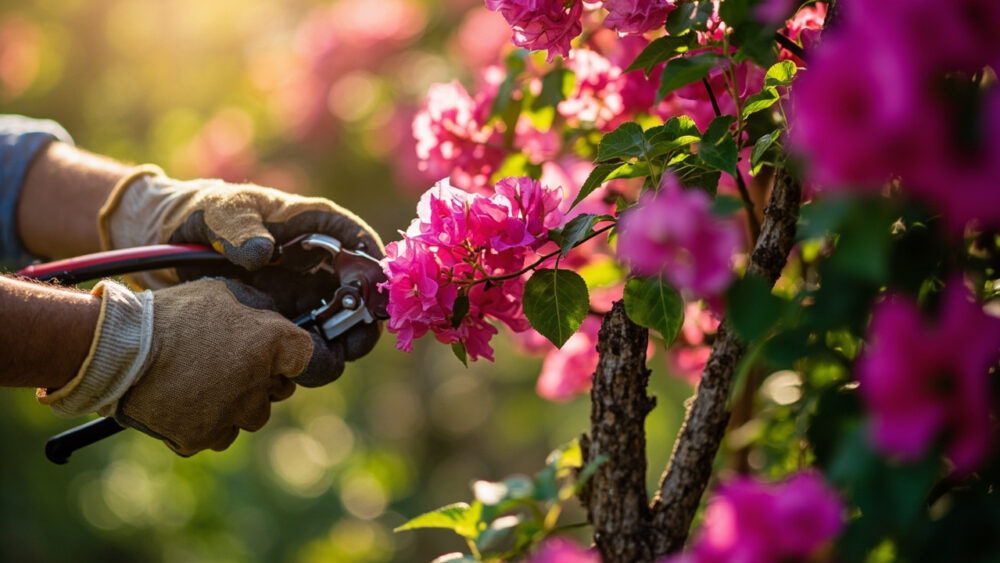
Bougainvillea blooms on new growth, so pruning isn’t optional maintenance, it’s how you get more flowers. Cut back spent flowering shoots by a third to a half after a bloom cycle fades, and don’t be shy about it. A harder pruning to shape the plant works best in late winter or early spring, before strong new growth starts.
It also blooms harder when its roots are a little snug, so resist repotting every year. Move it up one pot size only when roots are circling densely at the drainage holes or the plant is drying out within a day of watering, typically every 2 to 3 years.
Wipe dust off leaves occasionally if it’s grown indoors or on a covered patio, since heavy dust cuts down on the light it’s already working hard to use.
Handle the thorns with care while you prune, they’re stiff and sharp enough to draw blood through thin gloves.
Pruning keeps the plant productive, but even a well-pruned bougainvillea runs into a short, predictable list of problems worth knowing before they show up.
The Problems Most Likely to Strike
Bougainvillea is genuinely tough, but a handful of issues show up again and again.
- No flowers despite healthy leaves: almost always too little light, too much water, or soil that’s too rich. Cut water back and move it somewhere sunnier before touching the fertilizer.
- Leaf drop after a move or repotting: normal transition stress, not a crisis. Keep light bright, water sparingly, and give it 2 to 4 weeks to settle before judging it.
- Aphids and scale: check new growth and stems for small clustered insects or waxy bumps. Insecticidal soap or a horticultural oil, applied per the product label, handles most infestations.
- Root rot: soft, dark stems near the soil line and a sour smell mean waterlogged roots. Improve drainage immediately and let it dry out; badly rotted plants often don’t recover.
- Cold damage: blackened, mushy leaves after a cold night mean move it in earlier next time. Trim damaged growth back once new growth confirms which stems are still alive.
Bougainvillea is mildly toxic if chewed by pets or people, mainly from the sap and the sharp thorns rather than a dangerous poison. Watch for mouth irritation, drooling, or vomiting, and call a veterinarian if you suspect a pet has ingested any part of it.
Once you’ve ruled these out, the question flips from what’s wrong to what thriving actually looks like.
How to Tell It’s Genuinely Thriving
A thriving bougainvillea isn’t just green, it’s covered in the papery colored bracts that people actually plant it for, in waves rather than a few scattered blooms. New growth tips should be reddish or bronze before hardening green, a sign the plant is pushing actively rather than sitting still.
Slightly droopy leaves between waterings are a good sign here, not a bad one. That mild dry stress is exactly what keeps the bloom cycles coming. A bougainvillea that never wilts and never flowers is usually a bougainvillea that’s too comfortable.
Everything above only works if you can glance at it once and remember the numbers, so here’s the whole thing distilled.
Bougainvillea at a Glance
- Light: full sun, 6 to 8 or more hours daily, less light means fewer or no blooms.
- Temperature: thrives from 65 to 95°F, stops growing below 50°F, protect from any frost.
- Watering: soak deeply, then let the top 1 to 2 inches of soil dry out before watering again.
- Soil: fast-draining, lean mix, cactus or citrus blend or potting soil cut with perlite or sand.
- Feeding: a low-nitrogen, bloom-boosting fertilizer every 2 to 4 weeks in the growing season, little to none in winter.
- Pruning: cut spent blooms back by a third to a half after each flush, hard shaping cuts in late winter or early spring.
- Repotting: only every 2 to 3 years, keeping roots slightly snug boosts flowering.
If you remember one thing, remember this: bougainvillea blooms best when it’s a little thirsty, a little root-bound, and drowning in sun.
Treat it soft and rich, and it’ll reward you with leaves instead of flowers.