The right time to plant garlic in Michigan is mid-October through early November, roughly two to four weeks after your first fall frost and before the ground actually freezes solid. Most of Michigan sits in USDA zones 5 and 6, with a few colder pockets in the Upper Peninsula dipping into zone 4, and garlic planted in that fall window is what gives you the big, well-divided bulbs everyone pictures when they think of homegrown garlic.
Here is the part almost nobody tells you straight: garlic planted in spring in Michigan will grow, but it will not bulb properly, and you will harvest something closer to a scallion with delusions of grandeur. That is the mistake that quietly ruins most first attempts, and it has nothing to do with soil quality or watering.
Below, I will show you how to find your exact window using your own yard instead of a calendar, what too early and too late actually look like once the cloves are in the ground, and the prep that has to happen before planting day or none of it works. Save-able specifics, including the exact depth and spacing, are waiting in the Garlic at a Glance card at the bottom.
The Actual Planting Window for Michigan
Garlic needs a cold period to split into cloves and form a proper bulb, a process called vernalization. In Michigan that means getting cloves into the ground while the soil is still workable but cold enough to trigger root growth without pushing green top growth before winter.
Target soil temperature is around 50 to 60 degrees Fahrenheit at planting depth, which in most of Michigan lines up with mid-October to early November. Southern Michigan (zone 6, think Kalamazoo, Ann Arbor, Detroit area) can often push into early November. Northern Lower Michigan and the U.P. (zone 4 to 5) should aim for the first half of October, since the ground locks up sooner.
Your goal is roots, not shoots, before snow flies.
How to Read Your Own Yard Instead of a Date
Calendars lie to you because every yard is a little different. Microclimates, tree cover, and soil type all shift your real window by a week or two in either direction.
The soil check that actually matters: push a finger or a soil thermometer two inches down. If it reads 50 to 60 degrees and stays there through the forecast, you are in the window. If it is still sitting above 65, wait, because warm soil encourages top growth you do not want yet.
Watch your perennials too. When hostas and daylilies have fully browned back and the first hard frost has already hit, garlic planting time has arrived or is very close.
That signal is more reliable than any date printed on a seed packet.
If You Assumed Earlier Is Always Safer, It Is Not
Most gardeners assume planting garlic earlier just gives it a head start, the same logic that works for tomatoes. Garlic does not play by that rule.
Plant too early in still-warm Michigan soil and the clove sends up green shoots before real cold arrives. Those shoots get shredded or killed back by hard freezes, weakening the plant right when it should be building roots underground instead. You will still get a bulb next summer, but it is often smaller and more ragged than it should be.
Plant too late, after the ground has started to freeze, and cloves simply do not root well before winter locks in. Weak rooting means a slow, uneven start in spring and bulbs that stall out small.
Both mistakes are recoverable, technically, but neither gives you the harvest you were hoping for.
The fix for both problems traces back to the same piece of prep work, which is next.
The Prep That Has to Happen Before the Window Opens
Garlic sits in the same spot for eight to nine months, so bed prep matters more here than for almost anything else you grow. Do this before your planting window arrives, not the weekend you plant.
- Soil: loosen to about 8 to 10 inches deep and work in an inch or two of compost. Garlic hates heavy, waterlogged clay that Michigan is famous for in low spots.
- Drainage: raised rows or beds are worth the extra effort if your yard holds water, since rotted cloves are a common and avoidable failure.
- pH: aim for 6.0 to 7.0. Most Michigan garden soil lands close to this already, but a cheap test removes the guesswork.
- Source: buy seed garlic from a farm supplier or garlic grower, not grocery store bulbs, which are often treated to resist sprouting and may carry disease.
Break bulbs into individual cloves right before planting, not days ahead, and keep the papery skin on each clove intact.
Once the bed is ready and your soil temperature checks out, the actual planting takes about twenty minutes for a full row.
Planting Depth, Spacing, and Mulch
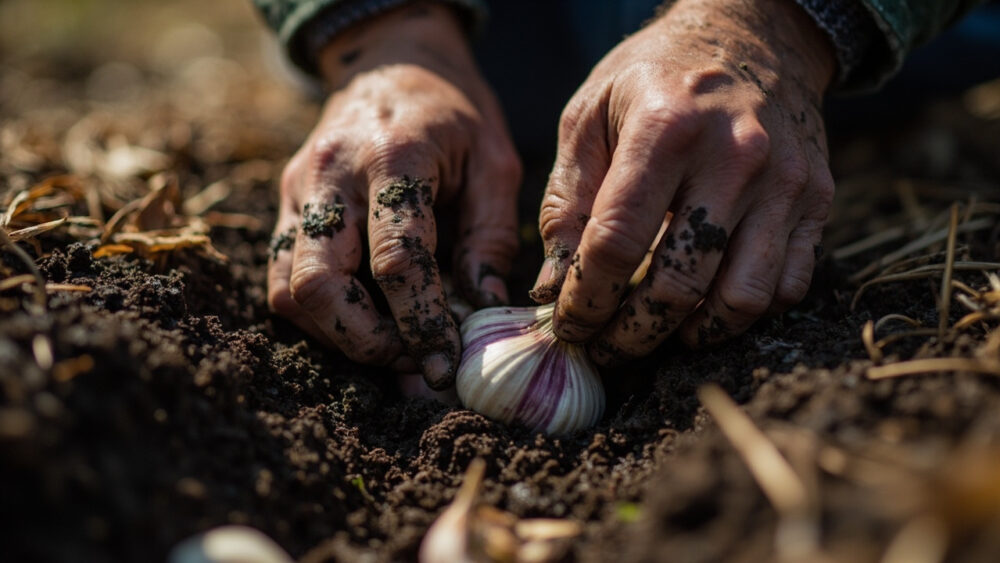
Plant cloves pointy end up, root end down, about 2 inches deep in most of Michigan, going to 3 inches in the coldest northern zones for extra insulation. Space cloves 4 to 6 inches apart in rows spaced 12 to 18 inches apart.
Mulch immediately after planting with 4 to 6 inches of straw or shredded leaves. This is the single most skipped step, and it is the one that protects cloves from Michigan’s freeze-thaw cycles all winter, which can otherwise heave half-rooted cloves right out of the ground.
Leave the mulch on through winter and pull it back gradually once green shoots appear in spring.
Do that, and the only thing left between you and next summer’s harvest is patience.
Regional Notes Across Michigan
Southeast and southwest Michigan, zone 6, get the longest fall window and the mildest winters, so early November planting is often fine there. Central and northern Lower Michigan, mostly zone 5, should not push much past late October.
The Upper Peninsula and far northern counties, zone 4 to low 5, need cloves in by mid-October at the latest, with a heavier mulch layer since ground freezes hard and stays that way.
Coastal areas near Lake Michigan and Lake Huron get a slight buffer from lake effect warmth in fall, sometimes buying you an extra week compared to inland spots at the same latitude.
Wherever you garden in the state, the same underlying rule holds, which brings us to the part worth screenshotting.
Garlic at a Glance
- When to plant: mid-October through early November across most of Michigan, two to four weeks after first frost, adjusted earlier for zone 4 and 5 areas.
- Soil temperature target: 50 to 60 degrees Fahrenheit at 2 inches deep.
- Depth: 2 inches in most of the state, 3 inches in the coldest northern zones.
- Spacing: 4 to 6 inches between cloves, 12 to 18 inches between rows.
- Mulch: 4 to 6 inches of straw or shredded leaves right after planting, pulled back gradually in spring.
- Never plant in spring: spring-planted garlic in Michigan skips the cold period it needs and rarely forms real bulbs.
- Harvest reminder: expect to dig bulbs the following summer, usually when the lower leaves brown and five or six upper leaves stay green.
Get the timing and mulch right this fall, and next July’s harvest is basically already decided.
Everything else, watering, weeding, feeding, is easy by comparison.