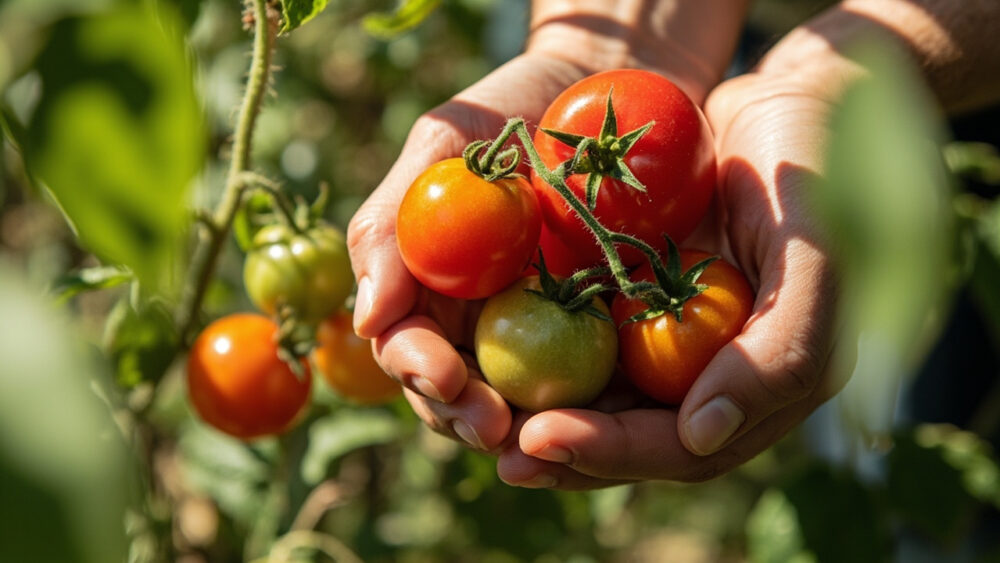
The best time to harvest cherry tomatoes is when they’ve reached their full variety color, whether that’s red, yellow, orange, or nearly black, and they pop off the vine with a gentle tug and barely any resistance. That usually happens 60 to 75 days after transplant, and once the plant starts ripening, you’ll be picking every day or two for weeks straight. Get the timing wrong in either direction and you either eat underripe fruit with none of the sweetness, or you feed the birds and split fruit your patience earned.
Most people watch color and stop there. That’s the guessable answer, and it’s only half right, because color can lie on a vine that’s stressed or a variety that ripens strange colors in the first place.
There’s also the mistake that costs people half their harvest without them noticing: leaving fruit on the vine “just one more day” too often, which invites splitting, cracking, and every bird in the yard. Stick around and I’ll tell you the twist-versus-pull debate nobody settles right, and the honest answer to what happens if you pick a cherry tomato too early. The full Cherry Tomatoes at a Glance card is at the bottom, saveable in ten seconds, for when you’re standing at the plant and just need the numbers.
The Real Ready Signs, Not Just Color
Color is the first cue but not the only one. A ripe cherry tomato is fully and evenly colored all the way around, including the shoulders near the stem, not just the bottom half.
The give test
Press gently. Ripe fruit yields slightly under light pressure, the way a ripe peach does. Rock hard means it needs more days regardless of color.
Firm with a hint of softness is what you’re after.
The pull test
A ripe cherry tomato separates from its stem with barely any tug, often staying on the vine with just the calyx (the little green star cap) attached, or coming away clean at the joint. If you have to yank or twist hard, it’s not ready yet.
Fight the vine and you’ll usually win the wrong way, by tearing the stem and bruising the fruit next to it.
Timing: What Early and Late Actually Cost You
The ripening window runs 4 to 8 weeks after the first flowers set, depending on variety and how warm your nights have been. Cherry tomatoes are quick compared to beefsteaks, often producing ripe fruit within 55 to 70 days of transplanting into warm soil, and then continuing for 8 to 12 weeks straight if the plant stays healthy.
Pick too early and you get fruit that’s technically edible but thin on flavor, more acid than sugar, with a mealy or hollow bite. Tomatoes do not build sugar off the vine the way some fruit does. A tomato pulled green and left on a counter will turn red, but it will never taste like it ripened in the sun.
Wait too long and the fruit splits from rain or uneven watering, softens and drops, or disappears entirely into birds and yellowjackets who have been watching that tomato as closely as you have. Overripe fruit left on the vine also signals the plant to slow down setting new flowers, since it’s still trying to finish what it’s already got.
The window is generous but it isn’t infinite, and that’s exactly where the next mistake happens.
The Twist-Versus-Pull Debate, Settled
Here’s the thing almost nobody tells you straight: both methods work, but only one protects the plant when you’re picking daily off a loaded vine.
Pinch and lift, don’t twist. Hold the fruit between thumb and forefinger, and lift up and slightly to the side rather than twisting it like a bottle cap.
Twisting works fine on a single tomato, but on a cherry tomato plant loaded with 20 fruit per cluster, twisting motion travels down the stem and can knock loose green fruit nearby before it’s ready.
Use garden snips or small scissors if the stems are tough, especially on indeterminate varieties late in the season when stems get woody. Snip the cluster stem, not the fruit itself, leaving a short stub rather than cutting flush against the tomato.
Small habit, and it’s the difference between a clean harvest and a bruised one.
Harvest by the Cluster, Not the Tomato
Cherry tomatoes ripen in trusses, clusters of anywhere from 5 to 30 fruit depending on variety, and they rarely all ripen on the same day. Check each cluster individually rather than scanning the whole plant at once, because ripe and unripe fruit often hang side by side on the same stem.
Harvest into a shallow container, not a deep bucket. Cherry tomatoes bruise and crush under their own weight if piled more than three or four inches deep, and a bruised tomato starts breaking down within a day.
Work the plant top to bottom and inside out. Ripe fruit hides under foliage more than you’d expect, especially lower on the plant where leaves have grown dense all season.
Miss a hidden cluster and you’ll find it a week later, overripe and split.
Right After the Harvest: Don’t Rinse Yet
Leave them unwashed until you’re ready to eat or cook them. Water on the skin speeds up softening and mold, so rinse right before use, not right after picking.
Store at room temperature out of direct sun, not in the refrigerator. Cold temperatures below about 55°F break down the texture and mute the flavor, turning a sweet cherry tomato mealy within a day or two.
Room-temperature cherry tomatoes hold well for 5 to 7 days on the counter, longer if you leave a bit of stem attached, which slows moisture loss at the scar.
Sort as you go: anything split or soft gets used first, today, not saved for later.
Keeping the Harvest Coming All Season
Consistent picking is what keeps the plant producing. A cherry tomato vine left unpicked for a week or two slows down, both because ripe fruit signals the plant to stop investing in new ones and because overloaded stems are more prone to snapping.
Water evenly, aiming for about 1 to 1.5 inches per week, more in real heat. Uneven watering, a dry week followed by a soaked one, is the single biggest cause of split skins on fruit that was otherwise ready.
Feed lightly through the season with a balanced or slightly potassium-forward fertilizer, since cherry tomatoes are heavy, continuous producers and will run out of steam in exhausted soil by midsummer.
Once nights start dropping into the 50s consistently, ripening slows regardless of how the plant looks, and that’s your cue to start picking a little earlier rather than waiting for perfect color.
Cherry Tomatoes at a Glance
- When to plant: transplant seedlings 2 to 3 weeks after your last frost, once soil has warmed to at least 60°F.
- Days to first ripe fruit: roughly 55 to 75 days after transplant, depending on variety and warmth.
- Spacing: 18 to 24 inches apart for determinate types, 24 to 36 inches for sprawling indeterminate vines, with sturdy staking or a cage from day one.
- Ready signs: full, even color to the shoulders, slight give under gentle pressure, and fruit that lifts off with barely a tug.
- How to pick: pinch and lift rather than twist, or snip the cluster stem, and gather into a shallow container to avoid bruising.
- Storage: keep unwashed at room temperature out of direct sun, good for 5 to 7 days, never refrigerate unless already cut.
- Keep it producing: pick every 1 to 2 days at peak, water evenly at 1 to 1.5 inches weekly, and feed lightly through the season.
If you only remember one thing, remember the give test: color can fool you, but ripe fruit always yields slightly under gentle pressure.
Pick a little early rather than a little late, since a few extra hours on the counter beats losing the tomato to a split skin or a hungry bird.