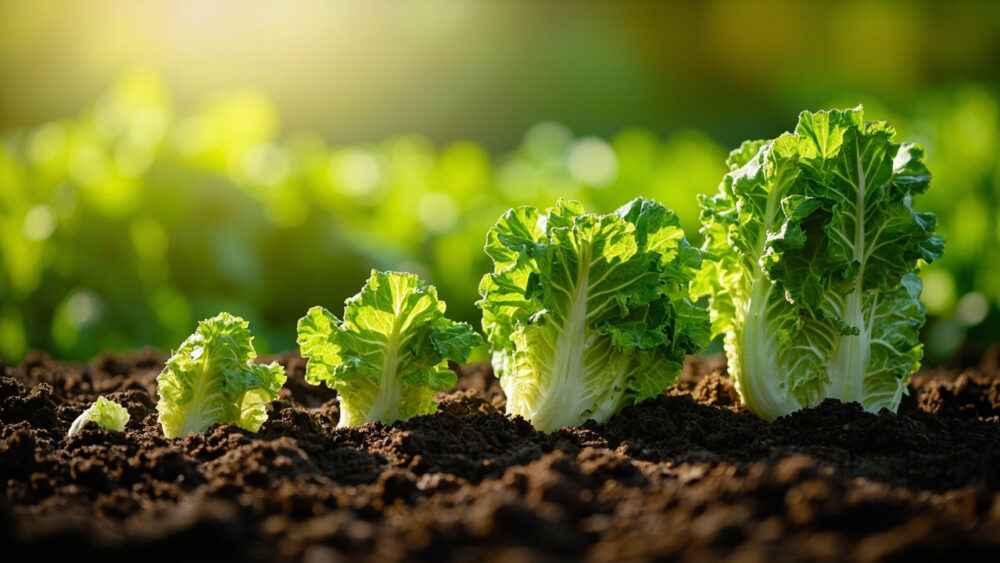
Romaine lettuce moves through five distinct stages between seed and harvest: germination, seedling, leaf development, head formation, and bolting. Under decent conditions, that whole run takes roughly 65 to 75 days from seed, or 45 to 55 days if you start with transplants. Knowing what romaine lettuce growing stages actually look like week to week is what tells you whether your plant is right on schedule or quietly in trouble.
Most people lose their romaine at one specific point in this timeline, and it is not the stage they worry about. There is also a sign at the head-formation stage that looks like a problem but is actually the plant behaving exactly as it should, and a different sign at that same stage that looks fine but means you are about to lose the whole planting to bitterness.
Stick with this and you will get the honest answer to the question every romaine grower eventually asks: why did it just shoot up a foot and turn bitter overnight. There is a full Romaine Lettuce at a Glance card at the bottom with every timeframe, spacing, and depth number saved in one place, worth screenshotting before you plant.
Stage 1: Germination (Days 1 to 10)
Romaine seed needs light and cool soil to germinate, which trips people up immediately. Bury it deep and it may never come up, since lettuce seed germinates best at a depth of about a quarter inch, barely covered, almost pressed into the surface. Soil temperature between 40 and 70°F works, but germination is fastest and most even around 60 to 65°F.
You will see a thin white root thread first, then two tiny oval seed leaves called cotyledons within 4 to 10 days. Keep the top half inch of soil consistently damp during this window. It dries out fast because the seed sits so shallow, and a dried-out surface is the single most common reason romaine seed never comes up at all.
The real test of a good start happens just after this, once those first leaves are up.
Stage 2: Seedling Stage (Days 10 to 25)
Once the cotyledons unfold, the plant pushes out its first true leaves, small, rounded, slightly ruffled at the edges. This stage runs about two to three weeks. The seedling is vulnerable here: shallow roots, tender leaves, and zero tolerance for drying out or getting smothered by mulch.
Thin seedlings once they have two true leaves, down to one plant every 8 to 12 inches. This is the step most gardeners skip because it feels wasteful to pull healthy little plants, and it is the mistake that quietly ruins the most attempts at romaine. Crowded seedlings compete for light, stretch thin, and never form the tight upright head romaine is supposed to have.
If you started indoors, this is also transplant time, once seedlings have three or four true leaves and outdoor soil has warmed past 45°F.
Thinning feels like a loss now, but it is the difference between a head of romaine and a clump of weak leaves later.
Stage 3: Leaf Development, or the Rosette Stage (Days 25 to 45)
This is where romaine starts looking like actual lettuce. Leaves multiply from the center in a loose rosette, gradually more upright than a butterhead or leaf lettuce, which is romaine’s whole personality. Growth is steady and visible week to week if conditions are right.
Romaine wants consistent moisture, about 1 to 1.5 inches of water a week, and a steady feed. A slow, even nitrogen feed now builds the leaf mass the plant will need to fold into a proper head later. Skip feeding here and you get a smaller, looser plant with pale, thin leaves no matter what happens afterward.
Romaine also prefers cooler air, ideally 60 to 70°F. It tolerates a light frost fine but stalls hard in real heat, which matters for the stage right after this one.
Next comes the part where the outer leaves start doing something that looks alarming but usually is not.
The Sign Everyone Misreads: Outer Leaves Splaying Out
As the rosette fills in, the oldest outer leaves often flatten out and splay toward the ground while the inner leaves stay upright. New growers see this and assume the plant is dying or bolting early. It is neither.
Those outer leaves are simply older and heavier, making room for the head to form at the center. As long as the inner leaves are still tight, pale green, and upright, the plant is on schedule.
The real trouble shows up not in the leaves splaying, but in what happens at the very center of the plant.
Stage 4: Head Formation, or Heading Up (Days 45 to 65)
This is where the inner leaves begin wrapping tighter around each other, building the dense, elongated head romaine is grown for. The head firms from the inside out. You will feel this before you fully see it: a gentle squeeze at the base of the plant should feel solid, not hollow or loose.
Romaine needs even more water at this stage, not less, since inconsistent moisture now causes tip burn, brown crisped edges on the inner leaves that never heal. Bitter, tough leaves at this stage almost always trace back to heat stress, not the plant’s age or variety. Sustained temperatures above 80°F push romaine toward stress even if it has weeks of growing left.
Harvest window opens once the head feels firm and leaves are 8 to 10 inches tall, usually 65 to 75 days from seed. You can harvest the whole head at once by cutting at the base, or take outer leaves gradually and let the center keep growing.
Miss this window and the plant does not just sit and wait for you, it moves straight into the stage nobody wants.
Stage 5: Bolting (Anytime Heat and Day Length Say So)
Bolting is the honest answer to that follow-up question every romaine grower eventually asks: why did it suddenly send up a tall central stalk and turn bitter within days. The plant is shifting into reproduction, triggered by sustained heat, typically several days above 75 to 80°F, combined with long daylight hours.
Once you see that central stalk elongating, harvest immediately rather than waiting. Leaves already turn bitter and the texture goes tough and stringy fast, and neither reverses once it starts.
There is no fixing a bolted romaine plant. Pull it, compost it if it has not gone to seed near your bed, and replant for a fall crop instead, since romaine started 8 to 10 weeks before your first fall frost tends to bolt far less than a spring crop pushed into early summer heat.
Knowing this stage is coming is what separates a stalled plant, which can recover, from a bolted one, which cannot.
Stalled Growth vs. Real Trouble
A stalled plant still looks like romaine: pale but intact leaves, slow but even growth, no elongating stalk. Usually the fix is simple, more nitrogen, more consistent water, or more sun, six hours minimum, eight or more ideally.
Real trouble looks different: yellowing that starts at the bottom and climbs fast, a hollow-feeling base, or leaves that go limp even after watering, which usually points to root rot from soggy soil or a pest chewing the roots below.
A stalled romaine plant is patient. A bolting or rotting one is not, and that timeline is exactly what the card below lays out.
Romaine Lettuce at a Glance
- When to plant: two to three weeks before your last frost for a spring crop, or 8 to 10 weeks before your first fall frost, since romaine grows best in cool weather.
- Seed depth and spacing: sow about a quarter inch deep, then thin to one plant every 8 to 12 inches once seedlings have two true leaves.
- Ideal temperatures: germinates fastest at 60 to 65°F, grows best in air temperatures of 60 to 70°F, and bolts under sustained heat above 75 to 80°F.
- Water needs: about 1 to 1.5 inches per week, kept consistent, since uneven moisture causes tip burn and bitter leaves.
- Days to maturity: roughly 65 to 75 days from seed, or 45 to 55 days from transplant.
- Signs of a healthy head: firm feel at the base, upright inner leaves, 8 to 10 inches tall.
- The point of no return: once a central stalk starts elongating, harvest now, since bolted leaves stay bitter and tough for good.
Thin it early, water it evenly, and harvest the moment it feels firm.
Do those three things and romaine is one of the most forgiving vegetables you will ever grow.