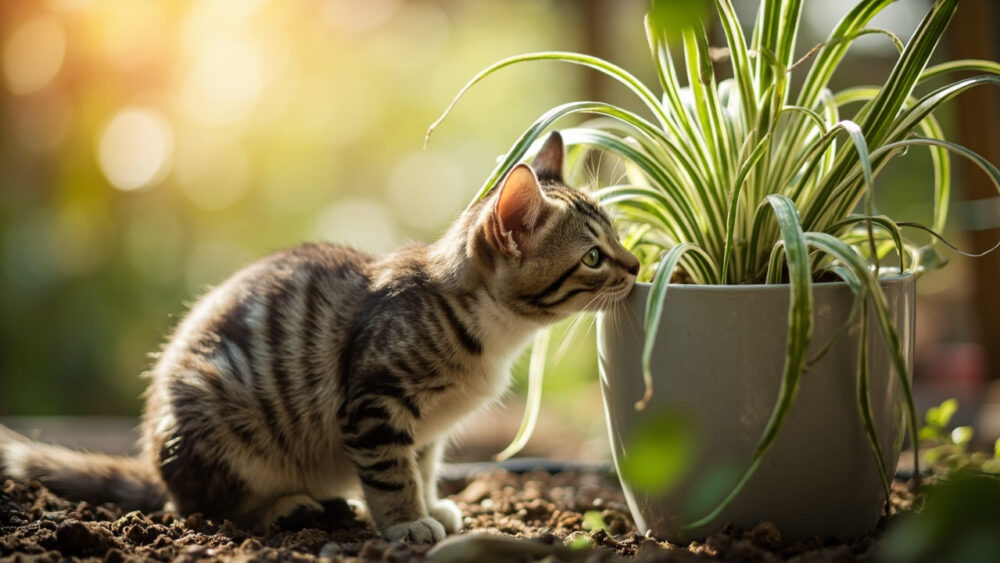
No, spider plant is not considered toxic to cats. The ASPCA lists it as non-toxic to cats and dogs, and it is one of the safer common houseplants to have around a curious cat. That said, “not toxic” does not mean “no effect,” and that gap is where most confused pet owners end up.
Some cats get mildly sick from spider plant anyway, and there is a strange, specific reason for that involving a chemical compound similar to something found in a much scarier plant family. There is also a real difference between a cat that nibbles one leaf tip and a cat that mows down half the plant. And plenty of people who ask this question actually have a different plant entirely, which changes the answer completely.
Stick around for all of it, including the signs actually worth watching for and what to do if your cat went to town on the pot. There is a save-able quick-reference card at the very bottom that sums up the whole thing in a few lines.
The Plain Answer: Spider Plant Is Non-Toxic
Spider plant, Chlorophytum comosum, is on the non-toxic list for cats and dogs from the ASPCA. It does not contain the compounds that cause serious organ damage the way true lilies do in cats, or the way sago palm does in dogs.
That makes it a genuinely good choice for households with pets, especially compared to the long list of common houseplants that are not safe at all.
Here is the twist people miss: spider plant contains trace compounds chemically related to those found in opium poppy, though in amounts far too small to cause the effects people associate with that plant. It is enough, in some cats, to produce a mild, short-lived, almost drunk-acting reaction.
That reaction is exactly what the next section explains.
Why Some Cats Act “High” After Eating It Anyway
If your cat ate spider plant and started acting a little loopy, dilated pupils, wobbly walking, unusual excitement, or a glassy stare, you did not imagine it. This is a documented mild behavioral response some cats have, separate from toxicity.
It is not dangerous in the way an actual toxin exposure is dangerous. It typically passes on its own within a few hours.
This is also exactly why so many cats seem obsessed with spider plant specifically. They are not just playing with dangling leaves, some of them are genuinely a little buzzed by it, which is why they come back for more.
Knowing the difference between “loopy” and “seriously ill” matters, and that is what the signs section below is for.
What Actually Changes the Answer
The core toxicity answer does not change much here, but a few things affect how your cat handles eating spider plant.
- Amount eaten: a nibbled leaf tip is a non-event; a cat that eats a large quantity is more likely to get an upset stomach from sheer plant fiber and roughage, not from any toxin.
- Fertilizer or pesticide residue: the leaf itself is fine, but anything you sprayed or fed the soil is a separate exposure your vet needs to know about.
- Look-alike confusion: some plants sold or nicknamed similarly are not actually spider plant, so confirm your specific plant if there is any doubt.
- Other health conditions: a kitten, senior cat, or cat with an existing GI or kidney issue can react more strongly to vomiting or diarrhea than a healthy adult cat would.
Once you know which of these applies to your situation, the signs to actually watch for make a lot more sense.
General Signs to Watch For
Most cats show nothing at all after eating a little spider plant. When there is a reaction, it tends to be mild and short.
Common signs include vomiting, mild diarrhea, drooling, or the dilated-pupil, wobbly, overexcited behavior described above.
These usually resolve within a few hours without treatment, but “usually” is not a guarantee for every individual animal.
Watch for anything outside that pattern too: repeated vomiting, lethargy that does not lift, loss of appetite lasting more than a day, or any breathing difficulty. Those are not typical for spider plant and deserve a call regardless of what plant is suspected.
If you are seeing any of those heavier signs, skip straight to what to actually do next.
What To Do If Your Cat Ate Spider Plant
Stay calm, this is one of the lower-risk plant exposures a cat can have. But “lower-risk” is not the same as “ignore it.”
Call your veterinarian or an animal poison control line for any suspected ingestion, especially if you are unsure how much was eaten or whether the plant is really spider plant and not a look-alike.
Before you call, try to note the approximate amount eaten, how long ago it happened, and whether your cat has vomited or shown any behavior changes. If you have a piece of the plant or a photo of it, that helps confirm identification.
Do not give any home remedies, induce vomiting, or attempt any treatment on your own. Let the vet or poison control line guide next steps based on your specific cat.
If your plant collection is making you nervous in general, there is an easy fix, and it starts with what you grow next.
Safer Look-Alikes and Companions to Grow Instead
If you want the same airy, trailing look as spider plant with even less drama, several other houseplants are also considered non-toxic to cats.
- Areca palm gives you height and movement without toxicity concerns.
- Calathea varieties offer bold leaf pattern and are pet-safe.
- Parlor palm is a classic low-light, cat-safe option.
- Boston fern gives a similar cascading shape to spider plant.
Mixing a few of these in means your cat has plenty of safe green things to investigate, and you have less to worry about when you catch them mid-nibble.
Whatever you grow next, keep this card handy so you never have to guess mid-panic again.
Spider Plant: Quick Reference
- Toxicity: spider plant is classified as non-toxic to cats and dogs by the ASPCA.
- Mild reaction possible: trace compounds can cause temporary loopy, wobbly, or overexcited behavior in some cats.
- Typical duration: mild effects usually pass within a few hours without treatment.
- Watch for: vomiting, mild diarrhea, drooling, dilated pupils, unsteady walking.
- Call the vet if: symptoms are severe, repeated, or last more than a day, or if you suspect a different plant.
- Never do: give home remedies or try to treat ingestion yourself without professional guidance.
Spider plant earns its reputation as a pet-friendly houseplant, wobbly cat and all.
Keep an eye on the ones who love it a little too much.