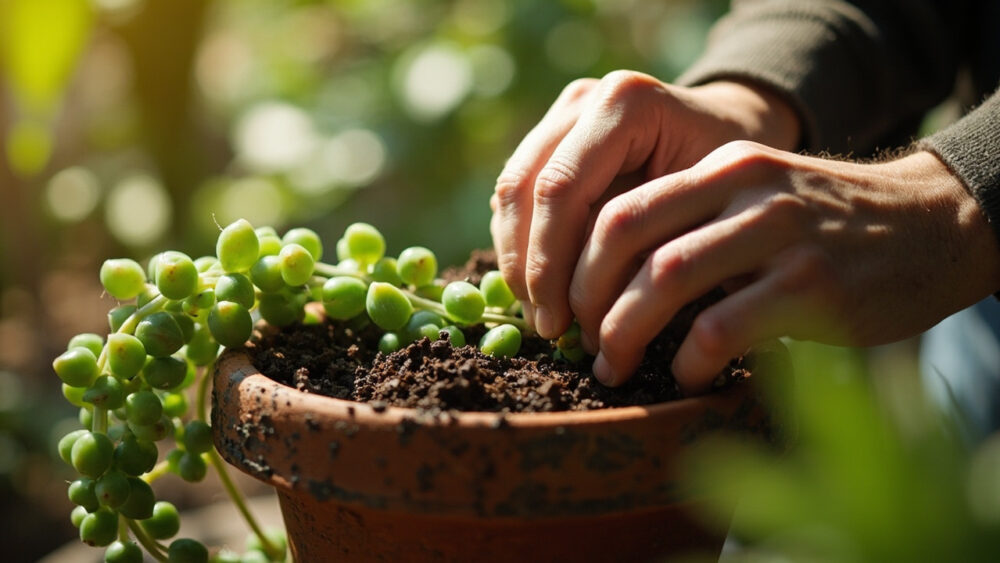
Repot string of pearls when the roots are circling the pot’s bottom or the strands have outgrown the container by a lot, and do it in spring or early summer when the plant is actively growing. Use a shallow, wide pot with drainage holes, a fast-draining succulent mix, and go up only one size from the current pot. Water it lightly a few days after repotting, not immediately, and keep it out of direct hot sun for the first week.
That’s the short version. The longer version is where most people lose the plant, usually within a month of doing everything they thought was right.
There’s a moment during repotting when nearly everyone makes the same call wrong, and it has nothing to do with soil or pot size. There’s also a sign of root rot that looks exactly like the plant is thirsty, which sends people straight to the watering can and straight into more rot. And there’s the question you’re about to ask right after this one: how soon can you water it, and how soon can it go back in its sunny spot. Stick around, because the save-able String of Pearls at a Glance card at the bottom covers all of it in one glance for next time.
When String of Pearls Actually Needs Repotting
String of pearls doesn’t need repotting often. Left alone, it’s happy being a little snug for a year or two.
The real signs are roots poking out of the drainage hole, water running straight through without the soil looking wet, or a pot so full of trailing strands that the plant is top-heavy and tipping over. Rootbound isn’t an emergency the way it is for a leafy tropical, but it does slow growth and makes the plant thirstier and harder to water evenly.
The best window is spring into early summer, once new growth is visibly pushing out and nighttime temperatures are staying above roughly 50°F. Repotting during winter dormancy or the worst of summer heat stresses a plant that is already not growing much.
Next up is the mistake that trips up almost everyone once they’ve got the plant out of its pot.
The Repotting Mistake That Costs People Their Plant
Here’s the guess almost everyone makes: bigger pot, more room to grow, faster growth. That guess is what kills string of pearls.
Oversized pots hold too much damp soil around roots that are thin, shallow, and easily rotted. Go up one pot size, not three. A plant in a 4 inch pot moves to a 6 inch pot, not a 10 inch one, even if the trailing strands look like they need the space.
The strands can hang over the edge of a small pot just fine.
The other classic error happens at the moment of unpotting: gripping and pulling on the strands themselves. They snap off in your hand constantly, and each broken pearl is a bead that will never regrow at that spot.
Instead, turn the pot sideways, tap the base, and ease the whole root mass out while holding the base of the plant, not the trailing chains. If it’s stuck, run a thin knife around the inside edge of the pot first.
Once it’s out, resist the urge to shake off every bit of old soil, especially if roots look healthy and pale.
Getting the plant out safely is only half the job, what you put it into matters just as much.
Soil, Pot, and the Planting Step Itself
String of pearls wants a mix that drains fast and never stays soggy. A cactus or succulent potting mix, ideally cut with extra perlite or coarse sand at roughly a one to one ratio, works well.
Straight bagged potting soil alone holds too much water and is the single biggest cause of collapsed, mushy stems down the line.
Choose a wide, shallow pot over a deep one. The roots are shallow by nature, and a shallow pot also lets the trailing strands drape properly over the edge instead of piling up in a deep well. Always pick one with a drainage hole. Without one, you’re managing water by guesswork in a plant that doesn’t forgive guesswork.
Set the plant so the base sits at the same depth it was before, add mix around the roots, and firm it gently. Don’t bury the stems any deeper than they were growing.
Skip water for two to three days after planting so any nicked roots can callus over rather than sitting in wet soil.
Where you put the pot next decides whether that root work pays off.
Light, Placement, and Temperature After the Move
Fresh out of repotting, keep the plant in bright but indirect light for about a week, not blasting direct afternoon sun. The disturbed roots can’t support the plant through heat stress yet.
After that settling week, string of pearls wants a genuinely bright spot: an east or west window, or a few feet back from a south-facing one. Too little light is the reason pearls go from round and plump to small, elongated, and spaced far apart on the strand, sometimes called etiolation.
Too much sudden direct sun after a big change like repotting can scorch pearls into brown, papery patches instead.
Room temperature is fine year-round, roughly 65 to 80°F, and this plant does not want to be near cold drafts, heater vents, or an air conditioner blast. It’s not frost hardy at all, so if it spends summer outside, bring it in well before the first frost.
Get light right and you’ve solved most future problems before they start.
Now for the part everyone gets backwards after they’ve settled the plant back in.
Watering After Repotting, and Going Forward
Here’s that thirsty-looking sign that fools people: shriveled, deflated pearls. The obvious guess is the plant needs water immediately. Often it’s the opposite, and the roots are already rotting and can’t take up water at all.
Check the soil, not just the pearls. If it’s still damp an inch or two down and the pearls are soft and shriveled, that’s rot, not thirst, and more water makes it worse. If the soil is bone dry and pearls are shriveled, that’s genuine drought stress and it’s fixable with a normal watering.
Going forward, water only when the soil is fully dry through the pot, which for most homes lands somewhere between one and three weeks depending on light, heat, and pot size. Soak it thoroughly until water runs from the drainage hole, then let it dry out completely again before the next drink.
Overwatering, not underwatering, is what actually ends most string of pearls plants.
Feeding follows the same restrained logic, and it’s next.
Feeding, Pruning, and Keeping It Tidy
Skip fertilizer entirely for at least a month after repotting. Fresh mix usually has enough nutrients to start, and tender new roots can be burned by feeding too soon.
Once established, feed sparingly during spring and summer with a diluted succulent or cactus fertilizer, roughly once a month, and stop entirely in fall and winter when growth slows.
This is not a heavy feeder, and pushing fast growth with rich fertilizer tends to produce weak, stretched strands rather than dense, healthy ones.
Trim leggy or bare strands anytime during the growing season with clean scissors, cutting just above a node. This encourages branching lower down and is also how you propagate more plants, since cut strands root easily laid across moist succulent mix.
Wipe dust off the pearls occasionally with a soft, dry brush rather than a damp cloth, since trapped moisture on the pearls themselves can encourage rot.
Even with all of this right, a few problems still show up uninvited.
The Problems Most Likely to Hit After Repotting
Root rot is the big one, and it usually traces back to dense soil, a pot without drainage, or watering on a schedule instead of by checking the soil. Mushy, discolored stems near the base and a sour smell from the soil are the tells. Trim away affected strands, let the plant dry out fully, and consider repotting into fresh, drier mix if it’s severe.
Mealybugs and spider mites can both turn up, especially on a plant recovering from stress. Look for small cottony clusters at the joints for mealybugs, or fine webbing and stippled, dull pearls for mites. Treat with insecticidal soap or a horticultural oil labeled for the pest, following the product label exactly, and isolate the plant from other houseplants while treating.
Shriveling from underwatering, scorch from too much direct sun, and stretched pearls from too little light round out the common complaints, and all three are covered by the checks earlier in this guide.
Note on pets: string of pearls is considered mildly toxic to cats and dogs if chewed or eaten, and can cause stomach upset. If you suspect a pet has eaten some, contact your veterinarian rather than waiting to see what happens.
Once you’ve ruled out the usual suspects, it’s worth knowing what success actually looks like.
Signs the Plant Has Truly Settled In
A string of pearls that’s thriving pushes new strands from the base or from cut points within a few weeks of repotting, not months. The pearls on new growth should be round, plump, and a consistent green, sometimes with faint purple striping depending on light exposure.
Firm pearls that spring back slightly when touched, rather than feeling soft or hollow, tell you hydration and roots are in good shape. Strands should feel lightly tensioned, not limp, and should be gaining length steadily through the growing season.
Occasional flowering, small white blooms with a faint cinnamon-like scent, is a bonus sign of a genuinely happy, mature plant, though plenty of healthy string of pearls never bloom indoors at all and that’s completely normal.
That’s the full picture. Here’s the short version to save.
String of Pearls at a Glance
- When to repot: spring into early summer, once new growth is visible and nights stay above about 50°F.
- Pot size: go up only one size, and choose a wide, shallow pot with a drainage hole.
- Soil mix: cactus or succulent mix cut roughly one to one with perlite or coarse sand.
- After repotting: wait two to three days before the first watering, keep out of direct sun for about a week.
- Watering going forward: soak thoroughly, then let the soil dry out completely before watering again, roughly every one to three weeks.
- Light needs: bright, indirect to lightly direct light, an east or west window or a few feet from south-facing glass.
- Feeding: none for the first month after repotting, then a diluted feed about once a month in spring and summer only.
Get the pot size and the watering rhythm right, and string of pearls forgives almost everything else. Everything above exists to help you nail those two.