The short answer on how to prune olive trees: do it once a year in late winter to early spring, after the worst frost danger has passed but before new growth pushes hard, and remove no more than a quarter to a third of the canopy in a single session. Cut suckers from the base, open the center so light reaches the inner branches, and take out anything crossing, dead, or growing straight up through the middle. That is the skeleton of it, but the details are where most people lose a season of fruit without realizing why.
Here is what trips people up. The biggest mistake is not a bad cut, it is bad timing that turns a healthy cut into a frost injury or a fruitless summer. There is also a sign on the wood that tells you exactly where flowers will form this year, and almost nobody looks for it before they start cutting. And if you are wondering whether that severe haircut you gave your tree last year is why it did not fruit, the honest answer is not what most guides tell you.
Stick around for all of it, including the mistakes that cost people an entire crop, because the save-able Olive Trees at a Glance card at the very bottom pulls the whole job into one list you can check from your phone while you are standing at the tree.
When to Prune an Olive Tree, and When to Leave It Alone
Prune in late winter to early spring, once the hardest freezes are behind you but before the tree pushes new spring growth. In most olive-growing climates that is a window roughly six to eight weeks before your last expected frost date, when daytime temperatures are reliably climbing but the tree is still dormant-ish.
Pruning too early is the mistake that costs people a season. Cut in the dead of winter and you expose fresh wood right when a hard freeze can still hit, and frost-damaged cuts die back further than you intended. Cut too late, after buds have swollen and flower clusters are visible, and you are cutting off this year’s crop with your own hands.
Young trees, under three years old, need very little cutting beyond shaping. Save the heavier structural work for trees that are established and already fruiting.
Get the timing right and the tools matter next.
Tools and the One Prep Step Nobody Skips Twice
You need bypass pruners for anything pencil-thick or smaller, loppers for branches up to about 1.5 to 2 inches thick, and a pruning saw for anything bigger. A pole saw earns its keep on mature trees where the canopy has gotten away from you.
The prep step that actually matters is disinfecting your blades before you start and between trees, not between every cut. Wipe them with rubbing alcohol or a diluted bleach solution. Olive trees can carry bacterial and fungal diseases that spread on dirty pruning tools, and a contaminated blade will move that problem from a sick tree to a healthy one in seconds.
Skip this step once, on the wrong tree, and you will not skip it again.
How to Prune an Olive Tree Step by Step
Work from the ground up and the outside in. Stand back and look at the whole tree before you make a single cut, because it is easy to lose track of shape once you are inside the canopy.
Step 1: Clear the base
Remove all suckers growing straight up from the roots or the base of the trunk. These steal energy and never fruit well anyway.
Step 2: Take out the dead, damaged, and crossing wood
Cut back to healthy wood or all the way to the trunk. Any two branches rubbing against each other should lose one of the pair.
Step 3: Open the center
Olives fruit best with light and air moving through the middle of the tree. Remove one or two of the largest interior branches growing straight up through the canopy’s center to create an open, vase-like shape rather than a dense ball.
Step 4: Thin, do not shear
Look for branch clusters that are shading each other out and remove entire branches back to their point of origin. Never top the tree or shear the outer surface into a ball or hedge shape, that ruins next year’s flowering wood.
Step 5: Check your total
Stand back again. If you have removed more than about a third of the live canopy, stop, even if the tree still looks uneven. You can finish the shaping next year.
Once the cuts are made, the waiting game starts, and this is where the flower-wood sign actually pays off.
What Happens After You Prune, and the Sign Everyone Misses
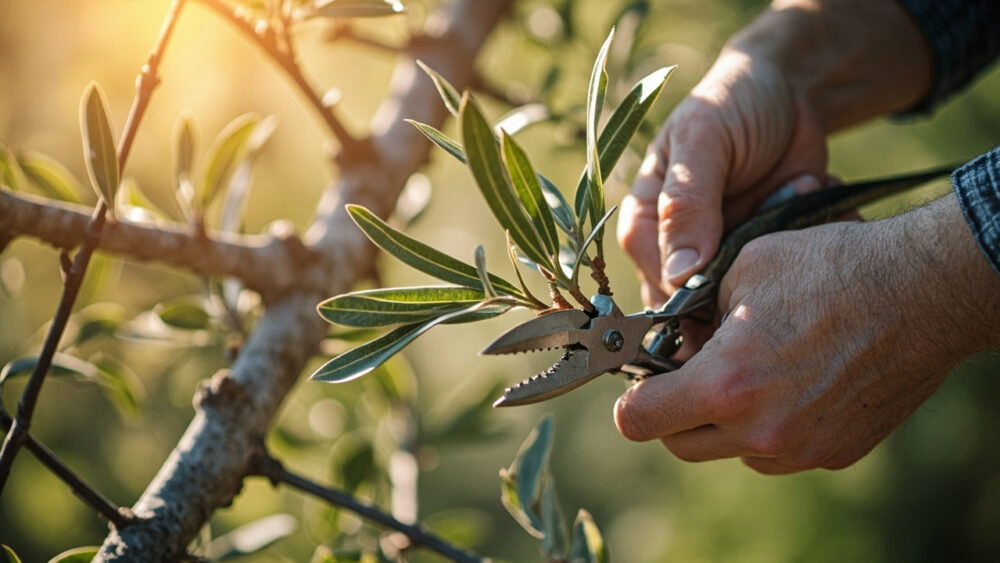
Olive trees flower on wood that grew last year, not on old, thick branches. That is the detail almost nobody checks before pruning season: the thinner, grayish-green stems from the previous year’s growth are where this season’s flowers will form.
If you strip all of that younger wood off in the name of tidiness, you can produce a beautifully shaped tree with almost no fruit that year. This is the real answer to the “why didn’t my pruned tree fruit” question, and it is not about pruning too hard in general, it is about removing the wrong age of wood specifically.
Expect new shoots within four to eight weeks of pruning, appearing along the remaining branches and sometimes vigorously from cut edges. Flower clusters typically show up in mid to late spring on that year-old wood you were careful to leave behind.
A tree pruned correctly this year is setting up the wood it will flower on next year.
The Mistakes That Cost You Fruit
Most fruitless olive trees were not neglected, they were mishandled at pruning time. These are the repeat offenders.
- Shearing into a formal shape: hedge trimmers create a dense outer shell and a dead, light-starved interior that never fruits.
- Pruning every year without restraint: constant heavy cutting keeps the tree in permanent vegetative recovery mode instead of fruiting mode.
- Removing all of last year’s growth: this is the flowering wood mistake, and it is the single most common reason a well-shaped tree goes fruitless.
- Cutting during or right before a cold snap: fresh wounds and exposed inner branches are far more vulnerable to frost damage than untouched growth.
- Leaving suckers unchecked for years: they eventually out-compete the productive canopy for water and nutrients.
Fix the timing and the wood you remove, and everything else about growing olives gets easier.
Olive Trees at a Glance
- When to prune: late winter to early spring, after the hardest frosts pass and before new growth pushes, roughly six to eight weeks before your last frost date.
- How much to remove: no more than a quarter to a third of the live canopy in one session.
- What to cut first: suckers at the base, then dead, damaged, or crossing branches, then one or two interior branches to open the center.
- What to leave alone: the thinner, year-old wood along the branches, since that is where this year’s flowers form.
- Tools needed: bypass pruners, loppers for branches up to about 2 inches, a pruning saw for anything larger, blades disinfected before starting.
- Young trees, under 3 years: light shaping only, save structural pruning for mature, established trees.
- After pruning: new shoots in four to eight weeks, flower clusters visible on last year’s wood by mid to late spring.
Get the timing and the wood age right, and the pruners do the rest. Everything else about an olive tree’s shape can be fixed next year, a missed fruit season cannot.