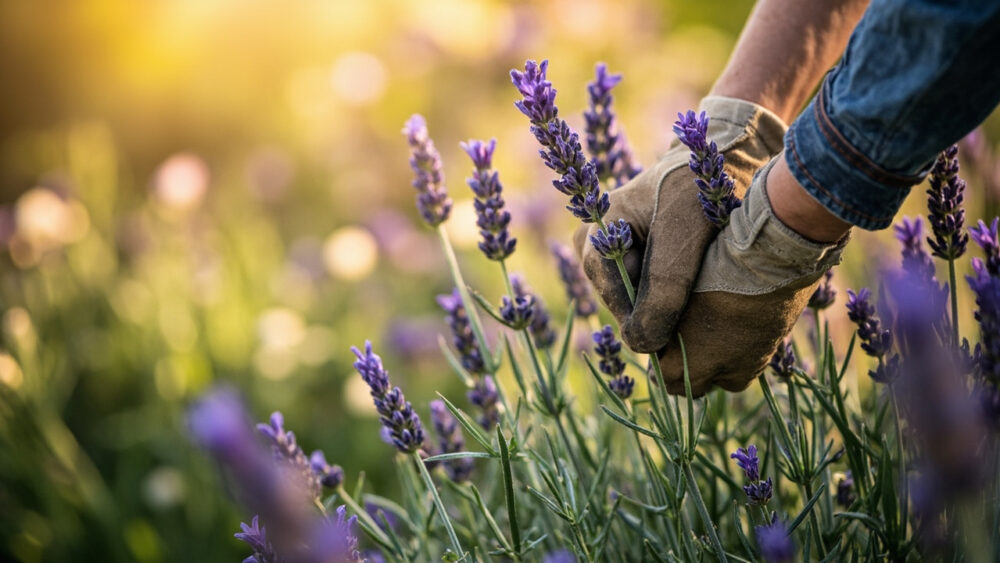
English lavender care comes down to four things it will not compromise on: full sun, sharp drainage, lean soil, and restraint with the watering can. Get those right and the plant more or less takes care of itself for a decade or more. Get any one of them wrong, especially the drainage, and you will be replacing the plant by next spring even though you did everything else right.
Most of what kills English lavender isn’t cold, pests, or neglect. It’s kindness. The mistake that ends more lavender plants than anything else is generous, well-meaning watering in soil that doesn’t drain, and I’ll show you exactly what that looks like before it’s too late to fix.
There’s also a pruning habit almost everyone gets backward, a “thriving” sign that looks a lot like a problem, and the honest truth about why some readers’ lavender never gets that tight, silvery mound they see in photos. Stick around, because the save-able English Lavender at a Glance card is waiting at the bottom once you’ve got the reasoning behind it.
Light, Placement, and Temperature
English lavender wants full sun, six to eight hours minimum, and it wants it every single day of the growing season. Part shade gives you a leggy, floppy plant with weak flowering and soft growth that rots easily. This is not a plant that compromises well on light.
It’s hardy roughly USDA zones 5 through 9, and it handles cold fine as long as its feet stay dry. What actually kills it in winter is usually wet soil around the crown, not the temperature itself. Pick a spot with good air movement too, since stagnant, humid air around the foliage invites fungal trouble faster than a hard freeze ever will.
Placement decides almost everything else you’ll deal with this season.
Watering: How Much, How Often, and How to Tell
Here’s the part that trips up nearly everyone. If you assumed a drought-tolerant Mediterranean herb wants frequent light watering to “help it along,” that instinct is exactly what causes root rot. English lavender wants infrequent, deep watering with total dry-out in between, not a steady trickle of moisture.
For a newly planted lavender, water deeply once or twice a week for the first month or two while roots establish. After that, established plants in the ground often need nothing beyond rainfall except during real drought stretches, maybe once every ten to fourteen days in dry heat.
Check the soil, not the calendar. Push a finger two inches down. If it’s still damp, wait. Lavender would rather be too dry than too wet, always.
Get the water right and you’ve already dodged the mistake that ends most attempts at this plant.
Soil, Potting Mix, and Feeding
Lavender evolved on rocky, alkaline, nutrient-poor Mediterranean hillsides, and it still acts like it. Drainage matters more than fertility here. Heavy clay or rich, moisture-retentive soil is the single biggest reason established plants collapse.
In the ground, amend clay soil with coarse sand or fine gravel, and consider planting on a slight mound or raised bed so water sheds away from the crown. Aim for a soil pH on the alkaline side, roughly 6.5 to 8.0. In containers, use a fast-draining mix built for cactus or succulents, not standard potting soil, and always use a pot with a real drainage hole.
Skip heavy feeding. Rich soil and nitrogen fertilizer produce soft, floppy growth with fewer flowers and worse winter hardiness. A light topdressing of compost once a year, if that, is plenty.
Get the soil right once at planting and you’ll spend far less time fighting the plant later.
Pruning, Cleanup, and Timing That Actually Matters
This is the step almost everyone gets backward. Most people prune lavender hard in late winter, right when it looks scraggly and bare, assuming that’s the safe time to cut. It isn’t. Cutting into old, leafless wood often kills that branch outright, because lavender doesn’t reliably resprout from bare wood the way many shrubs do.
The real routine: give it a light shaping trim in spring once new growth appears, then the real prune right after the main flush of flowering finishes, usually mid to late summer. Cut back by about a third to a half, always leaving some green foliage on every stem you cut. Never cut down into the bare woody base.
Do this every year, not occasionally, and the plant stays a dense mound instead of turning into a woody, splayed-open shrub with a bald center that can’t be reversed.
Skip this annual haircut for a few years and you’ll understand exactly why the next section on problems exists.
Problems Most Likely to Strike, and What to Do
Root rot from wet, heavy soil is the top killer, showing up as blackened stems at the base, wilting despite damp soil, and a plant that just gives up. There’s no reviving rotted roots. Improve drainage and replace the plant if the crown is already black and mushy.
Fungal issues like leaf spot or root rot fungi thrive in crowded, humid, poorly drained conditions. Space plants generously, roughly 18 to 36 inches apart depending on variety, so air moves freely between them.
Woody, hollow-centered plants are the result of skipped pruning, not disease. There’s no fixing a badly overgrown, splayed lavender bush with pruning alone once it’s gone that far; often the honest move is starting a new plant.
Aphids and whiteflies occasionally show up but rarely do serious damage; a strong water spray or insecticidal soap applied per the label handles most cases.
Most of these problems trace back to one root cause, and once you fix that, everything else gets easier.
How to Tell It’s Genuinely Thriving
A thriving English lavender has tight, silvery-green, compact growth and a rounded mound shape, not tall and gangly. Flower spikes should be abundant and fragrant, held on sturdy stems that don’t flop under their own weight.
Here’s the sign people misread: a slightly sparse, airy look in early spring right after you prune hard is not a problem. It’s exactly what a well-maintained lavender looks like before its spring growth fills back in. Panic-fertilizing at this stage is what pushes people toward the soft, floppy growth that actually causes trouble.
New basal shoots low on the plant, buds forming through late spring, and consistent bushiness that holds up year after year are the real signs things are on track.
Once you’ve got all of that dialed in, here’s the whole thing condensed onto one card worth saving.
English Lavender at a Glance
- When to plant: spring after your last frost, or late summer in mild-winter climates so roots establish before cold weather.
- Light: full sun, six to eight hours daily, non-negotiable for tight growth and strong bloom.
- Soil: lean, fast-draining, slightly alkaline, pH 6.5 to 8.0, amended with sand or gravel if you have clay.
- Watering: deep but infrequent, letting soil dry out between waterings, roughly once every one to two weeks once established.
- Spacing: 18 to 36 inches apart for good airflow and lower disease risk.
- Pruning: light spring shaping, then a real cutback of one third to one half right after flowering, always leaving green foliage on each stem.
- Feeding: little to none, a thin layer of compost once a year at most.
If you remember one thing, remember this: lavender fails from too much love in the form of water and rich soil, far more often than from neglect.
Give it sun, grit, and a firm pruning hand each summer, and it will outlast most other plants in your garden.