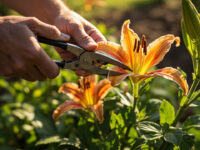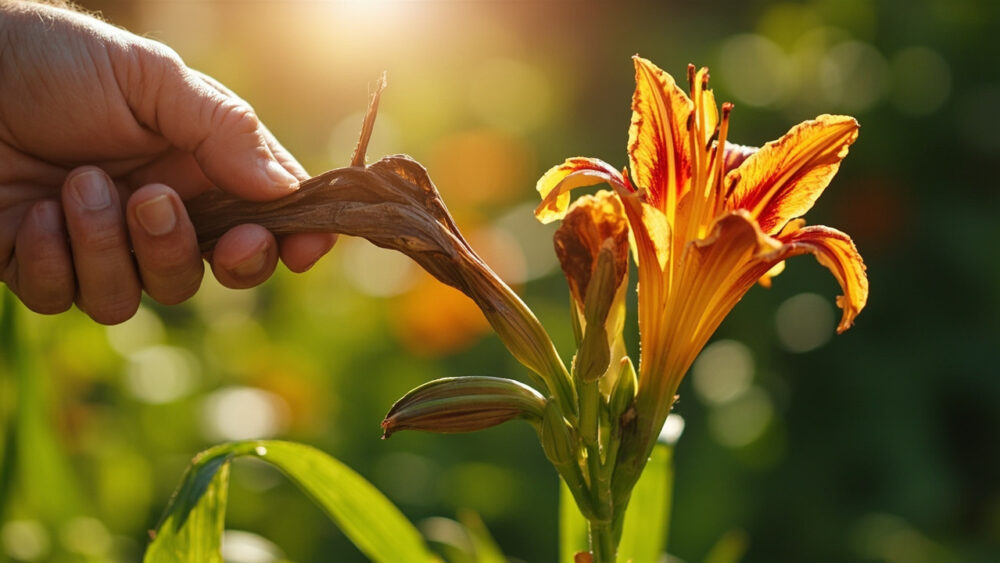
You deadhead daylilies by pinching or snipping off each spent bloom right where it joins the stem, as soon as it wilts and browns, and you do it every day or two through the whole bloom season. That is how to deadhead daylilies without a lot of fuss: no special tools required, no long wait for the right moment. Timing is daily, not seasonal, which surprises people who treat this like a once-a-month chore.
But daily deadheading is not the whole job, and this is where most people either waste time or miss the bigger payoff. There is one cut people skip that matters more than the daily pinching, a stalk most gardeners leave standing when they shouldn’t, and an honest answer to whether any of this actually buys you more flowers.
Stick around for the mistakes section, because one of them is the reason a whole clump can look ragged by August even when you deadheaded faithfully all summer. And bookmark this: the Daylilies at a Glance card at the very bottom has every number in one place for next time you’re standing in the bed with dirty hands and no memory of what you read.
When to Deadhead, and When to Leave It Alone
Start as soon as the first flowers finish, which for most daylilies means within a day of opening since each bloom only lasts about 24 hours. From there you’re deadheading continuously from early summer into fall, for as long as the plant keeps flowering.
Skip it on days you’re just walking by with nothing in hand, that’s fine, spent blooms don’t hurt the plant if they sit a day or two. But don’t skip it for a week at a time during peak bloom, because a stem loaded with browning flowers looks worse than one you never touched at all.
The one time to leave it alone entirely is on reblooming varieties late in their second or third flush, once nights start cooling. At that point the plant is winding down on its own and deadheading buys you nothing.
The daily habit is easy, but the cut everyone forgets is a different one entirely.
The One Prep Step That Actually Matters
You do not need pruners, shears, or gloves to deadhead daylilies. Your fingers do the job, since spent blooms snap off with a light pinch where they meet the stem.
The prep step people skip is looking closely before you grab anything. A daylily scape holds multiple buds along its length, and in full bloom season you’ll have open flowers, wilted ones, and unopened buds all on the same stalk at once. Grab in a hurry and you’ll take a good bud along with the spent bloom.
Take thirty seconds to actually look at each stem before you touch it. That single habit is the difference between a bed that keeps flowering hard through July and one that quietly loses buds you never saw coming.
Once you can tell bud from bloom at a glance, the actual cutting takes no time at all.
How to Deadhead a Daylily, Step by Step
Step 1: Find the spent bloom
Look for a flower that’s wilted, curled, or turned mushy and brown. It will usually be hanging limp rather than facing outward like a fresh bloom.
Step 2: Pinch or snip at the base of the flower
Take the flower where its short stem, called a pedicel, meets the main flower stalk (the scape). Pinch with your fingers or snip with clean scissors right at that junction.
Step 3: Leave the scape standing
Do not cut the whole flower stalk yet if it still has buds left to open. One scape can carry six to fifteen buds depending on the variety, opening a few at a time over two to three weeks. Removing the stalk early throws away flowers you haven’t seen yet.
Step 4: Remove the scape only when it’s fully finished
Once every bud on that stalk has bloomed and faded, cut the whole scape down at its base, at or just above the foliage. Leaving bare finished stalks standing all summer is where most gardens start to look tired.
That last step is the cut almost everyone forgets, and it’s the one that actually cleans up the bed.
What Happens After You Deadhead
Here’s the honest answer to the question you’re probably about to ask: deadheading does not make a daylily produce more flowers. If you assumed it triggers reblooming the way it does on roses or coneflowers, that guess doesn’t hold here.
Each daylily scape has a fixed number of buds set before it ever opens the first flower. Deadheading doesn’t add buds, it just removes the spent ones so the plant looks clean and puts less energy into forming seed pods.
What you will notice is a tidier plant with more visible color, since you’re not looking at a mix of fresh blooms and brown mush at the same time. On reblooming cultivars, the real second flush comes from a genuinely separate round of new scapes later in the season, not from your deadheading.
So the payoff is appearance and plant energy, not volume. Knowing that changes how you think about the mistakes ahead.
The Mistakes That Cost You Flowers
- Cutting the whole scape too early: if buds are still swollen and green along the stalk, you’re removing flowers that hadn’t opened yet.
- Letting seed pods form: an unpinched bloom that gets pollinated will swell into a seed pod, and the plant diverts real energy into it. Deadhead before pods set if you want the plant’s strength going into next year’s growth instead.
- Yanking instead of pinching: tugging a stuck bloom can tear healthy tissue off the scape or damage buds nearby. If it doesn’t pinch off easily, snip it instead.
- Ignoring the foliage: deadheading is not the same job as cutting back yellowing leaves. Leave green foliage alone all season, it’s still feeding the roots even after bloom is done.
- Quitting halfway through the season: stopping deadheading in mid-summer because the first flush is over means every scape sits there finished and brown right when reblooming types are gearing up for round two.
Get those five right and the rest of the care is genuinely simple.
Daylilies at a Glance
- When to deadhead: daily or every couple of days through the whole bloom season, since each flower lasts about one day.
- What to remove first: just the spent flower, pinched or snipped at the pedicel where it meets the scape.
- When to remove the whole stalk: only after every bud on that scape has opened and faded, cut at the base near the foliage.
- Tools needed: none required, fingers work fine, or clean small scissors or pruners for a tidier cut.
- Buds per scape: roughly six to fifteen, opening a few at a time over two to three weeks.
- Does it cause more blooms: no, bud count is already set on the stalk, deadheading just keeps the plant tidy and stops seed pod formation.
- Leave alone: healthy green foliage, and finished plants once nights cool and reblooming has clearly stopped for the year.
The one habit worth keeping is the daily pinch paired with the patience to leave a scape standing until every bud on it has had its turn.
Do that, and your daylilies will look clean all season without you ever picking up a tool.