The best time to plant rhododendrons is early fall, about six weeks before your ground freezes, with early spring as your backup window once the soil has thawed and dried out a bit. Fall wins because the roots get to settle in cool, moist soil without the stress of summer heat overhead. If you’re standing there with a container-grown plant in hand right now, the honest answer to when to plant rhododendrons is simpler than most guides make it: check the soil, not the calendar.
Here’s what nobody tells you upfront. The mistake that kills most rhododendrons isn’t the planting date at all, it’s the planting depth, and people get it wrong in both directions. There’s also a sign everyone misreads as transplant shock when it’s actually something else entirely, and a follow-up question you’re about to have about mulch that most articles skip.
Stick with me through the sections below and you’ll have all of it, including a save-able Rhododendrons at a Glance card at the bottom with the exact numbers.
The Real Planting Window: Fall First, Spring Second
Fall planting should happen when nighttime temperatures have cooled but the ground is still workable, typically four to six weeks before your average first frost. That gives roots time to establish before winter dormancy without pushing tender new growth into a freeze.
Spring is the fallback, and it works fine too. Plant once soil temperature sits around 50 to 60°F a few inches down, usually two to three weeks after your last frost date, once the ground has drained and isn’t a mudpit.
Avoid planting in the dead heat of summer if you can help it. The plant can survive it, but you’ll be babysitting it with a hose every other day just to keep it alive.
Knowing the season is only half the answer, your own yard has the final say.
How to Read Your Actual Window, Not the Regional Average
Regional frost dates are a starting point, not a guarantee. Soil temperature matters more than air temperature, and it lags behind it by weeks. Push a soil thermometer or even your bare finger four inches down. If it feels cold and slow to warm, wait.
Check drainage too. Dig a hole a foot deep, fill it with water, and see how long it takes to disappear. If water is still sitting there after an hour, your window isn’t about timing at all, it’s about fixing drainage first with raised beds or amended soil.
In the Pacific Northwest and similar mild, wet-winter climates, fall planting is almost always the better call since summers can stress roots and winters rarely punish new plantings hard. In colder inland zones, roughly zone 5 and colder, lean toward early spring so roots aren’t establishing right before a hard freeze.
Your soil thermometer just told you more than any calendar could.
The Mistake That Actually Ruins Most Rhododendrons
If you assumed the timing window is the make-or-break factor, that’s a reasonable guess, but it’s not the real killer. Planting depth ends more rhododendrons than a slightly wrong month ever does.
Rhododendrons have shallow, fibrous roots that need to breathe. Plant too deep and the roots suffocate slowly over a year or two, showing up as yellowing leaves and weak bloom that everyone blames on the wrong season. Plant too shallow with exposed roots and they dry out and die fast.
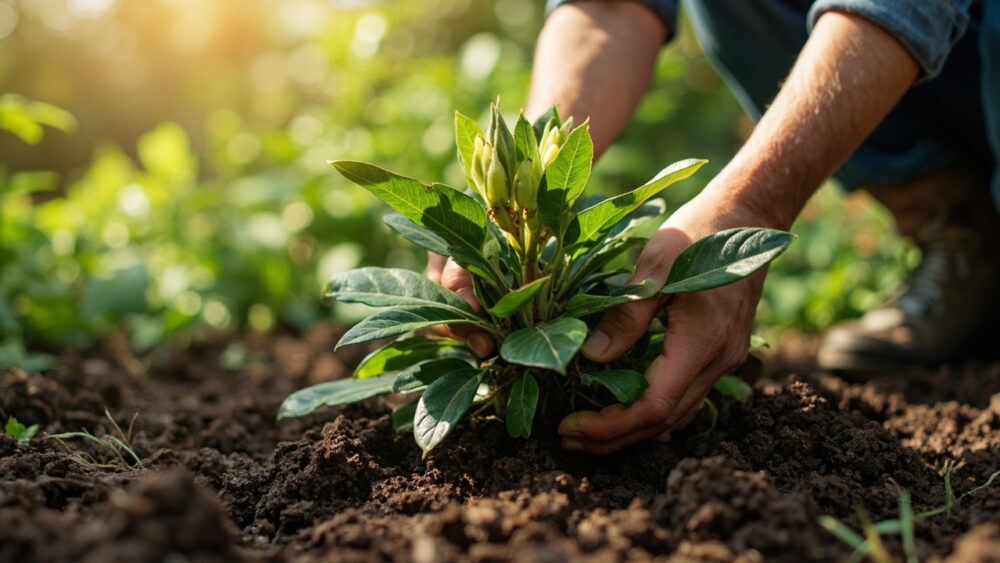
The fix is specific: the top of the root ball should sit slightly above the surrounding soil line, maybe an inch high, because the plant will settle. Never bury the trunk or crown.
That yellowing leaf everyone panics about later ties straight back to this one step.
Too Early, Too Late: What Actually Happens
Planting too early, meaning into cold, waterlogged spring soil, doesn’t kill the plant outright, but it stalls root growth and invites root rot in soggy ground. The plant sits there sulking, dropping leaves, looking half-dead for weeks.
Planting too late into summer heat is the more common real mistake. New roots haven’t spread yet, and hot sun on freshly disturbed soil dries the root zone fast. You’ll see leaf curl and browning at the edges within days, which is the plant protecting itself from moisture loss.
Late fall planting, too close to a hard freeze, is the one true point of no return. Roots that haven’t had four to six weeks to establish before the ground locks up can heave right out of the soil over winter.
None of these are unrecoverable if caught early, except that last one, so let’s get the prep right before you’re stuck choosing between bad options.
What to Do Before the Window Opens
Soil prep matters more for rhododendrons than almost any other shrub, because they need acidic, well-drained, humus-rich soil, roughly pH 4.5 to 6.0. Test it now if you haven’t, weeks before you plant, so amendments have time to work.
Work in compost, pine bark fines, or peat-free acidic amendments into an area at least twice the width of the root ball. Rhododendrons hate compacted clay and hate sitting in water even more.
Space plants 3 to 6 feet apart depending on the variety’s mature spread, since a compact dwarf and a big-leaf rhododendron are not sharing space the same way.
Pick a site with morning sun and afternoon shade, or dappled light all day, since full blazing sun scorches leaves and full shade kills bloom.
With the bed ready, the actual planting day takes fifteen minutes.
The Follow-Up Question: What About Mulch and Watering After Planting
This is the part most guides skip, and it’s the part you were about to ask anyway. Right after planting, water deeply and slowly so the root zone is thoroughly soaked, not just the surface.
Mulch with 2 to 3 inches of pine bark, pine needles, or shredded leaves, but keep it a couple inches back from the trunk. Mulch piled against the stem traps moisture against the bark and invites rot.
Keep soil consistently moist but never soggy for the first full season, whether you planted in fall or spring. A newly planted rhododendron with dry, curled leaves in its first summer usually needs water, not fertilizer, which is the opposite of most people’s instinct.
Skip fertilizer at planting time entirely. It can burn unestablished roots, and there’s plenty of time for that once the plant is settled.
Get the water and mulch right and the rest of the season mostly takes care of itself.
Rhododendrons at a Glance
- When to plant: early fall, four to six weeks before your average first frost, or early spring once soil hits about 50 to 60°F.
- Soil needs: acidic, pH 4.5 to 6.0, loose and well-draining, never soggy clay.
- Planting depth: top of the root ball sits about an inch above the surrounding soil line, never buried.
- Spacing: 3 to 6 feet apart depending on the variety’s mature spread.
- Light: morning sun with afternoon shade, or dappled shade all day.
- After planting: water deeply right away, mulch 2 to 3 inches deep but kept off the trunk, skip fertilizer until established.
- Watch for: yellowing leaves usually mean planted too deep or poor drainage, curled dry leaves usually mean not enough water.
Get the depth and drainage right and the calendar date becomes far less critical than people assume.
Rhododendrons reward patience the first year and forgive almost everything after that.