Growing peach trees means planting a bare-root or containerized tree in late winter to early spring while it is still dormant, giving it full sun and sharp drainage, and accepting that you will thin the fruit hard every single year whether you feel like it or not. Do that and a standard tree starts bearing real crops in year three or four. Skip the thinning and you get a tree full of golf-ball peaches and broken branches instead.
Here is what trips people up before they even get that far. Most first-time peach growers plant too deep, pick a spot that looks sunny in spring but shades out by July, and completely underestimate how much pruning a peach tree wants every winter of its life.
How to grow peach trees successfully really comes down to timing, drainage, and a willingness to cut the tree back hard on a schedule. Stick around for the mistake that kills more young peach trees than any pest does, and the honest read on why some varieties bloom their heads off and never set fruit. The savable Peach Trees at a Glance card is waiting at the bottom once you have the whole picture.
When to Plant a Peach Tree
Plant bare-root peach trees in late winter or very early spring, four to six weeks before your last expected frost, while the tree is still dormant and the ground can be worked. If you’re buying a containerized tree from a nursery instead, spring after the threat of hard freezes has passed is fine too, and so is early fall in mild-winter areas.
Soil temperature matters less here than soil workability. If you can dig a hole without hitting frozen or waterlogged ground, you’re in the window.
Peaches need a real winter to fruit well but not an endless one. Most varieties want somewhere between 600 and 900 hours of chill below about 45 F, which puts them squarely in USDA zones 5 through 8. Gardeners in zone 9 need a specifically low-chill variety or the tree will bloom sparsely and unevenly.
Get the timing right and the next decision, where you actually put the tree, matters just as much.
Choosing the Spot and Prepping the Soil
Peach trees want a minimum of six hours of direct sun, eight is better, and they want it on a site that drains fast. Standing water around the roots for even a day or two during a wet spring can kill a peach tree outright. This is the crop where drainage decides more outcomes than soil fertility does.
Test your drainage before you plant by digging a hole about a foot deep, filling it with water, and timing how long it takes to disappear. If water is still standing after an hour, pick a different spot or plan to build a raised mound 12 to 18 inches high to plant into.
Avoid low spots where cold air pools in spring, too. Peach blossoms open early and a frost pocket will cost you the whole crop some years even on a perfectly healthy tree.
Skip the fertilizer at planting time. Amend with compost if your soil is heavy clay or pure sand, but leave the actual feeding for after the tree is established.
Once the site is chosen, the planting itself is where a lot of trees get set up to struggle for years.
Planting a Peach Tree Step by Step
1. Dig the hole wide, not deep
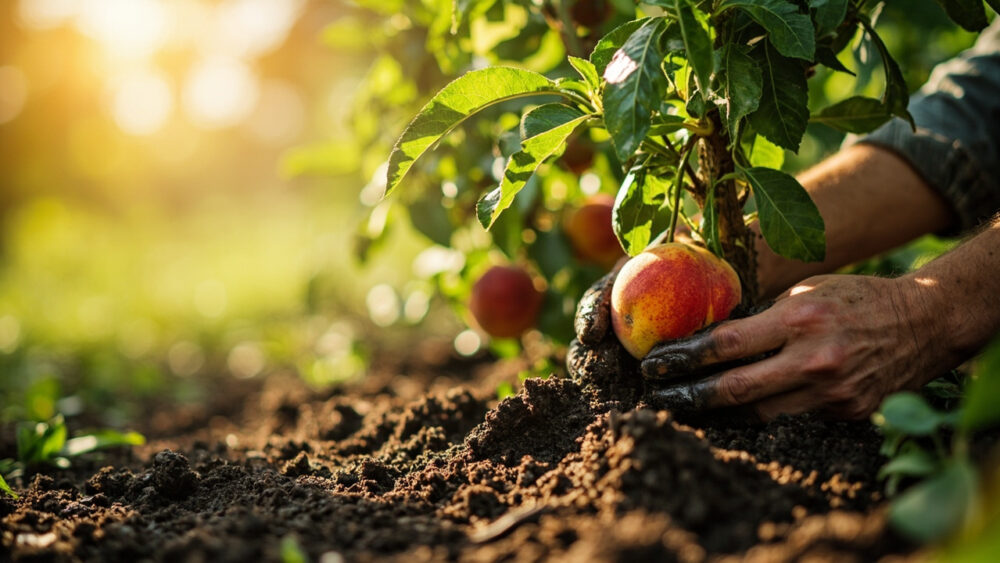
Dig a hole twice the width of the root ball but no deeper than the roots naturally sit. The classic mistake, and the one that quietly kills or stunts more young peach trees than any disease, is planting too deep. Bury the graft union or crowd soil up against the trunk and you invite crown rot within a year or two.
2. Find the graft union and keep it above soil
Almost every peach tree you buy is grafted, and you’ll see the swollen knuckle low on the trunk where the graft was made. That union needs to sit 2 to 3 inches above the final soil line, not buried, not even level with it.
3. Space trees correctly for the rootstock
Standard peach trees need 15 to 20 feet between trees. Dwarf and genetic dwarf varieties can go as close as 8 to 10 feet. Crowd them and you’ll fight for light and airflow for the tree’s entire life, which also invites the fungal problems peaches are already prone to.
4. Backfill, water, and stake if needed
Backfill with the native soil you dug out, tamping gently to remove big air pockets but not compacting it hard. Water in slowly with 5 to 10 gallons right away. Stake only if the tree is genuinely top-heavy or the site is windy, and remove the stake within a year.
Get the graft union height right and you’ve already dodged the single most common planting failure.
Watering and Feeding Through the Season
Young peach trees want consistent moisture, roughly the equivalent of an inch of water a week, more during fruit swell in a dry summer. The finger test still works best: push a finger 2 inches into the soil near the root zone, and if it comes out dry, water. Peaches hate wet feet just as much as they hate drought, so this is a balance, not a habit of daily watering.
If you assumed a fruit tree needs heavy feeding to produce well, that guess is what causes a lot of lush, leafy, fruitless peach trees. Too much nitrogen pushes green growth at the expense of flowers and fruit.
Feed lightly in early spring as buds swell, using a balanced fertilizer or a couple inches of compost worked into the surface. Established trees rarely need more than that once a year.
Mulch 2 to 3 inches deep out to the drip line, but keep it a few inches back from the trunk itself. Mulch piled against bark holds moisture right where you don’t want it.
Feeding and watering keep the tree alive, but the next section is what actually determines whether it survives.
The Problems Most Likely to Strike
Peaches are not a low-maintenance fruit tree, and anyone who tells you otherwise hasn’t dealt with peach leaf curl or brown rot yet. Here’s what actually shows up and what to do about each.
- Peach leaf curl: a fungal disease that puckers and reddens new leaves in spring. Prevent it with a dormant-season fungicide spray applied in late fall or winter before buds swell, following the product label exactly. Once leaves show symptoms, spraying won’t reverse it that season.
- Brown rot: a fungus that turns ripening fruit to soft brown mush, often right before harvest. Improve airflow through pruning, clean up fallen fruit and mummies promptly, and apply a labeled fungicide during bloom if the disease has hit your trees before.
- Peach tree borers: larvae that tunnel into the trunk near the soil line, often revealed by gummy sap and sawdust-like frass at the base. Keep the trunk free of mulch buildup and grass competition, and treat per label directions if you see the telltale gumming.
- Bacterial spot and split pits: often tied to uneven watering. Keep moisture consistent through fruit development rather than letting the tree swing between drought and drenching.
Most of these are manageable with a yearly rhythm of dormant spray, cleanup, and pruning rather than any single fix.
That same yearly pruning habit is also what decides how much fruit you actually get to harvest.
Pruning, Thinning, and the Step Everyone Skips
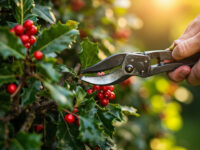
Peach trees fruit on one-year-old wood, so they need aggressive annual pruning in late winter while dormant, opening the center into that classic open, vase-like shape so light reaches every branch. Skip this a couple years running and fruiting wood ages out fast.
Thinning fruit is the step almost everyone underdoes. Once peaches are marble to golf-ball size, thin them to one fruit every 4 to 6 inches along the branch, even though it feels wasteful to pull off healthy young fruit by the handful.
An unthinned tree looks impressive in June and disappoints in July, with small, mediocre peaches and branches that sometimes snap under the weight. Thinning is what turns quantity into quality.
Do the thinning and the harvest that follows is the payoff for everything so far.
When and How to Harvest
Peaches ripen roughly two to four months after bloom, depending on variety, which in most zones lands somewhere from early summer to early fall. Color is a decent hint but not proof. The real test is background color shifting from green to cream or yellow between the red blush, and the fruit giving slightly to gentle pressure near the stem.
A ripe peach also releases from the branch with a light twist rather than a hard tug. If you have to yank it, give it another day or two.
Peaches do not ripen much further off the tree the way some fruit does, so picking too early locks in mediocre flavor. Pick a test peach every couple of days once color starts shifting, and let taste be the final judge.
Here is the full quick-reference card, worth saving before you head out to the tree.
Peach Trees at a Glance
- When to plant: bare-root trees in late winter to early spring while dormant, four to six weeks before last frost, containerized trees any time after hard freezes end.
- Zones and chill: USDA zones 5 through 8 for most varieties, needing 600 to 900 hours below 45 F, low-chill varieties for zone 9.
- Sun and site: six to eight hours of direct sun, fast-draining soil, avoid low frost pockets.
- Spacing and depth: 15 to 20 feet for standard trees, 8 to 10 feet for dwarf types, graft union 2 to 3 inches above the soil line.
- Water and feed: about an inch a week, light balanced feeding in early spring only, avoid heavy nitrogen.
- Fruit thinning: one peach every 4 to 6 inches once fruit reaches marble to golf-ball size.
- Harvest window: two to four months after bloom, ripe when background color turns cream or yellow and fruit gives gently near the stem.
If you remember one thing, remember the graft union height and the thinning. Get those two right and everything else about growing a peach tree gets a lot more forgiving.