The best time to plant hydrangeas in Michigan is spring, after your last frost date has passed and soil has warmed into the 50s, or early fall, roughly six to eight weeks before your first hard frost. For most of the state that means mid-May through mid-June in spring, or early September through late September in fall, depending on how far north you garden. Miss either window by much and you are not just risking a rough transplant, you are risking the whole plant through winter.
Here is what trips people up. Most Michigan gardeners assume “as soon as the garden center has them” is the right answer, and that guess is exactly what puts a hydrangea in the ground three weeks too early, sitting in cold, wet soil with no root growth to show for it.
There is also a fall mistake almost nobody sees coming until the plant is dead by February, and a spacing mistake that looks fine in year one and turns into a mildew problem by year three. Stick with me through the sections below and you will know exactly which window fits your yard, your zone, and your particular microclimate. The full save-it-to-your-phone rundown, “Hydrangeas at a Glance,” is waiting at the bottom.
The Real Planting Window for Michigan
Michigan spans USDA zones 5a to 6b, roughly, with the coldest pockets up in the interior north and the mildest strip running along Lake Michigan’s shoreline. That range matters because it shifts your last frost date by two to three weeks depending on where you sit.
Southern Michigan (zone 6a/6b, think Detroit, Ann Arbor, Kalamazoo) typically clears frost by early to mid May. Mid-Michigan (zone 5b/6a, Lansing, Grand Rapids) usually waits until mid to late May. Northern Michigan and the Upper Peninsula (zone 5a and colder pockets) often sit into early June before frost risk is truly gone.
Fall planting works on the opposite math: count back six to eight weeks from your average first fall frost. In the south that lands around early to mid September; up north you want the hydrangea in by early September at the latest.
Neither date on a calendar matters as much as what the soil is actually doing.
How to Read Your Own Yard, Not the Calendar
Forget the date on the seed rack. Grab a trowel and check soil temperature or just feel it: soil that’s still cold and squeezes into a mud ball is not ready, even if it’s technically May.
You want soil that crumbles rather than clumps, and that feels cool, not cold, an inch or two down. A cheap soil thermometer reading 50 F or better is the real green light, more reliable than any date.
Watch your own frost pattern too. If your yard sits in a low spot or a valley, you’ll get frost later in spring and earlier in fall than your county’s official average, sometimes by a full week or more.
South-facing beds against a house wall warm up faster and buy you extra weeks on both ends of the season.
Your microclimate is the tiebreaker between the zone map and reality.
Plant Too Early, and This Is What Actually Goes Wrong
If you assumed an early frost is the main danger of planting too soon, that’s the obvious guess, and it’s only half right. The bigger problem is cold, saturated soil smothering new roots before they ever get established, which shows up weeks later as wilted or blackened leaf edges even after the weather turns warm.
A hydrangea planted into 40-degree mud just sits there. No root growth means no ability to take up water once summer heat arrives, so you get a plant that looks fine in May and collapses in July, and by then it’s too late to fix by watering more.
Planting too late in fall carries a different risk entirely: the roots don’t get enough time to anchor into surrounding soil before the ground freezes, and winter heaving can push a shallow-rooted hydrangea right out of the ground.
Both mistakes are avoidable, but only if you know what to check before you dig.
Prep to Do Before the Window Opens
Do this work while you’re still waiting on soil temperature, not the day you plant.
- Pick the site now: morning sun with afternoon shade is the sweet spot for most hydrangeas in Michigan’s summer heat; full sun all day scorches leaves by August.
- Test drainage: dig a hole a foot deep, fill it with water, and if it hasn’t drained in an hour you need to amend or pick a different spot.
- Work in compost: two to three inches mixed into the top 8 to 10 inches of the bed gives roots something better than heavy Michigan clay to grow into.
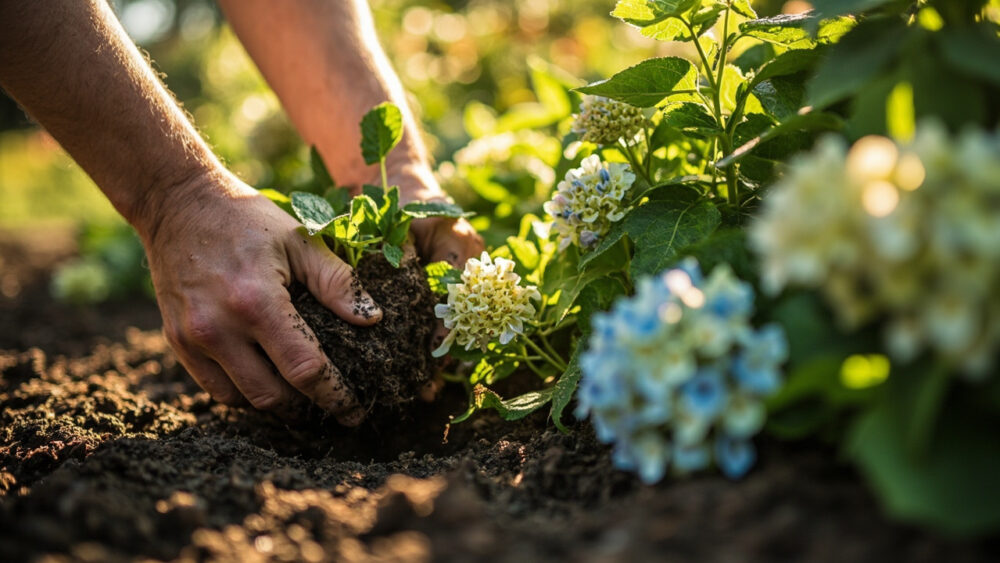
- Stage your hole: dig it twice as wide as the root ball and no deeper, so the crown sits level with the surrounding soil, not buried.
Space plants 3 to 6 feet apart depending on variety, since bigleaf and panicle types spread wider than smooth hydrangeas.
Crowd them and you’ll be fighting powdery mildew by the third summer, when airflow between plants disappears.
Get the hole and the spacing right beforehand and planting day itself takes ten minutes.
Zone and Region Notes That Actually Change Your Plan
If you’re in zone 5a or colder, up toward Traverse City, Marquette, or the interior north, lean spring over fall. A shorter window before winter means less margin for root establishment, and fall-planted hydrangeas up there are far more likely to heave or desiccate over winter.
If you’re in zone 6a or 6b along the southern tier or the lakeshore, fall planting is genuinely solid, and some gardeners prefer it since the plant skips summer transplant stress entirely.
Bigleaf hydrangeas (Hydrangea macrophylla) are the variety most likely to disappoint in northern Michigan, since their flower buds form on old wood and can get killed by a hard winter even when the plant itself survives. Panicle hydrangeas (Hydrangea paniculata) and smooth hydrangeas (Hydrangea arborescens) bloom on new wood and are far more forgiving statewide.
If you already own a bigleaf variety and garden north of Grand Rapids, that’s the honest tradeoff you’re working with, not a planting mistake you made.
Once you’ve matched the variety to your zone, everything else in this guide clicks into place.
Hydrangeas at a Glance
- When to plant: mid-May through mid-June in most of Michigan for spring planting, or early to late September for fall planting, timed to your local frost dates.
- Soil check: wait until soil crumbles rather than clumps and reads 50 F or warmer a couple inches down.
- Spacing: 3 to 6 feet apart depending on variety, wider for bigleaf and panicle types.
- Planting depth: hole as wide as twice the root ball, crown level with the surrounding soil, never buried deeper.
- Light: morning sun with afternoon shade in most of the state. Full sun stresses plants by midsummer.
- Zone notes: zone 5a and colder favor spring planting and new-wood bloomers like panicle and smooth hydrangeas. Zone 6a and 6b can plant fall or spring and grow bigleaf varieties with more success.
- Biggest mistake to avoid: planting into cold, wet soil before roots have any chance to establish, which shows up as collapse weeks later, not right away.
Get the soil temperature right and everything else about growing hydrangeas in Michigan gets easier.
When in doubt, wait one more week. The plant will forgive you.