The right time to prune smoke bush is late winter to early spring, while it is still dormant and before new leaves push out, roughly four to six weeks before your last expected frost. If you are pruning for the best smoky flower plumes, you can also do a lighter trim right after flowering finishes in mid to late summer. Get the timing backwards and you either lose the flower show for the year or you end up cutting into soft new growth that never hardens off right.
Most people who prune smoke bush make one of two mistakes: they either shear it into a meatball because it got big and unruly, or they cut hard in fall thinking they are tidying up for winter. Both cost you something specific, and I will tell you exactly what.
There is also a sign almost everyone misreads on an established smoke bush, something that looks like a problem but is not one at all. Stick with me and I will walk through the cuts, the timing, the recovery, and I have a save-able Smoke Bush at a Glance card at the very bottom with everything on one list.
When to Prune, and When to Leave It Alone
Dormant season pruning is the main event. That is late winter into very early spring, after the coldest snap has passed but before buds swell. You will know it is close when the buds along the stems start to look plump rather than tight and dry.
Smoke bush blooms on old wood mostly, meaning this year’s flowers set on growth from last season. A hard dormant prune removes some flower buds, which is fine if you are pruning for foliage and shape rather than bloom.
If your goal is maximum smoky plumes, do a light shaping cut in dormancy and save any harder cutback for right after flowering in summer. Never prune in fall. Fresh cuts made when the plant is heading into dormancy invite dieback at the cut edges over winter.
Next question: what actually counts as too much when you are standing there with pruners in hand.
Tools and the One Prep Step That Matters
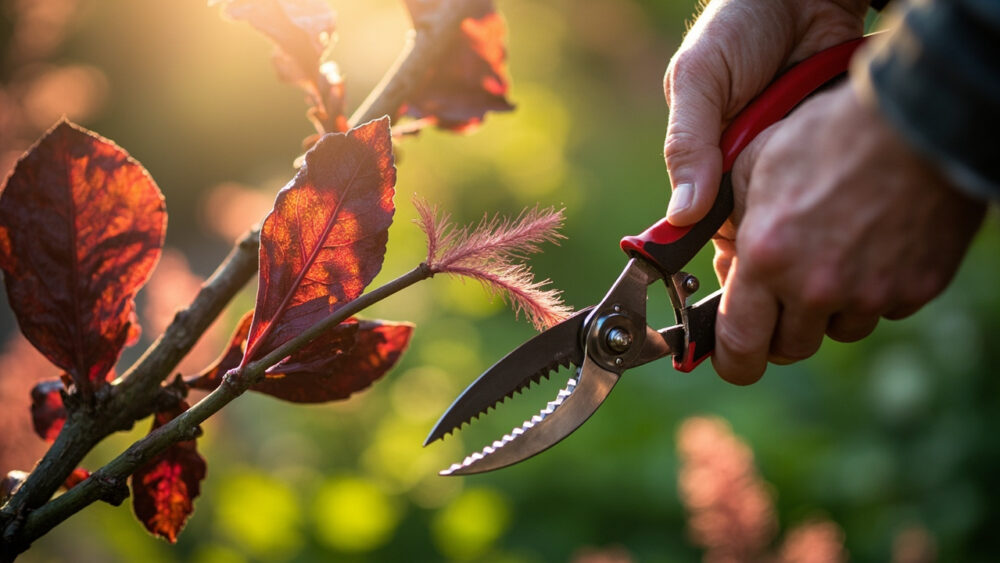
You need clean bypass pruners for anything under about half an inch thick, loppers for branches up to an inch and a half, and a pruning saw for anything bigger on an old, overgrown plant. Skip the hedge shears entirely unless you are doing a formal hedge, which is not how smoke bush wants to grow anyway.
Wipe your blades with rubbing alcohol before you start, especially if you pruned anything else recently. Smoke bush is not particularly disease prone, but clean cuts heal faster and dirty blades are how fungal problems move from one shrub to the next in your yard.
The prep step people skip is simply stepping back and looking at the whole shrub from ten feet away before making a single cut. Smoke bush’s airy, see-through branching structure is the whole point of the plant, and it is easy to ruin that shape by cutting reactively, branch by branch, up close.
Once you know the shape you are aiming for, the actual cutting is straightforward.
How to Prune Smoke Bush, Step by Step
Start with the three D’s
Remove anything dead, damaged, or diseased first, cutting back to healthy wood or to the ground if the whole stem is compromised. This alone often opens up a crowded shrub significantly.
Thin for airflow
Pick out one or two of the oldest, thickest stems at the base and remove them entirely, cutting flush at ground level. This renewal pruning keeps the shrub from turning into a dense, twiggy tangle over the years.
Shape the outer canopy
Cut remaining long shoots back by no more than a third of their length, angling the cut just above an outward-facing bud. This keeps the natural loose, rounded form instead of forcing a hedge look.
Know your limit for the year
As a general rule, take no more than a quarter to a third of the total plant in any single season unless you are doing a hard rejuvenation cut on an old, leggy shrub that has stopped flowering well.
That rejuvenation option deserves its own explanation, because it is the exception to almost everything above.
The Hard Reset: Cutting Smoke Bush Back Nearly to the Ground
If your smoke bush has gotten fifteen feet tall, leggy at the base, and bare in the middle, you can cut the whole thing back to 6 to 12 inches from the ground in early spring while fully dormant. This is sometimes called coppicing and smoke bush tolerates it well.
The tradeoff is bloom. You will get no flowers that year, sometimes none the following year either, but you will get vigorous new shoots and, if you keep them thinned, a much better shaped shrub within two to three growing seasons.
This hard reset is also the move if you specifically want the big, bold purple or dark foliage color some cultivars are known for, since that intense leaf color shows best on fresh, vigorous new growth rather than older wood.
Now here is what actually happens to the plant once your cuts are made.
What to Expect After Pruning
New shoots typically appear within two to four weeks of a dormant-season prune, depending on how warm your spring is running. They come in fast and can grow several feet in a single season on a shrub that was cut back hard.
Here is the sign almost everyone misreads: a flush of thin, reddish, whip-like shoots shooting straight up from lower on the plant after a hard prune. It looks like a problem, like the shrub panicking. It is not. That is exactly the vigorous regrowth you cut for, and by year two those shoots thicken and branch normally.
If you pruned lightly for shape rather than doing a hard reset, expect a normal bloom season, just slightly less full than an unpruned year since you removed some old wood buds along the way.
What you do in the weeks right after pruning matters almost as much as the cut itself.
The Mistakes That Cost You a Season
The single most common mistake is pruning in fall to tidy the yard before winter. Cuts made going into dormancy do not seal and callus the way spring cuts do, and you end up with dieback that forces you to re-cut lower in spring anyway. You lose nothing permanent, but you lose a full season of size and often that year’s bloom.
Second is shearing into a ball or hedge shape. Smoke bush’s whole appeal is the loose, cloud-like plume effect, and repeated shearing produces dense outer growth with a bare, woody interior that never fills back in properly.
Third is overcutting an already stressed shrub. A smoke bush that is drought stressed, recently transplanted, or growing in poor drainage does not have the reserves for a hard rejuvenation cut. Stick to light maintenance pruning until it is clearly healthy and vigorous again.
Get the timing and the restraint right, and the rest of this shrub basically takes care of itself.
Smoke Bush at a Glance
- Best time to prune: late winter to early spring, four to six weeks before your last frost, while fully dormant.
- Light touch-up option: right after flowering finishes in mid to late summer, for shaping only.
- Never prune in: fall, since cuts made heading into dormancy invite winter dieback.
- Normal season limit: no more than a quarter to a third of the total plant.
- Hard rejuvenation cut: back to 6 to 12 inches from the ground on old, leggy shrubs, done only in early spring dormancy, expect no bloom that year.
- Regrowth timeline: new shoots in two to four weeks after a dormant prune, reddish whip-like shoots on a hard cut are normal, not a problem.
- Cut placement: angle cuts just above an outward-facing bud, remove one or two oldest stems at the base each year for airflow.
When in doubt, prune less and prune earlier in spring rather than later. A smoke bush forgives a light hand far more easily than it forgives a fall cut or a hedge trimmer.