The fastest way to sort out garden snakes is to check the head and the pattern together, not just the color. A slim head with a solid stripe down the back usually means harmless, while a wide, triangular head paired with blotches deserves more caution and distance. Most snakes you will find in a backyard, mulch pile, or compost bin fall into a short list of common types of garden snakes, and knowing which one you are looking at takes the guesswork out of whether to relax or back away.
Most people panic at the first snake they see and assume it is dangerous, and that guess is wrong far more often than it is right. The garter snake, the one everyone half-remembers from childhood, gets picked as “the safe one” for the wrong reason, usually just because it is common, not because people can actually identify it. Meanwhile there is an underrated species that seasoned gardeners are quietly glad to see, because it eats more slug and rodent problems than almost anything else in the yard.
Number 13 on this list is the one most people get completely wrong, mistaking it for something far more dangerous than it is. Stick around for that one, plus the two entries at the very bottom and a simple method for figuring out what is coiled under your hose reel right now.
The Common Backyard Regulars
These are the snakes you are most likely to surprise while weeding, and most are harmless.
1. Eastern Garter Snake
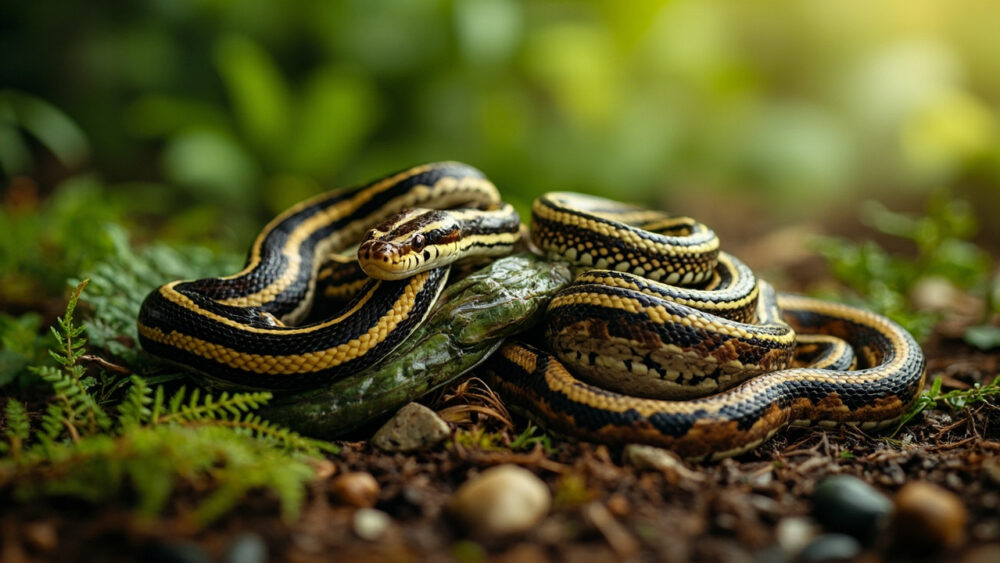
Three light stripes running the length of a dark body is the tell here, usually yellow or greenish stripes on brown, black, or olive. They rarely exceed 3 feet, tolerate almost any climate in the lower 48 states, and are the single most common snake found in vegetable gardens and near compost piles.
2. Common Garter Snake (Western populations)
Nearly identical to the eastern garter but with more variable, sometimes checkered patterning between the stripes. Found from the Pacific Northwest through the Rockies, this one is just as harmless and just as likely to bolt for cover the second you lift a board.
3. Ribbon Snake
A slimmer, longer-tailed cousin of the garter snake, with the same stripe pattern but a noticeably thinner body and a preference for damp edges near ponds, ditches, and irrigated beds. If your “garter snake” seems oddly skinny and hangs out near standing water, this is likely what you actually have.
4. Brown Snake (De Kay’s Snake)
Small, gray-brown, and almost never longer than 13 inches, this one is built for hiding under flat rocks, pavers, and leaf litter rather than for being seen. It feeds heavily on slugs and earthworms, which makes it a quiet ally in slug-plagued beds even though most gardeners never notice it is there.
5. Northern Watersnake
Thick-bodied with dark crossbands that fade to solid dark brown with age, this species is often mistaken for a venomous water moccasin, but true cottonmouths are limited to the southeastern U.S. and have a distinct blocky head. Northern watersnakes are aggressive if cornered near a pond but not dangerous, and they will bite hard if you try to handle one.
Those five cover almost every “is this dangerous” moment near a hose bib or raised bed, but the next group is where the real yard workhorses live.
The Slug and Rodent Patrol
These species are less common in a quick glance but genuinely useful to have around, since they thrive on pests gardeners actively fight.
6. Black Rat Snake
Solid glossy black as an adult, though juveniles show a blotched gray pattern that confuses a lot of new gardeners. These can reach 5 to 7 feet, climb fences and shed siding with ease, and are one of the best natural controls for mice and rats around a shed or coop.
7. Corn Snake
Orange to tan background with bold reddish-brown blotches outlined in black makes this one of the easiest snakes to identify on sight. Common across the southeastern and south-central U.S., corn snakes are excellent mouse hunters and almost never show aggression even when handled.
8. Milk Snake
Bands of red, black, and white or yellow that mimic a coral snake’s colors is the defining feature, though the actual sequence and color intensity vary a lot by region. This mimicry is exactly why milk snakes get killed on sight more than almost any other harmless species, which is a real shame since they hunt rodents aggressively.
9. Gopher Snake (Bullsnake in some regions)
A heavy-bodied snake with dark blotches on tan that hisses loudly and flattens its head when threatened, bluffing hard enough to fool most people into thinking it is a rattlesnake. Found through the western and central U.S., this bluff is its only real defense, and it backs off once it realizes you are not prey.
If you want fewer rodents around a coop or shed without lifting a trap, one of these four is doing that job for free.
The Ones People Misidentify as Dangerous
This is where fear outruns fact more than anywhere else on the list.
10. Eastern Hognose Snake
A short, thick snake with an upturned, pig-like snout that puts on one of the best defensive shows in the reptile world, flattening its neck like a cobra, hissing, and even playing dead with its tongue hanging out. It is mildly venomous to prey like toads but poses essentially no threat to humans and almost never actually bites.
11. Northern Water Snake vs. Copperhead confusion
The single most common misidentification in the eastern U.S. comes down to head shape: copperheads have a distinctly wide, triangular head and vertical pupils, while watersnakes have a narrower head that blends smoothly into the neck. If you are genuinely unsure which one you are looking at, treat it as venomous and keep your distance rather than getting close enough to check pupils.
12. Racer (Black or Blue Racer)
Fast, slender, and almost impossible to catch, racers move in quick, jerky bursts rather than the smooth glide of a rat snake. They are harmless, alert, and often mistaken for something more sinister purely because of how quickly they vanish when startled.
13. Copperhead
This is the one most people get completely wrong, either panicking over a harmless watersnake or, worse, dismissing an actual copperhead as “just a garter snake” because the coppery, hourglass-shaped bands can look surprisingly subtle in dappled shade. Copperheads are genuinely venomous, common in wood piles and leaf litter through the eastern and central U.S., and any suspected bite needs immediate medical attention rather than home treatment or a wait-and-see approach.
The last two entries are the ones almost nobody expects to find in a garden at all.
The Ones You Rarely See but Might
These round out the list, and they are the payoff for scrolling this far.
14. Ring-necked Snake
Small, dark, and secretive, with a bright yellow-orange ring right behind the head that is unmistakable once you spot it. Rarely longer than 15 inches, these snakes spend most of their lives under rocks and logs, and finding one usually means you just moved something they were hiding under.
15. Smooth Green Snake
A slender, bright grass-green snake that is almost invisible against foliage, this is the species experienced gardeners are quietly happiest to see, since it feeds almost entirely on soft-bodied insects, caterpillars, and spiders without touching a single plant. It is gentle, harmless, and genuinely rare in yards that use much pesticide, since it is sensitive to the same chemicals that kill its food supply.
How to Choose the Right One (or Identify What You Have)
- Check the head shape first: narrow and rounded usually means harmless, wide and triangular means treat it as venomous until proven otherwise.
- Look at the pattern type: continuous stripes down the back point toward garter or ribbon snakes, while blotches or bands point toward rat snakes, corn snakes, milk snakes, or venomous species, so pattern narrows the field fast.
- Note the size and body thickness: a thin snake under 2 feet is almost never dangerous, while a thick-bodied snake over 3 feet deserves a more careful look.
- Consider your region: copperheads, cottonmouths, and rattlesnakes have specific ranges, so knowing what is actually documented in your county rules out a lot of false alarms.
- Watch the behavior: fleeing fast means racer or garter snake, hissing and flattening the head means a bluffing hognose or gopher snake, and coiling with a rattle or standing ground means take it seriously and step back.
- When in doubt, do not handle it: photograph from a safe distance and identify later rather than getting close enough to check details in person.
Most garden snakes are doing you a favor, quietly working through the slugs and mice that actually damage your beds.
Learn to read the head, the pattern, and the behavior, and you will spend a lot less time worrying and a lot more time gardening.