The best companion plants for leeks are carrots, celery, and members of the cabbage family, because leeks repel carrot fly while carrots return the favor against onion fly, and the taller cabbages tolerate the shade leeks barely cast. Skip anything in the bean or pea family nearby, since legumes and alliums actively stunt each other. That is the short version.
The longer version has a few traps that catch people every season. There is one pairing everyone assumes is fine because it “worked for grandma” that actually cuts yields on both plants. There is a spacing mistake that looks generous on paper but starves leeks of the exact thing that makes them swell into thick, blanched stalks. And there is a companion-planting myth about marigolds that gets repeated so often people stop questioning it.
Stick around for all of it, including the Leeks at a Glance card at the bottom you can save to your phone before you walk back out to the bed.
Why Companion Planting Actually Matters Here
Leeks are slow growers, often sitting in the ground 90 to 120 days from transplant to harvest. That long window means whatever is next to them has months to help or hurt.
The real mechanism is smell-masking and root behavior, not magic. Onion-family plants give off a scent that confuses carrot fly, and carrot-family plants return the favor against onion fly and leek moth.
That is the whole trick, and it is worth doing on purpose instead of by accident.
The Companions Worth Planting
Carrots
This is the classic pairing and it earns its reputation. Leeks confuse carrot fly with their sulfur scent, and carrots do the same for onion fly and leek moth in return.
Space carrots about 3 inches apart in rows 12 inches from your leeks, and both crops finish the season with noticeably less pest damage than grown alone.
Celery
Celery shares leeks’ love of rich, moisture-retentive soil, so they make sensible bed neighbors without competing hard for nutrients. Celery’s dense foliage also helps shade out weeds around the base of the leek row, which matters since leeks hate competition at the root zone.
Cabbage Family (Broccoli, Cabbage, Kale)
These grow tall and leafy while leeks stay narrow and upright, so you are not fighting over sunlight. Leeks, in turn, help repel cabbage worms and aphids that would otherwise hit your brassicas hard.
Onions and Shallots
Same family, same needs, and no reason to keep them apart. Interplanting different alliums together simply consolidates your pest pressure into one manageable group instead of spreading allium pests across the whole garden.
Strawberries
An underused pairing. Strawberries stay low and shallow-rooted, leeks stay narrow and don’t shade them out, and the combination lets you double up a bed’s productivity without either crop fighting for space.
That covers what to plant next to leeks, but the plants you keep away matter just as much.
What to Never Plant Near Leeks
Beans and Peas
This is the pairing that trips people up, because legumes are usually the garden’s generous neighbor, fixing nitrogen and helping almost everything around them. Alliums are the exception. Leeks release compounds that inhibit the nitrogen-fixing bacteria in bean and pea root nodules, and the legumes return the disfavor by stunting allium bulb and stalk development.
Plant them in the same bed and you will get smaller leeks and weaker bean yields, no obvious disease, just underperformance you might blame on soil or weather instead.
Asparagus
Asparagus is a heavy, permanent feeder with a deep, established root system, and leeks competing for the same nutrients in that zone tend to lose. Keep leeks in the annual vegetable bed and leave the asparagus patch alone.
Now that you know what to avoid, the layout itself decides whether any of this actually works.
Laying Out the Bed So Companions Actually Help
Plant leeks in trenches or holes 6 to 8 inches deep, spaced 4 to 6 inches apart within the row, with rows 12 to 18 inches apart. That row spacing is exactly where your carrot or celery companions go, close enough for the scent-masking effect to matter, far enough that nobody is choking anybody’s roots.
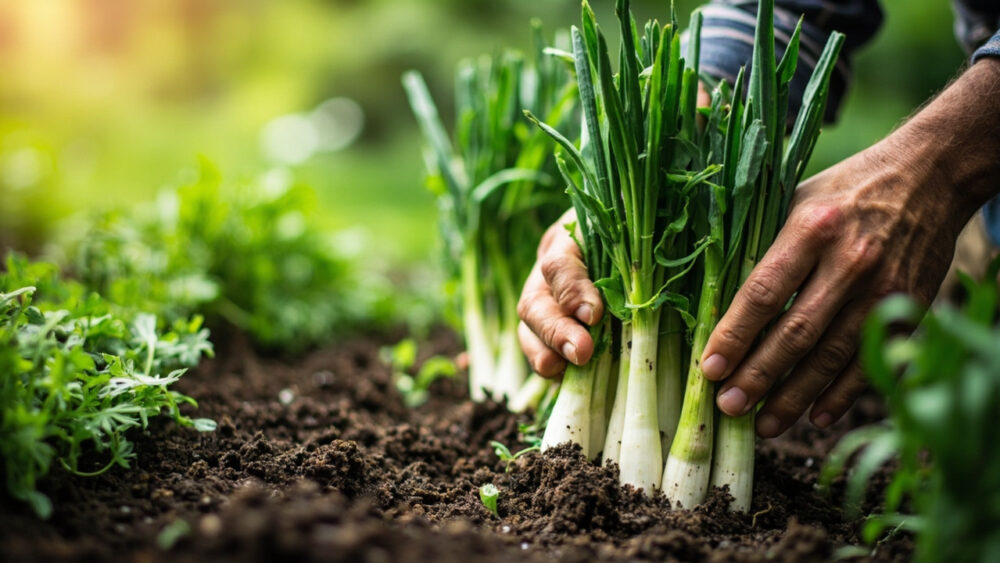
Transplant leek seedlings once they are pencil-thick, usually 8 to 10 weeks after sowing, and once nighttime temperatures reliably stay above 45°F. Backfill gradually as they grow to blanch the lower stalk white.
The spacing mistake that looks generous but backfires: giving leeks 10 or 12 inches between plants “for bigger bulbs.” Leeks are not onions. Spreading them out that far does not make them fatter, it just wastes bed space your companions could be using, since leek girth comes from consistent water and steady hilling, not elbow room.
Get the spacing right and the pest-confusion benefits from your companions actually reach the leeks instead of dissipating across a half-empty bed.
The Companion Planting Myths Worth Retiring
Marigolds get credited with repelling almost everything in the vegetable garden, leeks included, and the claim mostly does not hold up under real observation. Marigolds are fine filler plants and genuinely useful against some nematodes and whiteflies, but there is no strong evidence they meaningfully deter the onion fly or leek moth that actually bother leeks. Plant them for their own sake, not as leek insurance.
Another myth: that leeks and onions should never touch because they are “too similar” and will cross-pollinate problems. Leeks and onions are related but different species with different pest and disease pressures, and growing them side by side causes no crossover issues at all.
Strip away the myths and what is left is a short, dependable list, which is exactly what belongs on your saved card.
Leeks at a Glance
- When to plant: transplant pencil-thick seedlings once nights stay above 45°F, usually 8 to 10 weeks after sowing indoors.
- Spacing: 4 to 6 inches apart within the row, rows 12 to 18 inches apart.
- Depth: set transplants 6 to 8 inches deep in a trench or hole, backfilling gradually as they grow to blanch the stalk.
- Best companions: carrots, celery, cabbage family crops, onions and shallots, strawberries.
- Never plant nearby: beans, peas, or asparagus.
- Days to harvest: roughly 90 to 120 days from transplant, depending on variety.
- Harvest cue: stalks reach 1 inch or more in diameter with firm, tightly wrapped white bases.
Get the carrot and cabbage pairings right and skip the legumes, and the rest of leek growing is mostly patience.
Consistent water and steady hilling will do more for your harvest than any companion ever will.