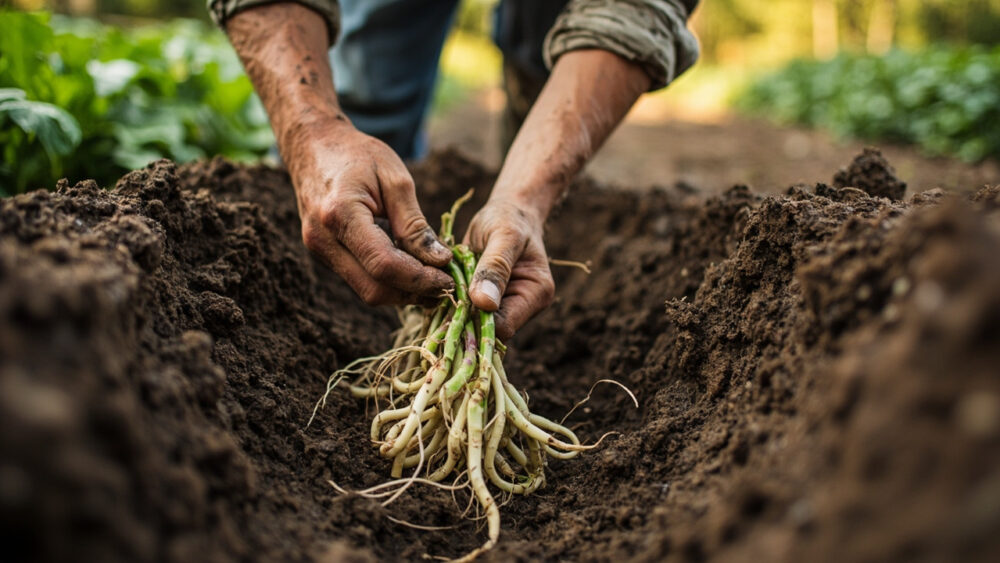
Plant asparagus crowns 6 to 8 inches deep in a trench, spaced 12 to 18 inches apart, with rows 3 to 4 feet apart. You do not fill the trench all the way at planting. You cover the crowns with 2 to 3 inches of soil first, then backfill gradually over the next several weeks as the spears grow up through it.
That part is simple. Where people get into trouble is everything around the number: the mistake that stunts a bed for a decade, the sign that tells you your spacing was wrong (and it does not show up this year, it shows up in year three), and the honest answer to whether you can fix a bad planting without starting over.
Stick with me through the layout and spacing sections below and you will also get the full Asparagus at a Glance card at the bottom, the kind of thing worth screenshotting before you drive to the garden center.
The Exact Depth, and Why Shallow Planting Is the Number One Mistake
Asparagus crowns want to sit 6 to 8 inches below the final soil surface. Dig the trench 8 inches deep, set the crown on a small mound at the bottom so the roots drape downward like a spider, then cover with just 2 to 3 inches of loose soil.
If you assumed deeper is always better, that instinct is right here, unlike with most vegetables. Shallow planting, 2 to 3 inches and done, is the single most common mistake, and it does not fail this year. It fails in year four or five, when the crown has multiplied close to the surface and spears come up thin, bent, and scarred from cultivation and frost heave.
Deep planting delays the first harvest by a year but builds a crown system that produces for 15 to 20 years.
Depth is only half the equation, spacing decides how those crowns compete underground.
Spacing: In the Row and Between Rows
Space crowns 12 to 18 inches apart within the trench. Tighter than 12 inches and you get more spears per foot of row but each one is thinner, because the crowns are fighting for the same root zone.
Wider than 18 inches gives you fatter individual spears but fewer of them per row length.
Row spacing matters more than most gardeners expect. Give rows 3 to 4 feet of separation, not the 18 to 24 inches you would use for most vegetables. Asparagus roots spread out 4 to 5 feet horizontally by their third or fourth year, and rows set too close start stealing water and nutrients from each other before you even notice the crowding above ground.
Next comes the decision that shapes the whole bed for good: trench rows, or a raised block.
Trench Rows vs. Raised Beds: Picking Your Layout
A single trench row is the traditional approach and it works fine in open ground with decent drainage. Dig one long trench, 8 inches deep and wide enough to spread the roots, and space multiple trenches 3 to 4 feet apart if you are planting more than one row.
Raised beds solve the depth problem differently. If your native soil is heavy clay or shallow over hardpan, build a bed 10 to 12 inches tall and you can plant crowns at a shallower dig depth within it, 4 to 6 inches into the native soil topped by the raised soil above.
Either layout works. What does not work is squeezing asparagus into a bed under 3 feet wide, because you lose the row spacing that keeps mature crowns from choking each other.
Get the layout right and you still have to survive the part everyone underestimates: what actually happens underground when spacing is wrong.
What Really Goes Wrong When Plants Are Too Close
Here is the part most people guess incorrectly. They assume overcrowded asparagus just means a slightly smaller harvest.
The real failure mode is disease, not just yield. Crowns packed tighter than 12 inches create dense foliage with poor air circulation at ground level, and that is exactly the environment fusarium crown rot and asparagus rust prefer. You will see it as yellowing, prematurely browning ferns in mid to late summer, well before frost should be doing that.
Yield decline is real too, spears get pencil-thin as crowns mature and compete, but it is the disease pressure that actually kills sections of an overcrowded bed outright.
Too-wide spacing has its own quieter cost: it just wastes bed space and lets weeds fill the gaps, which then compete with the asparagus anyway.
So what do you do if your planting is already too tight? That is not a hypothetical for a lot of readers standing in their garden right now.
Fixing an Overcrowded Planting
You cannot thin established asparagus crowns the way you thin carrot seedlings. The crowns are permanent, interlocking root masses, and digging into a mature bed to remove some risks damaging the ones you keep.
Realistic options, in order of how much disruption they cause:
- Improve airflow instead: cut ferns down at the end of each season and clear debris promptly, which reduces the disease pressure crowding causes even if the crowding itself stays.
- Renovate in early spring: before spears emerge, you can dig and divide a badly overcrowded bed, but expect to lose a harvest year or two while divisions reestablish.
- Start a new bed correctly: for beds planted at 6 to 8 inches apart with no row spacing at all, this is often the honest answer. Asparagus is a 15-to-20-year investment, and a bed doomed from spacing is worth replacing on proper ground rather than nursing indefinitely.
That third option sounds harsh, but it is the same honest math that makes correct spacing worth the extra trench-digging effort up front.
If a full bed is not realistic where you garden, there is a smaller-scale version of all of this worth knowing.
Growing Asparagus in Containers or Raised Boxes
Asparagus is not a great container plant long-term, its roots want more lateral room than most pots offer, but a large raised box can work if you are patient. Use a container at least 18 to 24 inches deep and at least 24 inches wide per 2 to 3 crowns.
Plant at the same 6 to 8 inch depth, filled gradually the same way as in-ground trenches.
Drainage matters more in containers than in open ground, since asparagus crowns rot quickly in soil that stays soggy. A container without generous drainage holes will cost you the whole planting within a season or two, no matter how well you got the depth right.
Get the numbers right once, in the ground or in a box, and the payoff card below is what you carry with you to make sure it sticks.
Asparagus at a Glance
- Planting depth: dig the trench 8 inches deep, set crowns on the bottom, cover with 2 to 3 inches of soil at planting, then backfill gradually as spears grow.
- Spacing in the row: 12 to 18 inches between crowns.
- Row spacing: 3 to 4 feet apart, since mature roots spread 4 to 5 feet.
- When to plant: in early spring, once soil is workable and no longer waterlogged, roughly around your last frost.
- First harvest: wait until year three after planting crowns, harvesting lightly for 2 to 3 weeks that first cutting year.
- Container minimum: 18 to 24 inches deep, 24 inches wide per 2 to 3 crowns, with strong drainage.
- Bed lifespan: 15 to 20 years when spacing and depth are correct from the start.
Depth protects the crown, spacing protects the whole bed. Get both right at planting and you will not be revisiting this decision for the next two decades.