The best time to plant creeping phlox is early spring, two to three weeks after your last frost, once soil temperatures sit reliably above 50 F, or in early fall about six weeks before your ground freezes for good. Both windows work. Most people miss both of them, either by planting into cold, wet spring soil the moment garden centers stock flats, or by tucking plants in too late in fall and losing them to heaving and frost before roots ever grab hold.
There is also a fall window most gardeners never consider, and it is honestly the better one in a lot of climates. And there is one mistake, buying phlox in full bloom and planting it that same afternoon, that costs more plants than bad weather ever does.
Stick around for the part nobody tells you about telling your own yard’s window apart from the calendar’s, plus the save-able Creeping Phlox at a Glance card at the bottom with every number in one place.
The Real Planting Window, Spring and Fall
Creeping phlox (Phlox subulata and Phlox stolonifera) roots best when soil is workable but not soggy, and air temperatures are mild rather than hot. In spring, that means waiting until two to three weeks after your last average frost date, once nighttime temperatures stay reliably above the mid 30s F. Soil temperature matters more than the calendar: push a thermometer four inches down and look for at least 50 F before you plant.
Fall planting runs from late summer into early autumn, timed so roots get six to eight weeks of mild weather before the ground freezes hard. This gives the plant a full season to establish before it has to bloom, which is why fall-planted phlox often outperforms spring-planted phlox the following year.
Both windows share one requirement that trips people up constantly.
The Mistake That Ruins Most First Attempts
Here is the guess most people make: buy the phlox already in full purple or pink bloom, since that is how garden centers sell it, and plant it right into the border that same day. That guess is not wrong exactly, it just skips a step.
A blooming plant is putting all its energy into flowers, not roots. Transplant shock hits harder when a plant is mid-bloom, and phlox planted this way often sulks, drops flowers, and stalls instead of spreading.
The fix: pinch off open blooms at planting time, or at least the top third of flowering stems. It feels wrong to cut flowers off a plant you just bought. Do it anyway. That energy redirects straight into root establishment, which is the only thing that determines whether this plant survives its first winter.
Once you know that trick, the next question is how to read your own yard instead of a generic date.
How to Tell Your Actual Window, Not the Calendar’s
Frost dates are averages, not promises, and your yard has its own microclimate. A south-facing slope warms up two to three weeks ahead of a low, shaded corner of the same property.
Squeeze a handful of soil from where you intend to plant. It should hold loose clumps that crumble with light pressure, not compact into mud or crack dry and dusty. Wet, cold soil that sticks to your boot means you are early. Soil that has already cracked and hardened by midday sun means you are pushing toward summer heat, and you have missed the spring window.
Watch what is already growing nearby, too. If early perennials like creeping phlox’s own established patches, or things like crocus and daffodil foliage, are actively pushing new green growth, the soil has warmed enough for root activity generally.
That reading tells you when to plant, but not what happens if you get the timing wrong in either direction.
Planting Too Early vs. Too Late
Plant too early in spring, into cold and saturated soil, and roots sit idle or rot before they ever take hold. Creeping phlox tolerates a light frost once established, but a young transplant with no root system yet has no reserves to draw on.
Plant too late in either season and you get a different failure. A spring planting pushed into early summer heat means the plant is trying to establish roots while also fighting drought stress and blast-furnace afternoon sun, right when it should be settling in quietly.
A fall planting done too close to the first hard freeze is the riskier mistake. Without six weeks of mild soil to root into, freeze-thaw cycles heave the shallow root ball right out of the ground over winter. This is the one that is genuinely not recoverable. A heaved plant with exposed roots in January usually does not come back in spring.
So the smart move is doing the prep before either window even opens.
What to Prep Before the Window Opens
Creeping phlox wants well-drained soil and full sun to light shade, at least six hours of direct sun for the best bloom. If your planting site holds water after rain, work in some compost or coarse sand before you ever set a plant in the ground, since fixing drainage after the fact is much harder.
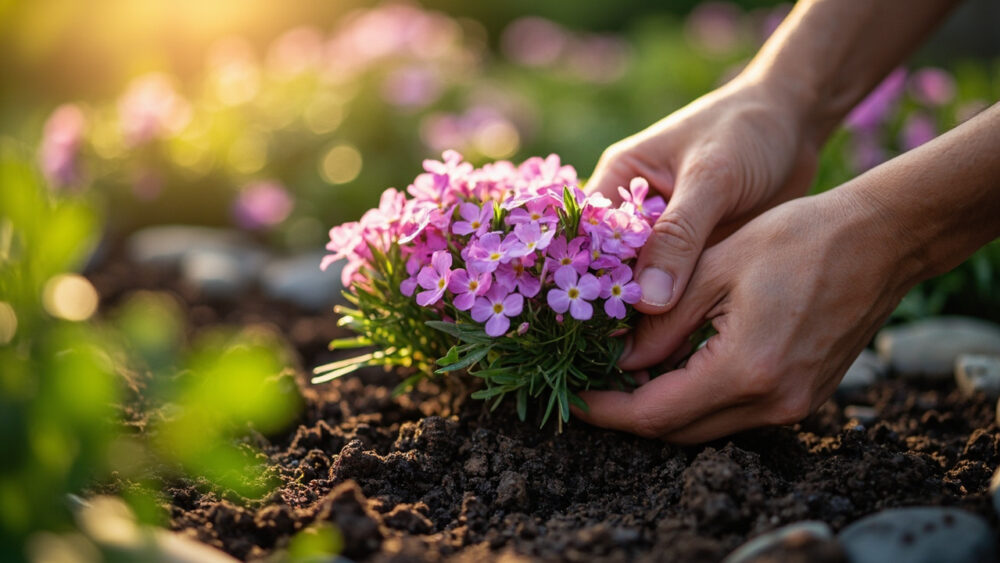
Space plants 12 to 18 inches apart if you want a solid, fast-filling mat within two seasons, or up to 24 inches apart if you are patient and want to save on plant count. Set the crown, where stems meet roots, right at soil level, no deeper. Buried too deep, the crown rots. Planted too high, roots dry out and the plant never fully anchors.
Water deeply right after planting regardless of season, then keep soil lightly moist, never soggy, for the first two to three weeks while roots establish.
With the ground ready, the last variable left is where you actually garden.
Zone and Region Notes
Creeping phlox is reliably hardy in USDA zones 3 through 9, which covers most of the continental US, so the limiting factor is almost always timing, not whether it can survive your winters at all.
In colder zones, 3 to 5, spring planting is generally the safer default, since fall’s six-week root window closes fast once autumn arrives. In milder zones, 6 to 9, fall planting often gives better results, letting the plant establish through a cool, rainy autumn and skip the stress of summer heat entirely in its first year.
In hot summer climates, zones 7 and up, avoid planting in the dead heat of mid to late summer even if soil looks fine, since young roots and 90 degree afternoons do not mix well.
Here is everything from above, condensed to what you actually need standing in the yard.
Creeping Phlox at a Glance
- When to plant: two to three weeks after last frost in spring, or six to eight weeks before first hard freeze in fall.
- Soil temperature target: at least 50 F, measured about four inches down.
- Spacing: 12 to 18 inches apart for faster fill, up to 24 inches if you are patient.
- Planting depth: crown level with soil surface, not buried, not raised.
- Sun needs: full sun to light shade, six or more hours of direct sun for best bloom.
- Before planting: pinch off open blooms so energy goes into roots, not flowers.
- Hardiness range: USDA zones 3 through 9, with fall planting favored in milder zones and spring planting favored in colder ones.
Get the soil temperature and the bloom-pinching right, and this plant does most of the work itself.
Everything else on this list is just protecting that one root-establishment window from your own good intentions.