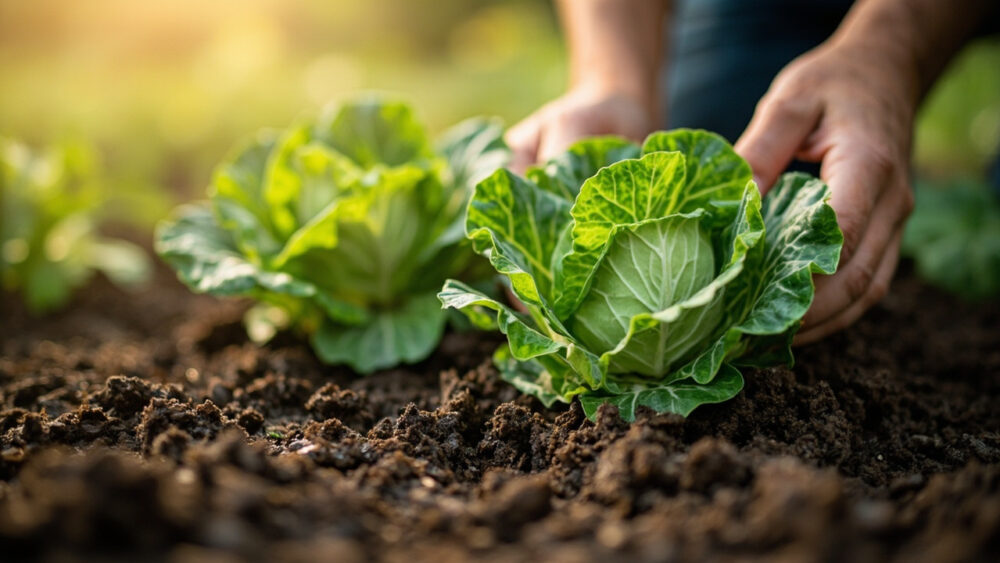
Space cabbage 12 to 18 inches apart within the row, with rows 24 to 36 inches apart, and set transplants no deeper than the pot they came in. Smaller, fast-maturing heads like early green cabbage can go at 12 inches; the big storage types that bulk up to 8 or 10 pounds want the full 18 to 24 inches. Get this wrong and you will not know it for weeks, which is exactly the problem.
Here is the part almost nobody tells you straight: cabbage does not fail loudly when it is crowded. It fails quietly, by simply refusing to head up, and by the time you notice, you cannot fix it without pulling plants. There is also a sign every new gardener misreads as disease when it is actually just spacing, and a follow-up question about pots and raised beds that most spacing charts skip entirely.
Stick with me through the how and why, because the numbers alone will not save your crop if you do not know what they are protecting against. At the bottom you will find the full Cabbage at a Glance card, worth saving to your phone before you head out to the garden.
The Exact Numbers, and Why Cabbage Needs the Room
A mature cabbage head is not the whole plant. Underneath, it is spreading a root system 12 to 18 inches wide and outer leaves nearly as broad.
Twelve inches is the floor, reserved for compact varieties and gardeners who plan to harvest some heads small and young to relieve crowding later. Eighteen inches is the safer standard spacing for full-size green and red cabbage. Large storage or Savoy types that mature over 90 to 100 days do best at 20 to 24 inches, because they simply build more plant.
Depth is the easy part: transplants go in at the same depth they sat in their cell, maybe a half inch deeper if they are leggy. Direct-seeded cabbage goes 1/4 to 1/2 inch deep, no more, because a cabbage seed does not have the reserves to push up from deep soil.
Get the spacing right and the depth question barely matters.
Rows, Beds, and the Layout That Actually Works
In traditional rows, keep 24 to 36 inches between rows. That gap is not wasted space; it is walking room, air movement, and space for the outer leaves of two rows to nearly touch without overlapping.
In raised bedsskip rows entirely and use a grid: one plant every 15 to 18 inches in both directions. A 4-foot-wide bed comfortably fits two staggered columns of cabbage with room to reach in from either side without stepping on soil.
Wide-row growers sometimes try to wedge in three across a 4-foot bed. It looks efficient in April and looks like a leaf jungle by July.
Layout decides how much air and light your cabbage gets for the next three months, and that decision gets made on planting day.
The Sign Everyone Misreads as Disease
Here is the loop I promised. Gardeners see loose, leafy cabbage that never tightens into a firm head, or heads that stay small and yellowish on the inside leaves, and they assume rot, a nutrient deficiency, or a virus.
Nine times out of ten it is spacingnot pathology. Crowded cabbage plants compete for light so hard that the outer leaves stretch upward and outward instead of wrapping tightly around the center, and the head simply never closes up. There is no fungus to spray and no fertilizer that fixes it.
The real tell: pull one crowded plant and look at its roots next to a well-spaced neighbor’s. The crowded one has a stubby, tangled root ball because it never had the underground room to spread and pull nutrients.
That root competition is doing more damage below ground than the leaf crowding is doing above it.
What Too Close Actually Costs You
Crowd cabbage under 10 to 12 inches and you get one or more of these, usually all at once by midsummer:
- Small, loose heads that never firm up, sometimes barely bigger than a fist
- Increased cabbage worm and aphid pressure, because dense foliage hides pests from you and from predators that would otherwise pick them off
- Fungal issues like black rot and downy mildew, which thrive where leaves stay damp and air cannot move through
- Bolting or premature splitting in a few plants as they race each other for light
None of these show up on day one. They show up around week six to eight, right when you were expecting heads to start forming.
That delay is exactly why so many gardeners blame the wrong cause.
Can You Plant Cabbage Too Far Apart?
Yes, though it is a smaller mistake than crowding. Space cabbage at 30 or 36 inches and each plant will grow larger and produce a bigger head, but you waste bed space you could have used for a second crop.
Weeds are the real cost of overspacing. Bare soil between widely spaced cabbage fills in fast with whatever seed is waiting in your soil, and now you are weeding instead of harvesting.
If you want bigger heads on purpose, for storage cabbage you plan to keep all winter, go ahead and give the extra room. Just plan to mulch the gaps so you are not fighting weeds all season for it.
Wide spacing is forgivable. It just asks something else of you in return.
Growing Cabbage in Containers and Raised Beds
Cabbage does fine in containers, but the pot has to match the plant. One cabbage per container, minimum 5-gallon size, and closer to 7 to 10 gallons for the large storage varieties.
Do not multi-plant a big pot the way you might with lettuce or herbs. Two cabbage plants sharing a 10-gallon container will fight over root space exactly the way two plants 8 inches apart in the ground do, and you will get two disappointing heads instead of one good one.
In raised beds under 12 inches of soil depth, tighten spacing slightly toward the 12 to 15 inch end of the range, since shallow beds limit root spread no matter how far apart the tops are.
Containers forgive a lot of gardening mistakes, but crowding is not one of them.
How to Fix Cabbage You Already Planted Too Close
If you are reading this with cabbage already in the ground and too close together, you have two honest options, and neither one is free.
Thin it now. Pull every other plant while they are still small, ideally before the heads start to form. What you pull is not wasted: young cabbage leaves and tiny developing heads are perfectly good to eat, sauteed or in slaw.
Transplanting survivors to new spots works only if they are still young, under 4 to 5 inches tall, with roots intact and moved on a cool, overcast day. Past that stage, cabbage roots resent disturbance and the shock usually costs you the head.
If the plants are already forming heads and hopelessly crowded, the honest move is to harvest the smaller, weaker ones early as baby cabbage and let the strongest ones finish with the room they just gained.
That triage approach salvages most of a crowded planting instead of losing all of it.
Cabbage at a Glance
- Spacing within the row: 12 to 18 inches for compact varieties, 18 to 24 inches for large storage types.
- Row spacing: 24 to 36 inches between rows, or a 15 to 18 inch grid in raised beds.
- Planting depth: transplants at the same depth as their pot, seeds at 1/4 to 1/2 inch deep.
- When to plant: transplants out 2 to 3 weeks before your last frost, since cabbage tolerates light frost and prefers cool soil in the 45 to 75 F range.
- Container size: one plant per container, 5 gallons minimum, 7 to 10 gallons for large varieties.
- Sign of overcrowding: loose heads that never firm up, along with stunted, tangled roots.
- Fix for crowding: thin while plants are under 4 to 5 inches tall, or harvest weaker plants early as baby cabbage.
Get the spacing right at planting and most of cabbage’s other problems solve themselves. Everything else you will deal with this season is easier to fix than a head that never closed up.