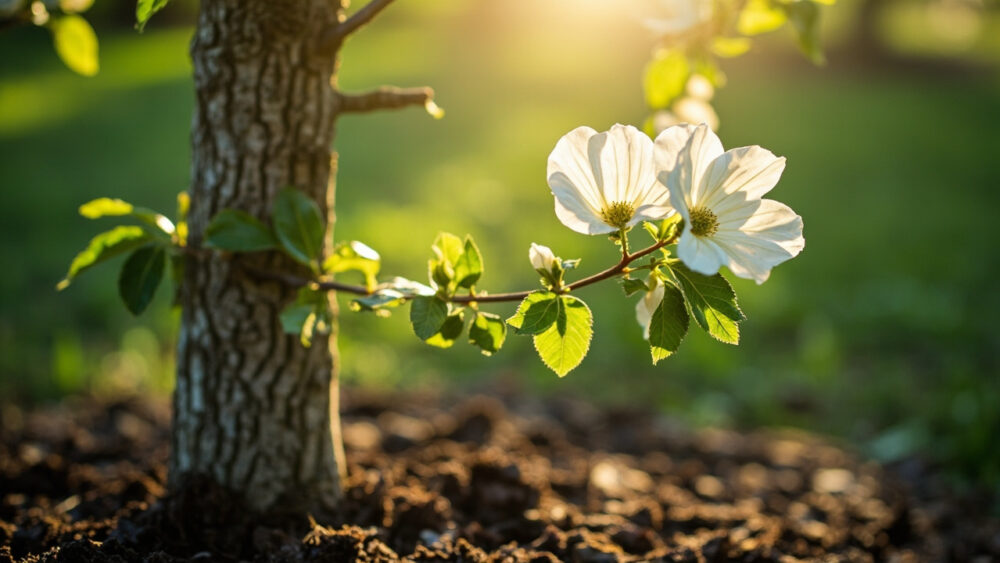
Most dogwood trees grow about 12 to 24 inches a year once established, which puts them in the slow-to-moderate growth category. That means a nursery tree planted at 4 to 5 feet tall usually needs 8 to 12 years to reach a mature height of 15 to 25 feet. If your dogwood is doing less than that this year, it is not automatically failing.
A lot depends on which dogwood you actually planted. A flowering dogwood grows differently than a kousa, and both grow nothing like a fast-growing pagoda or gray dogwood. There is also a first-year slump almost every transplanted dogwood goes through that panics new owners for no good reason.
Stick with this one. The quick-reference card at the bottom gives you the exact growth rate by stage and species, so you can save it and check your tree against it whenever you start second-guessing yourself.
The Realistic Growth Timeline
A young dogwood, meaning the first 2 to 3 years after planting, often grows slower than its mature rate while it rebuilds root mass. Expect 6 to 12 inches a year during this window, sometimes less.
Once established, typically year 3 or 4 onward, growth picks up to that 12 to 24 inch annual range and holds fairly steady for a decade or more. Growth slows again as the tree approaches its mature size, the way most trees taper off rather than stopping abruptly.
Full maturity, meaning full height and a filled-out canopy, generally takes 15 to 20 years depending on species and site.
That is the average curve, but averages hide the variables that actually decide your tree’s speed.
What Actually Controls the Speed
Species matters more than almost anything else. Flowering dogwood (Cornus florida) and kousa dogwood (Cornus kousa) are the classic ornamental types, both landing in that 12 to 24 inch range at maturity of 15 to 25 feet.
Pagoda dogwood and gray dogwood grow faster and shrubbier, sometimes pushing 24 inches or more a year in good conditions, but they max out smaller and less tree-like.
Sunlight is the next biggest factor. Dogwoods are understory trees by nature. They want dappled light or morning sun with afternoon shade, especially flowering dogwood, which struggles and slows in full baking sun.
Soil moisture and drainage come third. Dogwoods want consistently moist, well-drained soil. They sulk in compacted clay that stays soggy, and they stall out in dry, sandy spots that bake in summer.
Climate zone plays a role too. Flowering dogwood is happiest in zones 5 through 9, and pushing it to the edges of that range slows growth and increases stress.
Once you know which of these your yard is missing, the stage-by-stage picture makes a lot more sense.
Stage by Stage: What to Actually Expect
Here is how that timeline usually breaks down in a real yard, not a textbook.
- Year 1: transplant shock is normal, expect minimal visible growth, sometimes none, while roots establish.
- Years 2 to 3: slow but visible growth, 6 to 12 inches a year, canopy still sparse.
- Years 4 to 10: steady growth of 12 to 24 inches a year, this is the tree’s prime growing window.
- Years 10 to 15: growth slows as the tree fills out width and canopy density rather than pure height.
- Year 15 and beyond: growth is mostly maintenance level, the tree is focused on maturing, not expanding.
If you are in year one wondering why nothing seems to be happening, that is the most common false alarm in dogwood ownership.
How to Actually Speed It Up
If you assumed more fertilizer is the fix, that guess causes more problems than it solves. Heavy nitrogen pushes soft, fast growth that is more vulnerable to disease and winter dieback, and dogwoods are already prone to fungal issues like anthracnose and powdery mildew.
What actually works is consistent moisture. A 2 to 3 inch layer of mulch out to the drip line, kept a few inches back from the trunk, keeps roots cool and evenly moist, which is the single biggest legitimate growth booster.
Watering deeply once a week during the first two growing seasons, and during dry stretches after that, matters more than any feeding schedule.
Correct placement helps too. A dogwood planted in the right light and drainage from day one will consistently outgrow an identical tree fighting bad siting, no amount of babying fixes a bad spot.
Skip high-nitrogen fertilizer entirely unless a soil test tells you the tree is actually deficient.
Getting the site right the first time saves years of coaxing a struggling tree along later.
When Slow Growth Is Actually a Problem
Normal slow growth looks like a tree that is short on inches but has healthy green leaves, decent leaf size, and no dead branch tips.
A real problem looks different. Watch for stunted, undersized leaves, browning leaf margins, dieback at branch tips, or a trunk that has not thickened at all in 2 to 3 years.
Those signs usually point to root competition from nearby trees, chronic drought stress, compacted soil, or a graft or planting depth issue where the root flare got buried too deep.
A dogwood planted too deep is one of the most common, most fixable causes of a tree that seems permanently stuck, and it is worth checking before you assume anything worse.
Here is the card that puts every number in one place so you can check your own tree against it in ten seconds.
Dogwood Trees: Quick Reference
- Average growth rate: 12 to 24 inches per year once established, slower during the first 2 to 3 years after planting.
- Time to maturity: roughly 15 to 20 years to reach full height and canopy.
- Mature height: 15 to 25 feet for flowering and kousa dogwood, smaller and shrubbier for pagoda and gray dogwood.
- Best light: dappled shade or morning sun with afternoon shade, especially for flowering dogwood.
- Soil needs: consistently moist, well-drained soil, mulched 2 to 3 inches deep out to the drip line.
- Climate range: generally USDA zones 5 through 9 for flowering dogwood, check your species for exact range.
- Red flag signs: stunted leaves, tip dieback, or no trunk thickening over 2 to 3 years point to a site or planting depth problem, not normal slow growth.
Save this card and pull it up again next spring when you check your tree’s new growth.
By then you will know exactly whether it is right on schedule.