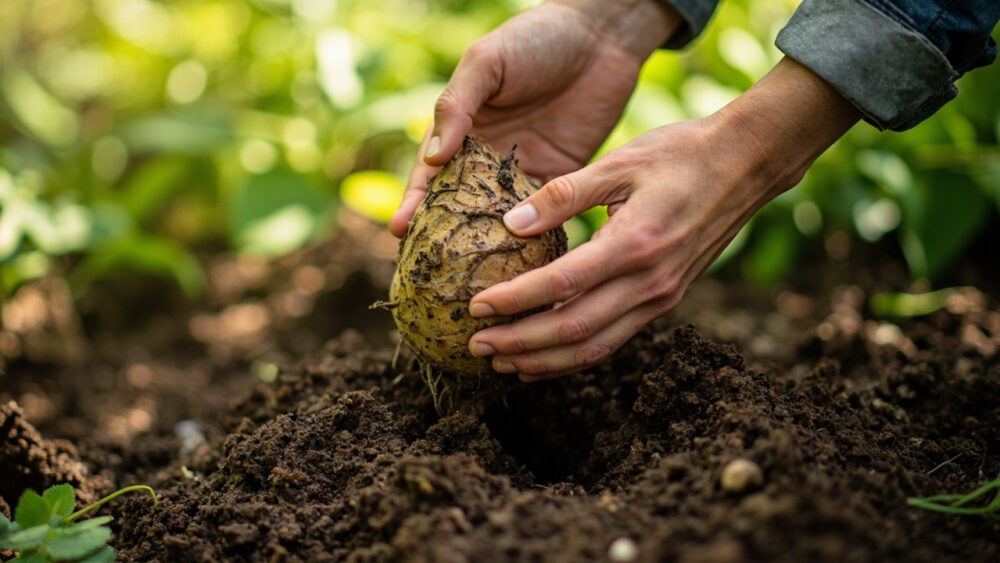
Plant dahlia tubers 4 to 6 inches deep, laid horizontally with the eye (growth point) facing up, and space them 18 to 24 inches apart for full-size dinner plate varieties or 12 to 15 inches for shorter border types. That is how deep to plant dahlias, full stop, but the depth number is the easy part. The spacing decision and a few planting habits most people get backwards are what actually decide whether you get a hedge of blooms or a tangle of mildewed stems.
Here is what nobody tells you before you drop that tuber in the hole: planting too deep is rarely what kills dahlias, but planting too shallow rots them just as fast as too deep does, and the reason surprises most gardeners. There is also a spacing mistake that looks totally fine in June and turns into a disaster by August, after it is too late to fix without real surgery.
Stick with me through the sections below and I will walk you through the exact numbers, the layout options for rows versus beds, what too-close and too-far actually look like on a mature plant, and how to rescue a planting you already crowded. The full save-it-to-your-phone rundown, Dahlias at a Glance, is waiting at the bottom once you have the reasoning behind it.
The Real Depth Number, and Why Shallow Is the Sneaky Killer
Four to six inches deep is the range for a reason. Deep enough that the tuber stays insulated from temperature swings and the emerging stem develops a sturdy underground section that anchors the plant against wind and its own top-heavy blooms.
If you assumed shallow planting is the safe choice because it warms up faster and sprouts sooner, that guess causes more rot than deep planting ever does. A tuber sitting 2 inches down sits in the layer of soil that swings wettest and coldest after a spring rain, and wet plus cold on an exposed tuber is exactly what invites rot before it ever sprouts.
Lay the tuber on its side, eye up, cover with 4 to 6 inches of soil, and do not firm the soil down hard on top. Loose coverage lets the sprout push through without fighting compacted dirt.
Get the depth right and the next decision, how far apart to space them, is where most gardens actually go wrong.
Spacing That Matches the Plant You Will Actually Get
Dahlias look like a small, sad stick when you plant them. Three months later that stick is a 3 to 5 foot shrub with a canopy just as wide, and your spacing has to plan for the shrub, not the stick.
Dinner plate and large decorative dahlias want 18 to 24 inches between plants. Border and bedding types, the compact 12 to 18 inch tall varieties, can go 12 to 15 inches apart. Give pompon and ball dahlias, which stay bushy but modest, about 15 to 18 inches.
These numbers are not decoration, they are airflow math. Dahlias are notorious for powdery mildew and botrytis blight once the foliage stays damp and stagnant, and spacing is your first and cheapest defense before you ever reach for a fungicide.
Now here is the part that trips people up even when they follow the spacing chart correctly.
Rows, Blocks, or Beds: Laying Out More Than a Few Plants
If you are planting a cutting row, space tubers 12 to 18 inches apart within the row and leave 30 to 36 inches between rows. That row gap looks excessive in May and feels exactly right by August when you are wading in to cut stems.
For a mixed bed or block planting, stagger tubers in a diamond pattern rather than a strict grid. Staggering gets you the same plant count in less linear space while keeping the same true distance between any two neighbors, which is what airflow actually depends on.
Tall dinner plate varieties belong at the back or center of a bed, since they will shade anything planted too close in front of them by midsummer. Put your border types on the outer edges where they get full light all season.
Layout on paper is easy, but the real test of your spacing decision happens weeks later, in the leaves.
What Too Close Actually Looks Like on a Living Plant
The sign everyone misreads is dahlias reaching or leaning toward each other. Most gardeners assume that means the plants are competing for light and need more sun, but it almost always means they are too close and stretching to find open air.
Crowded dahlias show a specific pattern: yellowing lower leaves that stay damp long after morning dew burns off elsewhere in the garden, weaker stems that flop under bloom weight instead of standing upright, and powdery gray-white coating on leaves, which is powdery mildew settling into still, humid air pockets between plants.
Flower count drops too, and it is not obvious why at first. Crowded roots compete for the same nutrients and moisture, so plants that look full and green often bloom noticeably less than the same variety given proper spacing.
Too close is the common failure, but swinging too far the other way costs you something different.
What Too Far Apart Costs You Instead
Spacing dahlias at 30 or 36 inches when the variety only needed 18 will not kill them, but it wastes bed space and invites a different problem: weeds fill the open ground faster than the dahlia canopy can close it.
Wide spacing also means each plant stands more exposed to wind with nothing around it to break the gusts, so staking becomes mandatory rather than optional, especially for the tall dinner plate types that already run top-heavy.
There is no real yield penalty from generous spacing, unlike overcrowding, so if you are unsure, err wide rather than tight. The fix for too far apart is patience and mulch, not surgery.
Container growers face their own version of this same spacing math, and the numbers shrink fast.
Dahlias in Containers: Depth and Spacing Scale Down Together
A single dahlia tuber needs a container at least 12 to 16 inches wide and equally deep, planted at the same 4 to 6 inch depth as in-ground tubers. Do not scale the depth down just because the pot is smaller, the tuber still needs that same insulation and anchoring.
Skip cramming two tubers into one 14 inch pot even though it looks reasonable at planting time. Container dahlias hit the crowding problems faster than ground-planted ones because roots have nowhere to spread when they run out of lateral room.
One compact or border variety per 14 to 16 inch pot, one dinner plate variety per 18 to 20 inch pot, is the realistic ratio. Bigger pots also hold moisture more evenly, which matters since containers dry out faster than garden beds.
If your containers are already packed shoulder to shoulder, or your ground bed turned into a jungle, there is still something you can do about it.
Already Crowded? Here Is the Honest Fix
If you planted too tight and the season is still young, meaning plants are under 12 inches tall, you can dig and transplant. Lift the whole root ball with a garden fork, keeping as much soil intact as possible, and move it to open ground with the same 4 to 6 inch depth.
Once dahlias are tall and budding, transplanting risks snapping stems and setting bloom back by weeks, so at that stage the better move is selective removal. Cut out the weakest plant in an overcrowded cluster at soil level rather than trying to move it.
Improve airflow after the fact by removing lower leaves up to about 12 inches from the ground on mature, crowded plants. This will not fully replace proper spacing, but it noticeably cuts the humid pocket where mildew and blight take hold.
Next season, the fix is simpler: measure before you plant, not after the mildew shows up.
Dahlias at a Glance
- When to plant: after your last frost, once soil has warmed to at least 60°F, usually two to three weeks past the frost-free date in your area.
- Planting depth: 4 to 6 inches deep, tuber laid on its side with the eye facing up, soil covered loosely rather than packed firm.
- Spacing, tall varieties: 18 to 24 inches apart for dinner plate and large decorative dahlias.
- Spacing, compact varieties: 12 to 18 inches apart for border, bedding, and pompon types.
- Row spacing: 30 to 36 inches between rows for cutting gardens, staggered diamond pattern for beds.
- Container size: at least 12 to 16 inches wide and deep for one compact variety, 18 to 20 inches for one dinner plate variety.
- Warning sign of overcrowding: plants leaning toward each other, yellowing lower leaves that stay damp, powdery white coating, reduced blooms.
Get the depth right and the tuber survives. Get the spacing right and the whole plant thrives, so measure both before you drop that first tuber in the ground.