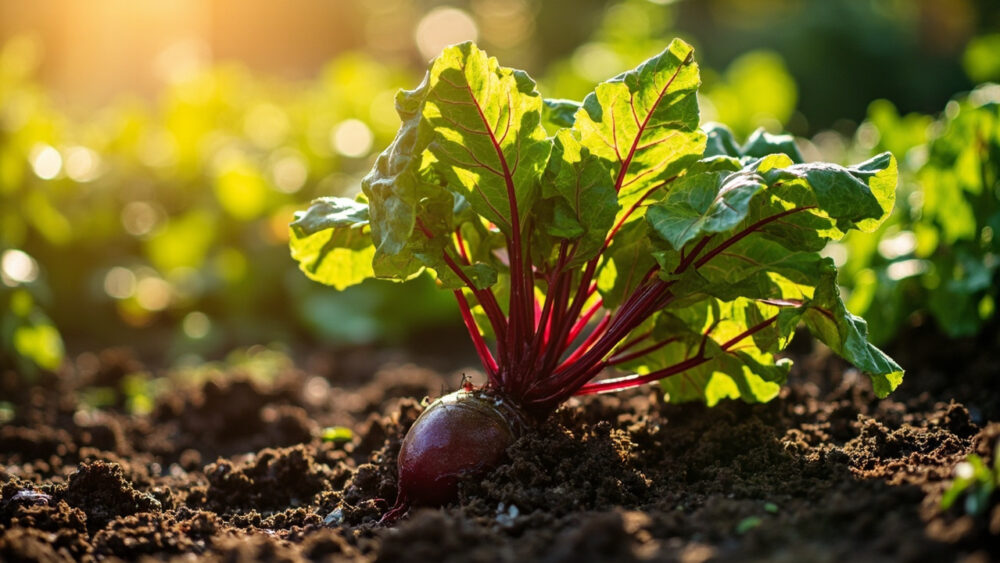
Most beets take 50 to 70 days from seed to harvest if you want them at classic slicing size, and closer to 35 to 45 days if you are pulling them young for greens and baby roots. That answer to how long does it take to grow beets shifts fast depending on soil temperature, variety, and how crowded the row is, which is exactly where most gardeners lose weeks without realizing it.
Two things throw the timeline off in almost every yard. One is a soil temperature problem that looks like a slow-plant problem. The other is a spacing mistake made at planting that does not show up until week five, when the roots that should be golf-ball size are still marble size and jammed against their neighbors.
Stick with this. Below the stage-by-stage breakdown and the honest fixes, there is a save-able quick-reference card with the timeline, the temperature numbers, and the spacing that actually works.
The Realistic Timeline, Start to Finish
Beet seed germinates in 5 to 10 days in warm soil, slower in cool soil. From there, expect small greens by week 3, a root the size of a marble by week 5, and a harvestable root somewhere between week 7 and week 10 depending on the variety and how big you want them.
Baby beets for roasting whole or shaving raw into salads are ready around 35 to 45 days. Full-size beets for storage or canning want the full 55 to 70 days. There is no wrong choice here, just a different harvest window.
The range exists because beets are unusually sensitive to temperature swings compared to something like radishes, and that sensitivity is the next thing to understand.
What Actually Controls the Speed
Soil temperature is the biggest lever. Beet seed germinates slowly below 50°F and stalls almost completely below 40°F, but it speeds up nicely between 60°F and 75°F. If your beets seem stuck at the seedling stage, check soil temperature with a simple probe thermometer an inch or two down before you blame anything else.
Variety matters too. Types bred for early harvest, often labeled as fast or baby types, can shave a week or two off the full-size timeline. Storage varieties, the dense, dark ones bred to keep well in a root cellar, tend to run on the slower end of the range on purpose, building density instead of speed.
Crowding is the third factor, and it is the one nobody blames until harvest day. Beet seeds are actually seed clusters, so thinning to 3 to 4 inches apart is not optional if you want roots instead of a mat of greens fighting each other for space.
Get the temperature and spacing right and the variety differences barely matter anymore.
Stage by Stage: What You Should Actually See
Knowing what a healthy beet looks like at each point saves you from panicking over something totally normal.
- Days 5 to 10: thread-thin sprouts push up, often several from one seed cluster.
- Weeks 2 to 3: first true leaves appear, reddish veining shows in the stems.
- Week 4: this is thinning time, when you should be down to one seedling every 3 to 4 inches.
- Weeks 5 to 6: the root shoulder starts pushing up out of the soil, visibly widening.
- Weeks 7 to 10: the shoulder reaches 1.5 to 3 inches across, depending on variety, and it is ready to pull.
If your plant has skipped straight from tiny to bolting with a tall flower stalk instead of a fat root, that is a different issue entirely, and it is covered next.
How to Legitimately Speed Things Up
The honest speed-ups are all about temperature and consistency, not tricks. Warm the soil before planting with dark mulch or a cold frame if you are pushing an early spring planting, since beets germinate far faster once soil clears 60°F.
Keep the soil evenly moist. Beets that dry out and then get soaked grow in fits and starts, and that stop-and-go pattern adds real time to the calendar, sometimes a week or more.
Thin early and thin hard. This is the fix most people skip, and it is the single biggest legitimate speed gain available, because every root left crowded is a root growing slower than it has to.
What does not work: extra nitrogen fertilizer. It pushes leafy top growth and can actually slow root sizing down, so skip the high-nitrogen feeds and let the roots do their thing.
None of these tricks matter if the plant bolts early, which brings up the one failure mode that is not fixable.
Slow Beets: Normal Setback or Real Problem?
A slow start in cool soil is normal, not a problem. Beets planted when soil is still in the 40s will simply sit for a couple extra weeks, then take off once things warm up.
Bolting is the real problem. If young plants get hit with a stretch of cold nights below about 50°F after they already have a few leaves, many varieties respond by sending up a flower stalk instead of building a root. Once a beet bolts, the root stays small and woody. There is no fix, only replanting.
Stunted, pale, oddly shaped roots usually point to compacted or rocky soil, or roots still too crowded from skipped thinning. Loosening the bed 8 to 10 inches deep before planting next time solves most of this.
If your beets are simply behind schedule but look healthy and green, they are fine, just give them the extra week or two the range already accounts for.
Beets: Quick Reference
- Full timeline: 50 to 70 days from seed to full-size harvest, in good conditions.
- Baby beets: ready in 35 to 45 days for greens and small roots.
- Germination: 5 to 10 days in warm soil, much slower below 50°F, stalls below 40°F.
- Ideal soil temp: 60°F to 75°F for fastest, most even growth.
- Spacing: thin to 3 to 4 inches apart by week 4, this is the fix most timelines are lost to.
- Bolting risk: cold snaps below about 50°F after early growth can trigger flowering instead of a root, and it is not reversible.
- Fertilizer note: skip heavy nitrogen, it grows leaves at the root’s expense.
Beets reward patience and even conditions more than any fertilizer or trick you can buy.
Get the soil warm, the spacing right, and the water steady, and that 50 to 70 day window is yours to count down.