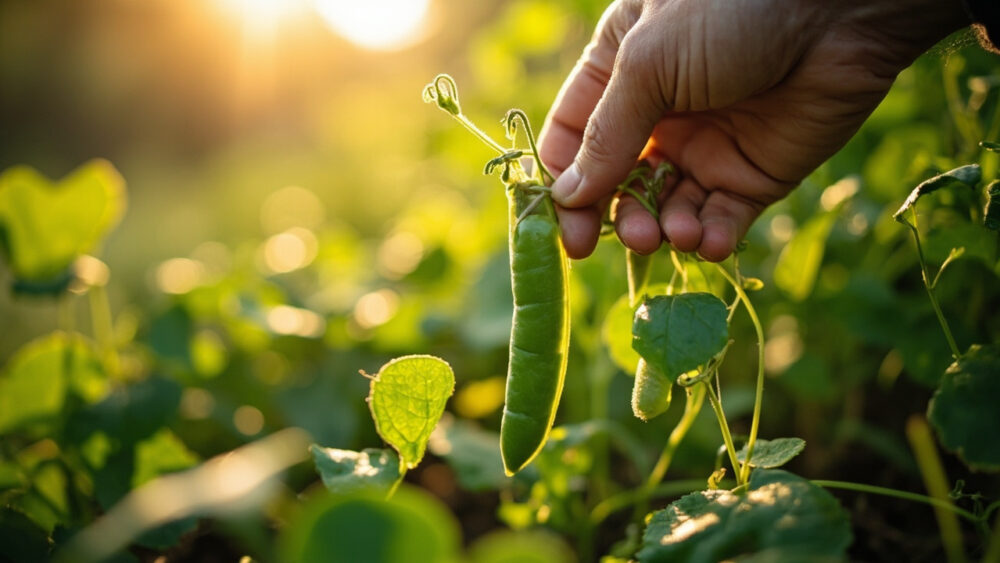
When to harvest peas comes down to the pod, not the calendar. For shelling peas and snow peas, check daily once pods form, because the window from perfect to overgrown can be as short as two or three days. Snap peas and shelling peas both tell you they’re ready through touch as much as sight, and most people harvest by eyeball alone, which is exactly the mistake that costs a whole planting its flavor.
There’s a sign almost every new pea grower misreads, and it has nothing to do with color. There’s also a timing trap that ruins texture even when the pods look fine hanging on the vine. And if you’re wondering whether picking now will stop the plant from producing more, that answer surprises people who’ve been gardening for years.
Stick around for the exact feel test, the harvest window by pea type, and the mistakes that turn a good crop starchy overnight. At the bottom you’ll find a save-able Peas at a Glance card with everything worth pinning to your phone before you walk out to the garden.
The Ready Signs: What to Actually Look and Feel For
Peas ripen fast once they start, so the visual cues matter more here than with almost any other vegetable. What you’re checking depends on which type you grew.
Shelling peas (English peas)
The pod should look plump and full along its whole length, with visible bumps where the peas sit inside. Give it a gentle squeeze: it should feel firm and slightly springy, not squishy and not rock hard. A pod that’s gone dull green or started to feel leathery is already past its best.
Snap peas
These are ready when the pod is plump but still glossy and bright, and it snaps cleanly when you bend it, hence the name. If it bends without a crisp break, give it another day or two.
Snow peas
Harvest these the earliest of the three, while the pod is still flat and the peas inside are barely visible bumps. This is the sign most people misread. They wait for the pod to fill out like a shelling pea, but by then the snow pea has gone fibrous and lost the tenderness that’s the whole point of growing it.
Once you know what ready looks like for your type, the next question is how long that window actually stays open.
The Timing Window: Early, Late, and the Honest Middle
Peas generally reach harvest 60 to 70 days after planting for most varieties, though snow peas and some snap varieties can be ready closer to 55 days. That number is a rough guide, not a deadline. The pod always overrides the calendar.
Pick too early and shelling peas taste thin and starchless, snap peas lack their characteristic crunch, and you’re leaving yield on the table since pods keep bulking up for several more days.
Pick too late and it’s a harder problem. Shelling peas turn starchy, the sugars converting to less palatable carbohydrates within a day or two of peak ripeness. Snap and snow peas get tough strings running the seam and the pod turns from glossy to matte. None of this is fixable in the kitchen. Overripe peas can still be cooked, but they will never taste like a fresh-picked pea again, and that’s the part nobody wants to hear.
There’s also a plant-level cost to letting pods sit. Mature, drying pods signal the plant that its job is done, and it slows new flower and pod production in response.
That slowdown is exactly why harvest technique matters as much as timing, and that’s next.
How to Pick a Pea Pod Without Wrecking the Vine
Pea vines are surprisingly fragile at the stem, and a rough harvest today costs you pods next week.
- Use two hands. Hold the vine steady with one hand right above the pod, and pull or snip the pod off with the other. Yanking with one hand is the single most common way people tear vines off the trellis.
- Snip when in doubt. A small pair of scissors or garden snips is faster and safer than fingers once a plant is loaded with pods, especially on snap and snow pea varieties with tougher stems.
- Work from the bottom up. Lower pods mature first, so start there and work upward each time you check the plant.
- Harvest in the morning if you can, when pods are crisp and full of moisture, before the heat of the day softens them slightly.
Get the picking technique right and you protect the very thing that keeps this harvest going, which is the plant itself.
Right After You Pick: What Actually Preserves Flavor
Peas start losing sweetness the moment they’re off the vine, faster than almost any other garden vegetable. Get them out of the sun and into the refrigerator as soon as you’re done picking, ideally within the hour.
Don’t shell or top-and-tail snap peas until you’re ready to cook or blanch them. Peas held in the pod keep their sugar and moisture longer than shelled ones sitting in a bowl.
If you’re not cooking them same-day, a quick blanch (a minute or two in boiling water, then straight into ice water) followed by freezing locks in flavor far better than raw refrigeration past a couple of days. Shelling peas freeze especially well this way and hold quality for months.
Fresh flavor fades fast, but a productive vine can keep handing you more of it, if you manage the plant right.
Keeping the Harvest Coming
Here’s the honest answer to the question most people are about to ask: picking peas does not stop the plant, it’s actually what keeps it going. Pea vines are bred to keep flowering and setting pods as long as you keep removing the mature ones and the weather stays cooperative.
Stop harvesting, or let too many pods mature and dry on the vine, and the plant reads that as mission accomplished and shifts energy into seed production instead of new flowers.
Check plants every day or two once the first pods start filling out, since a missed week can mean a dozen overripe pods you have to clear off just to convince the vine to keep working.
Peas are also a cool-season crop with a hard stop coming. Once daytime temperatures push consistently past 80°F (27°C), production drops off and quality declines regardless of how well you’ve kept up with picking.
That heat cutoff is worth knowing before you plant next time, and it’s one of the details on the card below.
Peas at a Glance
- When to plant: as soon as soil can be worked in spring, generally when soil temperature is at least 45°F (7°C), often 4 to 6 weeks before your last frost date.
- Days to harvest: roughly 55 to 70 days from planting, depending on variety, with snow peas typically fastest.
- Spacing and depth: sow seeds 1 to 1.5 inches deep, about 2 inches apart, in rows 18 to 24 inches apart, or closer if using a trellis.
- Shelling pea sign: pod plump and full-length, firm with a slight spring when squeezed.
- Snap pea sign: pod glossy and plump, snaps cleanly when bent.
- Snow pea sign: pod still flat, peas inside barely visible as bumps.
- Storage: refrigerate unshelled immediately after picking, use within a couple of days, or blanch and freeze for longer storage.
Check pods daily once they start filling, and trust your hands as much as your eyes.
Pick on time, pick often, and the vine will keep paying you back until the heat shuts it down for the season.