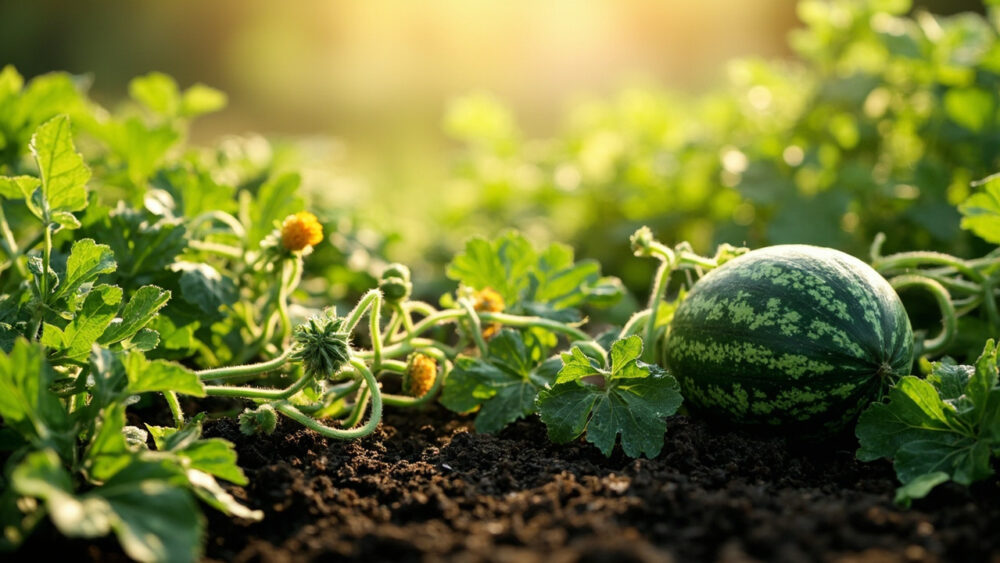
A watermelon plant moves through six distinct stages between seed and harvest: germination, seedling, vining, flowering, fruit set, and ripening, and the whole run takes 70 to 100 days depending on the variety. Knowing the watermelon growing stages matters because each one asks for something different from you, and giving a fruiting-stage plant seedling-stage care is how a lot of vines end up all leaves and no melons.
There is one stage where almost everyone loses the season without realizing it, and it is not the one most people worry about. There is also a sign at the flowering stage that gets misread constantly, one that makes gardeners think their plant failed when it is actually doing exactly what it should.
Stick with me through each stage and I will tell you what healthy progress looks like versus a stall, and the honest read on how long you can expect to wait once you see that first female flower. Save-able specifics, including days to maturity and spacing, are waiting in the Watermelon at a Glance card at the bottom.
Germination: Days 1 to 10
Soil temperature drives everything here. Watermelon seed wants soil at 70 to 95 F to germinate reliably, and below 65 F it will often just sit and rot instead of sprouting. Direct-sown seed goes in about 1 inch deep, once soil has warmed well past your last frost date, usually two to three weeks after.
You will see a bent stem push up first, then two rounded seed leaves (cotyledons) unfold. That is germination finishing, not the seedling stage starting.
If nothing has shown after 10 days in warm soil, the seed likely rotted rather than stalled.
Seedling Stage: Weeks 2 to 4
The true leaves appear now, rougher-edged and lobed compared to the smooth cotyledons. The plant stays compact and low, putting energy into roots more than visible growth, which is exactly why this stage frustrates new growers who expect fast action.
This is also the most fragile stage for cold and transplant shock. A night that dips into the 40s can stunt a seedling for a week even without killing it. If you started indoors, harden off over 4 to 7 days before transplanting, giving increasing outdoor time each day.
Space plants 24 to 36 inches apart in rows 6 to 8 feet apart for standard vining types; bush varieties can go tighter, around 3 to 4 feet between plants.
Slow and steady here is normal, but there is a stage right after this one where slow becomes a real problem.
The Stage Where Most Attempts Go Wrong
If you guessed flowering or fruit set is where watermelon crops fail, that is the understandable guess, but it is usually wrong. The vining stageweeks 4 through 6, is where most home watermelon crops quietly lose the season, and it happens through under-feeding and under-watering, not through any dramatic pest or disease.
Vines are extending fast now, sometimes 6 inches a day in good heat, and they need consistent moisture, roughly 1 to 2 inches of water a week, plus nitrogen to build that vine structure. Skimp here and the plant enters flowering already behind, too small to support much fruit.
The other vining-stage mistake is overhead crowding: letting vines from multiple plants tangle so thickly that leaves shade each other out, cutting the sunlight that later fruit needs to size up.
A vine that looks lush but has grown less than a foot in two weeks during warm weather is not thriving, it is stalling.
Flowering Stage: Weeks 6 to 8
Watermelon plants produce male flowers first, often a week or two before any female flowers show up, and this early wave of male-only blooms is the sign almost everyone misreads. Growers see flowers with no fruit forming and assume something is wrong.
Nothing is wrong. The plant is not failing to fruit, it simply has not produced female flowers yet. You can tell them apart easily: female flowers have a small bulb at the base, the beginning of a fruit, while male flowers sit on a plain thin stem.
Bees do the pollinating in the vast majority of home gardens, moving pollen from male to female blooms. Cool, rainy, or very windy stretches that keep bees inactive can lower fruit set during this window, which is out of your control but worth knowing so you do not blame yourself.
Once female flowers start opening and bee activity is decent, the next thing to watch for is what happens at the base of that little bulb.
Fruit Set: Weeks 7 to 9
A pollinated female flower’s bulb starts swelling within a few days; an unpollinated one shrivels and drops. This is the honest answer to the question every flowering-stage gardener is about to ask: yes, some flowers will fail, and that is normal, not a sign of a sick plant.
Vines typically set more fruit than they can properly finish. Many gardeners let 2 to 4 melons develop per vine on standard varieties and remove extras while they are still small, so the plant channels energy into fewer, bigger fruits instead of spreading itself thin.
At this stage the plant needs less nitrogen and more potassium and phosphorus, since you are now supporting fruit development rather than vine growth. Heavy nitrogen here just grows more leaf at the fruit’s expense.
A melon that swells steadily for the first two weeks after set is on track. One that stays golf-ball size for that same stretch is worth investigating rather than waiting out.
Ripening: Weeks 9 to 12+
This final stretch is where patience gets tested, because watermelon gives no dramatic color change like a tomato does. The fruit is finishing internally while the outside looks nearly the same for days at a time.
Three checks together tell you it is close: the tendril nearest the fruit’s stem turns brown and dries up, the pale ground spot where the melon touches soil shifts from white to a creamy yellow, and the skin surface goes from glossy to a duller, slightly matte finish.
The classic thump test is real but unreliable alone. A ripe melon gives a deep, hollow sound rather than a sharp, high one, but it takes experience to trust that sound by itself.
Days to maturity from fruit set is typically 30 to 45 days depending on variety, so once you see a golf-ball-sized fruit, you are counting down a real window, not guessing blind.
Healthy Progress Versus a Stall, Stage by Stage
A plant that is behind schedule but still moving is fine. A plant that stops moving entirely is telling you something. Here is how to tell them apart quickly at each stage.
- Seedling stage: new true leaves appearing every few days is healthy. Leaves staying the same size for over a week in warm weather is a stall, usually from cold soil or root disturbance.
- Vining stage: several inches of new vine growth every few days is healthy. Vines under a foot of growth over two warm weeks signals a water or nitrogen shortfall.
- Flowering stage: a steady mix of male and eventually female flowers is healthy. Flowers dropping without ever swelling for more than two weeks after females appear points to poor pollination, often from low bee activity.
- Fruit set: visible daily size increase is healthy. A fruit stuck at the same size for over a week usually means it was not fully pollinated and will not finish.
Once you can read these signs on your own vines, the only thing left is knowing exactly when to cut the fruit loose.
Watermelon at a Glance
- When to plant: direct sow or transplant two to three weeks after your last frost date, once soil is consistently 70 F or warmer.
- Planting depth and spacing: sow seed 1 inch deep, space vining types 24 to 36 inches apart in rows 6 to 8 feet apart, bush types 3 to 4 feet apart.
- Total days to maturity: 70 to 100 days from seed depending on variety, with 30 to 45 days from fruit set to ripe.
- Water needs: about 1 to 2 inches per week, most critical during vining and fruit sizing, tapering off in the final week before harvest for better sweetness.
- Feeding pattern: higher nitrogen during vining, then shift toward potassium and phosphorus once female flowers and fruit appear.
- Signs of ripeness: tendril at the fruit’s stem turns brown and dry, ground spot shifts from white to creamy yellow, skin loses its glossy shine.
- Fruit per vine: let standard varieties finish 2 to 4 melons each for the best size and sweetness rather than leaving every set fruit on the vine.
Watermelon does not rush for anyone, and every stage has its own honest timeline. Match your care to the stage in front of you and the vine will tell you the rest through how it looks and grows.