No, Christmas cactus is not considered toxic to dogs. It is one of the few common houseplants that gets an actual pass from the ASPCA’s toxic plant list. That does not mean a dog can eat a whole stem with zero consequences, and it does not mean every plant sitting on your windowsill labeled “Christmas cactus” is what you think it is.
There are a couple of honest wrinkles here worth knowing before you relax completely. The amount matters, the plant’s identity matters, and the symptoms that show up afterward can look scarier than the actual risk warrants, which trips up a lot of owners into either panicking or ignoring something they shouldn’t.
Stick with this one. Below you’ll get the real signs to watch for, what to actually do if your dog took a bite, and a save-able quick-reference card at the bottom that sums up the whole answer in one glance.
The Plain Answer: Not Toxic, But Not Nothing
Christmas cactus (Schlumbergera) does not contain the toxic compounds found in true cacti-adjacent succulents or in genuinely dangerous houseplants like sago palm or lilies. Veterinary toxicology references classify it as non-toxic to dogs and cats.
That said, “non-toxic” is not the same as “harmless snack.” Any plant material can cause mechanical irritation or an upset stomach, especially in a smaller dog that eats a large mouthful of thick, fleshy stem segments.
If your dog is a chewer and this plant is within reach, the bigger risk isn’t poison. It’s a dog treating your prized six-year-old cactus like a chew toy.
The Mix-Up That Changes Everything
Here’s the part most people never think to ask: is the plant on your shelf actually a Christmas cactus? A lot of plants sold under that name in December are something else entirely.
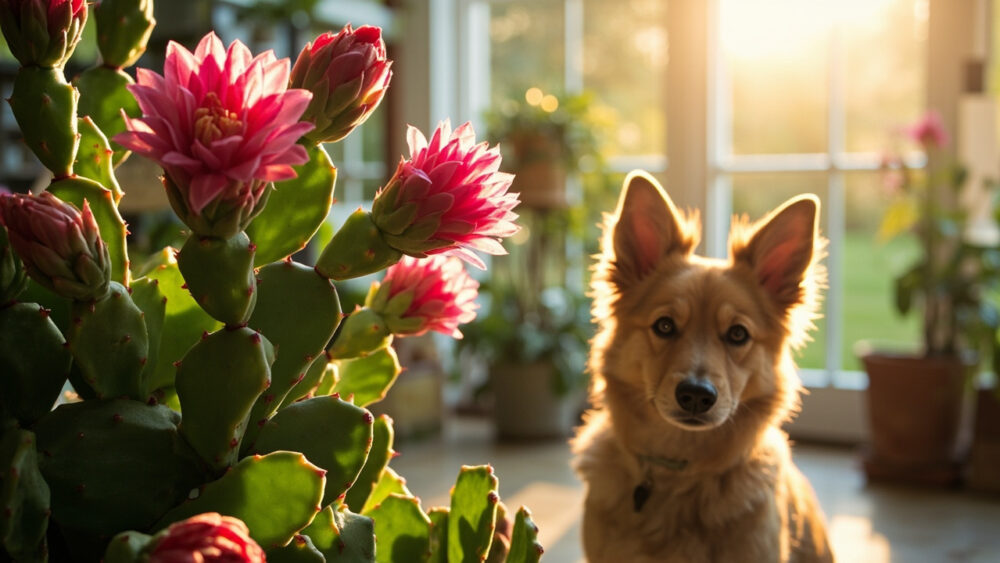
True Christmas cactus (Schlumbergera) has flat, scalloped, jointed segments with rounded edges and no spines. Easter cactus (Rhipsalidopsis) looks similar and is also considered non-toxic.
The plant to actually worry about is the unrelated Christmas rose (hellebore) or true holiday cacti mislabeled at big box stores as something in the Euphorbia family, which can cause real irritation. If your plant has milky sap when cut, it is not a Schlumbergera, and that sap alone should send you looking up the actual species.
Knowing which plant you actually own is step one, and step two is knowing what a bite even looks like.
Signs to Watch For After a Bite
Even with a genuinely non-toxic plant, dogs can react to the fiber and plant matter itself. Watch for vomiting, drooling, mild diarrhea, or a dog pawing at its mouth after chewing on a stem segment.
Most of these signs, if they show up at all, are mild and short-lived. That is the nature of a mechanical, not chemical, reaction.
- Drooling or lip licking right after chewing
- One or two episodes of vomiting
- Soft stool or mild diarrhea within a few hours
- Disinterest in food for a meal or two
None of that is an emergency on its own, but it still deserves a phone call, and here’s why.
What To Actually Do If Your Dog Ate It
Call your veterinarian or an animal poison control line any time you suspect your dog ate a significant amount of any plant, even one considered safe. This isn’t about panic, it’s about ruling out the mix-up covered above.
Have the plant in front of you, or a photo of it, when you call. Being able to describe the leaf shape, whether it has spines, and whether it has sap will help a vet or poison control confirm you actually have Schlumbergera and not a lookalike.
Note how much your dog ate, roughly when it happened, and whether any symptoms have started. Do not induce vomiting or give any home remedy on your own. Let the professionals on the phone tell you whether a visit is needed.
If your dog is otherwise acting normal, the call still matters, if only for peace of mind and a paper trail.
Safer Look-Alikes If You Want Zero Risk
If you’d rather not test your dog’s restraint against a swaying stem of holiday blooms, there are other options that give a similar look with even less worry.
African violets are non-toxic, low to the ground, and bloom for weeks. Haworthia and other true non-toxic succulents give you that fleshy, sculptural look without the trailing stems a dog can grab and pull down.
If you love the winter-blooming timing specifically, Christmas kalanchoe is not the answer, despite the name similarity, since kalanchoe is actually toxic to dogs and cats. Skip that one entirely.
Plant choice matters, but so does where you put it, which brings us to the part most owners skip.
The Placement Habit That Prevents the Whole Problem
A Christmas cactus that hangs in a spot no dog can reach never becomes an incident report. Trailing stems within jumping or counter-surfing distance are the actual risk, not the plant’s chemistry.
Elevated shelves, hanging planters, and rooms with doors solve ninety percent of this before it starts. Curious puppies and bored adult dogs are the ones who turn a houseplant into a snack, so match the plant’s location to your specific dog’s habits.
Get the placement right and this entire question becomes theoretical, which is exactly where you want it.
Christmas Cactus: Quick Reference
- Toxicity: Christmas cactus (Schlumbergera) is classified as non-toxic to dogs and cats by veterinary toxicology sources.
- Real risk: mechanical irritation or mild stomach upset from chewing plant fiber, not chemical poisoning.
- Confirm identity: flat, scalloped, spineless segments mean true Christmas cactus, milky sap or spines mean it’s something else.
- Watch for: drooling, vomiting, mild diarrhea, or loss of appetite after a large bite.
- What to do: call your veterinarian or animal poison control for any suspected ingestion, no home treatment or induced vomiting.
- Bring to the call: the plant or a photo, the amount eaten, and the time it happened.
- Avoid confusion with: kalanchoe, hellebore, and Euphorbia species sold under similar holiday names, all of which carry real toxicity risk.
Christmas cactus earns its reputation as one of the safer houseplants to keep around a curious dog.
Just make sure the plant in your hands is the one this whole answer is actually about.