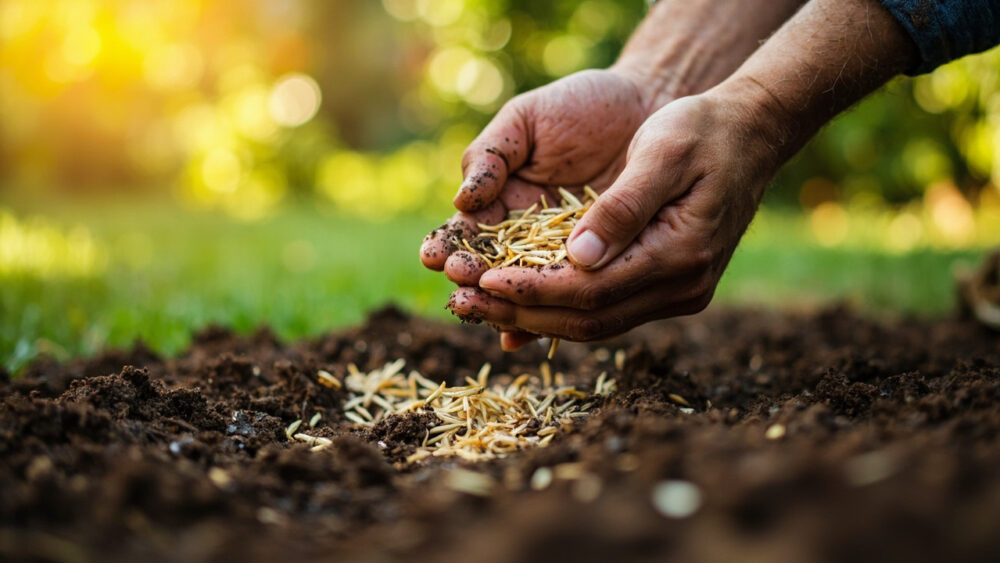
The best time to plant ryegrass is when soil temperatures sit between 50 and 65 degrees F, which usually lines up with 6 to 8 weeks before your first fall frost or 3 to 4 weeks before your last spring frost. Fall is the better of the two windows almost everywhere ryegrass grows. Get the timing for ryegrass wrong by even two or three weeks and you either watch it burn out in summer heat or get shredded by winter before it roots deep enough to survive.
Here’s the part most people miss: the calendar date on a seed bag is a regional average, not a promise. Your actual window depends on soil temperature, not the month, and there’s an easy way to check it yourself that takes about ten seconds.
There’s also a common mistake that wastes an entire bag of seed, a sign gardeners misread as “it didn’t take” when the seed is actually still fine, and a straight answer about whether you can push the window in a warm winter. All of that’s ahead, and the quick-reference card with every number on this page is saved at the bottom so you can pull it up again without rereading everything.
The Real Planting Window, Anchored to Soil and Frost
Ryegrass, whether you’re planting annual (Italian) or perennial ryegrass, germinates fastest and roots strongest when soil temperature is between 50 and 65 degrees F. Air temperature is a poor substitute for this because soil lags behind air by days or weeks depending on sun exposure and moisture.
In fallthat soil window typically falls 6 to 8 weeks before your area’s first hard frost. That gives seedlings enough warm weeks to establish a root system before winter dormancy or, for annual ryegrass, before it simply finishes its lifecycle.
In springaim for 3 to 4 weeks before your last frost date, once soil has warmed past 50 degrees F but before summer heat arrives. Spring plantings of perennial ryegrass are riskier because the plant barely gets established before heat stress sets in.
Knowing the calendar range is only half the job, though.
How to Find Your Actual Window, Not the Average One
Forget the guess most people make, which is “it’s been warm for a week, so it must be time.” Soil temperature is measured, not felt.
Push a soil thermometer (or even a meat thermometer) 2 to 3 inches into bare soil in the morning, before the sun has heated the surface. Do this for three or four days running. If you’re consistently landing between 50 and 65 degrees F, you’re in the window.
No thermometer handy? A rough visual cue works too: soil that’s workable, crumbles rather than clumps into mud, and has had about two weeks of daytime temps in the 60s is usually close. It’s not exact, but it beats guessing off the calendar alone.
Once you know your real number, the next question is what happens if you miss it.
Too Early or Too Late: What Actually Goes Wrong
If you assumed early planting just means a head start, that guess is what kills most fall ryegrass seedings. Seed put down while soil is still above 70 degrees F germinates fine, but the tender seedlings hit peak summer heat and drought stress before roots are deep enough to handle it. You end up reseeding the same patch in six weeks anyway.
Plant too late in fall and you get the opposite failure. Seed germinates in cool soil, but there isn’t enough warm-soil time left for roots to establish before hard frost locks things down. Thin, weak turf going into winter usually doesn’t make it to spring.
Spring has its own version of both mistakes. Too early means seed sits in cold, often waterlogged soil and simply rots before it sprouts. Too late means the grass is still juvenile when summer heat and weed pressure hit it hardest.
The sign everyone misreads here: sparse, patchy growth two weeks after seeding looks like failure, but it’s often just normal germination lag, not a dead seeding.
Ryegrass germinates fastusually 5 to 10 days, faster than almost any other common lawn grass. If you see nothing at all by day 14 in soil that’s been consistently moist and in range, that’s when you should suspect a real problem, not before.
Timing mistakes are recoverable if you catch them early, but only if the prep work was done first.
What to Do Before the Window Opens
Prep work doesn’t wait for the ideal soil temperature. Do this while you’re still watching the thermometer creep toward your range.
- Mow existing turf short (around 1.5 to 2 inches) and rake out dead thatch so seed can reach soil.
- Loosen the top inch of soil with a rake or dethatcher; ryegrass seed needs soil contact, not just a landing spot on top of grass.
- Test drainage by checking if water pools longer than a few minutes after rain; ryegrass tolerates average soil but not standing water.
- Have your seed and starter fertilizer ready so you can plant the day soil hits 50 degrees F rather than waiting another week to shop.
Sow ryegrass at roughly 5 to 10 pounds per 1,000 square feet for lawn overseeding, or up to 20 pounds per 1,000 square feet for a thick, standalone stand, at a depth of about a quarter inch, no deeper. Keep the top inch of soil consistently moist, watering lightly once or twice a day, until you see uniform green.
With prep done, the only variable left is your specific climate, and that changes the math more than people expect.
Regional Notes That Change the Date, Not the Rule
In the cool, humid North and upper Midwest (roughly USDA zones 3 to 6), fall planting from late summer into early autumn is far more reliable than spring. Perennial ryegrass is often used here as part of a cool-season mix rather than alone.
In the transition zone (zones 6 to 7, think mid-Atlantic through the lower Midwest), both windows can work, but fall still wins because summer heat is brutal on young perennial ryegrass roots.
In the South (zones 8 and warmer), annual ryegrass is mostly used for winter overseeding of dormant warm-season lawns, planted in fall once nighttime temps cool consistently, and it’s expected to die out on its own by late spring when heat returns. That’s normal, not a failure.
Wherever you garden, the soil thermometer matters more than the zone map.
All of that adds up to one card worth saving before you forget a single number.
Ryegrass at a Glance
- When to plant: soil temperature between 50 and 65 degrees F, ideally 6 to 8 weeks before first fall frost, or 3 to 4 weeks before last spring frost.
- Best season overall: fall, in almost every region, for stronger root establishment before stress season hits.
- Seeding depth: about a quarter inch, never deeper than half an inch.
- Seeding rate: 5 to 10 pounds per 1,000 square feet for overseeding, up to 20 pounds per 1,000 square feet for new stands.
- Germination time: 5 to 10 days with consistent moisture. Wait at least 14 days before assuming failure.
- Watering: keep top inch of soil moist with light, frequent watering until seedlings are uniformly up.
- Southern use: annual ryegrass for winter overseeding on dormant warm-season lawns, expected to fade out by late spring.
Check the soil, not the calendar, and plant the day it reads right. Everything else on this page is just there to help you trust that number when you see it.