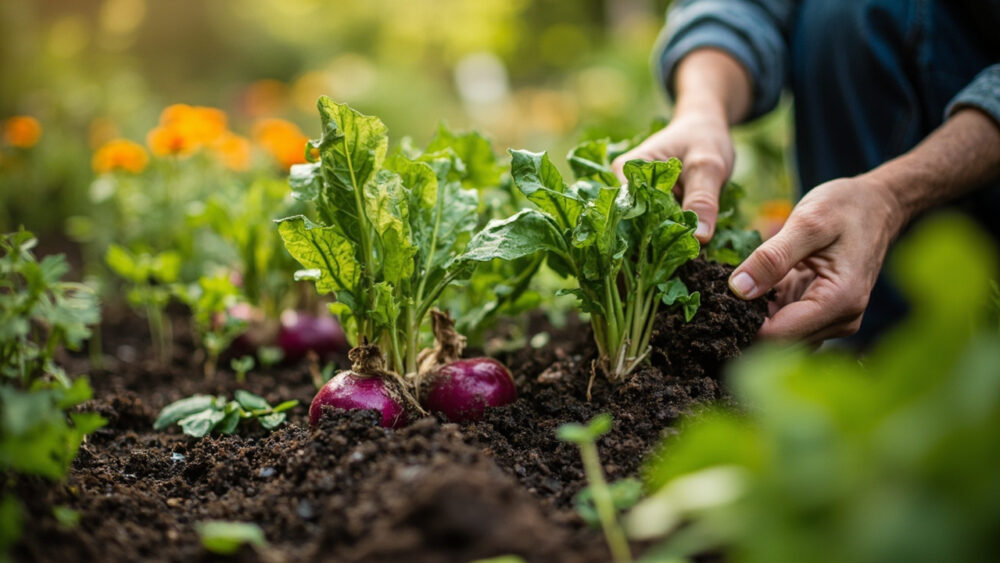
The best companion plants for turnips are peas and beans, which feed the soil nitrogen that turnips burn through fast, plus aromatic herbs and alliums like onions, which throw off the flea beetles and root maggots that go straight for your turnip greens and roots. Lettuce and spinach make good bed-mates too, since they hug the ground while turnips grow up and out without ever competing for the same root space.
Where turnips get people in trouble is the brassica family itself. Plant them too close to cabbage, broccoli, or mustard and you are not adding variety, you are building a buffet that concentrates every brassica pest and disease into one section of the garden.
Below I will walk through exactly why each good companion earns its spot, the pairing that ruins more turnip patches than bad soil ever does, and one companion-planting “rule” that sounds smart but does not actually hold up in the dirt. Save the Turnips at a Glance card at the very bottom for the numbers you will want again this weekend.
The Companions Worth Planting
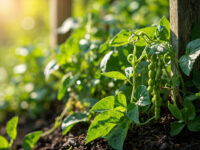
Peas and beans
Turnips are heavy feeders, especially for nitrogen, and they will tell you when they are hungry through pale, slow-growing leaves. Peas and beans fix nitrogen in the soil through bacteria on their roots, banking fertility that turnips planted nearby or in succession can pull from.
Plant bush beans or peas 4 to 6 inches from your turnip rows, not tangled directly on top of them, since both crops want their own root room.
That nitrogen boost is only half the story, the pest protection is the other half.
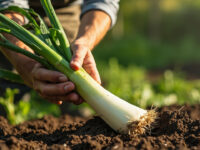
Onions, garlic, and leeks
Alliums are the turnip’s best pest deterrent that costs nothing extra. Their sulfur compounds mask the smell turnip greens give off, which is exactly what flea beetles and cabbage root maggots use to find their target.
Tuck a row of onions or garlic along the edge of your turnip bed rather than mixing them in randomly. A border works as well as interplanting and is far easier to manage at harvest.
Smell isn’t the only defense worth stacking into this bed.
Aromatic herbs: dill, rosemary, sage, and mint
These herbs confuse pests the same way alliums do, through strong scent that overrides the chemical signal turnip foliage sends out. Dill also draws in beneficial predators like lacewings and parasitic wasps that hunt down aphids and caterpillar eggs before they become a problem.
Keep mint contained in a pot sunk into the bed or nearby in its own container. Left loose, it spreads by runners and will crowd out everything within a couple of seasons.
Now for the plants that share space without competing for it.
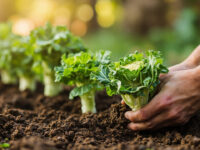
Lettuce, spinach, and low growers
Turnips send roots down while their greens grow upright, leaving the soil surface around them mostly open. Lettuce and spinach fill that gap, acting as a living mulch that shades the soil, holds moisture, and crowds out weeds.
Because they mature fast, 30 to 45 days for most lettuce varieties, you can often harvest them before turnip roots need the extra space anyway.
Good pairings only tell half of what you need to lay this bed out well, the bad ones matter just as much.
What to Never Plant Near Turnips
Other brassicas: cabbage, broccoli, kale, mustard
This is the mistake that costs the most gardeners their whole turnip patch, and it is not obvious if you have not been burned by it before. You might assume mixing brassicas adds diversity to the bed, but diversity of species is not what matters here, diversity of pest targets is.
Cabbage, broccoli, kale, and mustard share turnips’ exact vulnerabilities: flea beetles, cabbage worms, aphids, and clubroot disease. Planting them together does not spread the risk, it concentrates it into one dense pest magnet that is far harder to protect than several small plantings scattered around the garden.
Clubroot is the one that should worry you most, since it lives in the soil for years once established and there is no cultural fix once a bed is infected, only crop rotation and time.
If brassicas are already too close for comfort, here is what actually helps, and what does not.
Fennel, and why potatoes are riskier than people think
Fennel releases compounds that suppress the growth of many nearby vegetables, turnips included. It earns a spot off on its own, never inside a mixed vegetable bed.
Potatoes are the sleeper problem. They do not directly harm turnips, but both draw heavily on similar soil nutrients and both attract overlapping pests, including flea beetles and wireworms, which means planting them side by side just doubles your pest pressure instead of spreading it out.
Once you know what to keep apart, the actual bed layout becomes the easy part.
Laying Out the Bed
Sow turnip seed 1/2 inch deep, in rows spaced 12 to 18 inches apart, thinning seedlings to 3 to 4 inches apart once they have their first true leaves. Turnips like cool soil, ideally 60 to 65 F, and grow best from an early spring sowing 2 to 3 weeks before your last frost, or a fall sowing 6 to 8 weeks before your first frost.
Run your allium or herb border along the outer edge of the bed rather than scattered through it, so you get the scent barrier without constant root disturbance from harvesting.
Keep peas or beans on an adjacent bed or a nearby trellis rather than directly interplanted, since their vines can shade turnip foliage if left unchecked.
Lettuce or spinach can go directly between turnip rows since both are shallow-rooted and finish quickly.
That layout handles the real threats, but one popular companion-planting claim about turnips does not hold up.
The Myth Worth Retiring
You will see marigolds recommended for nearly every vegetable, turnips included, with the claim that they repel root maggots through their roots. The actual evidence for this with turnips specifically is thin, and in practice marigolds mostly help against nematodes in soil, a different pest problem than what typically bothers turnip roots.
Marigolds are not harmful nearby and they do bring in pollinators and some general beneficial insects, so there is no real downside to keeping them in the garden. Just do not count on them as your main flea beetle or root maggot defense the way alliums and aromatic herbs genuinely function.
With the good pairings, the bad ones, and the myths cleared up, here is the whole thing distilled into one card.
Turnips at a Glance
- When to plant: 2 to 3 weeks before your last spring frost, or 6 to 8 weeks before your first fall frost, once soil sits around 60 to 65 F.
- Spacing and depth: sow 1/2 inch deep in rows 12 to 18 inches apart, thin to 3 to 4 inches between plants.
- Best companions: peas and beans for nitrogen, onions and garlic for pest masking, dill and other aromatic herbs for beneficial insects, lettuce and spinach as living mulch.
- Never plant nearby: other brassicas like cabbage, broccoli, kale, and mustard, since they share the same pests and clubroot risk.
- Also avoid: fennel, which suppresses nearby growth, and heavy interplanting with potatoes, which doubles pest pressure.
- Skip the marigold myth: they help against nematodes generally but are not a real fix for turnip-specific pests.
- Days to maturity: most turnip varieties are ready in 40 to 60 days, with greens often pickable in as little as 30.
Get the alliums on the border and the brassicas out of the bed, and most turnip pest problems never get the chance to start.
Everything else on this list is a bonus once those two things are handled.