Climbing roses need six or more hours of direct sun, a deep weekly soak instead of frequent sips, a sturdy support they’re actually tied to, and a hard pruning once a year once they’re established. Skip any one of those and you get a rose that grows plenty of leaf and almost no bloom. That combination, more than fertilizer or variety, is what separates a climber smothered in flowers from one that just sits there being green.
Most of the trouble people run into isn’t disease or bad luck. It’s tying the cane straight up like a flagpolewhich is the single most common mistake and it quietly kills half the bloom potential for years. There’s also a sign almost everyone misreads the first time they see it, a cane that looks dead in late winter but isn’t. And there’s the question you’re probably about to ask right after this one: how hard can you actually cut this thing back without losing the whole season’s flowers.
All of that gets answered below, in order, and the exact numbers you’ll want to save are waiting in the Climbing Roses at a Glance card at the very bottom.
Light, Placement, and Temperature
Climbing roses want a minimum of six hours of direct sunand full-day sun produces noticeably more flowers than the bare minimum. Morning sun with light afternoon shade works in hot climates, zone 8 and up, where afternoon sun can scorch blooms and stress the plant in summer.
Give the support itself room. A wall, fence, or arbor should sit far enough from the rose’s root zone, at least 12 to 18 inches, that air moves behind the foliage. Tight, airless spots against solid walls are where black spot and mildew take hold fastest.
Most climbers are hardy to zone 5, some to zone 4, but check the tag for your specific variety since hardiness swings widely across climbers.
Where you plant it now decides how much disease pressure you’re fighting for the next ten years.
Watering: How Much, How Often, and How to Tell
Water deeply once or twice a week rather than a little every day. A newly planted climber wants the soil moist to about 8 inches deep for its first full season while roots establish; an established one wants roughly 1 inch of water a week from rain or hose, more during summer heat or drought.
Check by pushing a finger 2 inches into the soil near the base. If it’s dry at that depth, water. If it’s still damp, wait.
If you assumed wilting leaves always mean more waterthat guess causes as many rose problems as drought does. Wilting combined with soggy soil usually means root rot or poor drainage, not thirst, and more water only makes it worse.
Water at the base, not overhead, and morning is better than evening so foliage dries before nightfall.
Get the water right and the soil underneath it barely has to work to keep the plant fed.
Soil, Feeding, and the Support Question
Climbing roses want rich, well-draining soil with a pH around 6.0 to 6.5. Work several inches of compost into the planting hole and mulch 2 to 3 inches deep afterward to hold moisture and moderate soil temperature.
Feed with a balanced or rose-specific fertilizer starting in early spring as new growth appears, then again after the first flush of bloom, and stop feeding roughly 6 to 8 weeks before your first expected fall frost so the plant hardens off instead of pushing tender new growth into cold weather.
The support matters as much as the soil. A trellis, arbor, or fence needs to be installed before or at planting, strong enough to hold years of woody growth, and climbers need to be tied to it with soft garden twine or clips, loosely, since roses don’t have tendrils or twining stems that grip on their own.
Here’s the mistake that costs people entire seasons of bloom: training canes straight up. A cane trained vertically puts all its energy into one tall shoot with flowers only at the very top. Train canes horizontally or in a fan shape against the support instead, and each bend triggers side shoots, and every side shoot is a flowering spot. This single habit change is the difference between a rose with ten blooms and a rose with a hundred.
Once the framework and feeding are right, the yearly maintenance is what keeps it productive.
Pruning, Cleanup, and Timing That Actually Matters
Do not prune hard in the first two years. Let the plant establish a framework of long canes first; heavy pruning too early is a common way to set a climber back a full season or more.
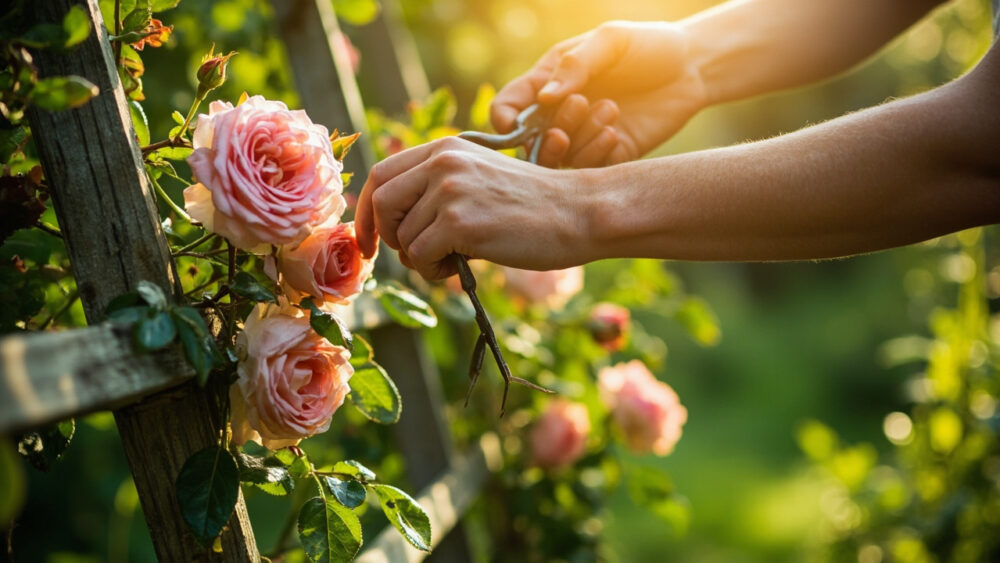
Once established, prune in late winter or very early spring, while the plant is still dormant and before new leaf buds swell. Remove dead, damaged, or crossing wood entirely, cut back the previous year’s flowering side shoots to two or three buds, and keep three to eight strong main canes trained along the support.
This is the sign almost everyone misreads: a cane that looks gray, dry, and dead in late winter often isn’t. Scratch the bark lightly with a fingernail. Green underneath means it’s alive. Brown all the way through means cut it out.
Deadhead spent blooms through summer on repeat-flowering varieties to encourage another flush. Skip deadheading in fall if you want rose hips for winter interest and wildlife.
Clean up fallen leaves and debris around the base each fall, since fungal spores overwinter there and reinfect the plant come spring.
Get the pruning rhythm right and most of the disease pressure that follows never gets a foothold.
Problems Most Likely to Strike, and the Real Fix
Black spot shows up as circular black spots with yellowing leaf margins, usually worse in humid weather or when foliage stays wet overhead. Improve air circulation, water at the base, remove and destroy infected leaves, and use a fungicide labeled for black spot on roses if it’s recurring, following the product label exactly.
Powdery mildew looks like a gray-white dusting on leaves and buds, common when days are warm and nights are cool. Prune for airflow and treat with a labeled fungicide if it spreads.
Aphids cluster on new growth and buds. A strong water spray or insecticidal soap handles light infestations.
Japanese beetles chew ragged holes in flowers and leaves during their summer emergence. Hand-picking into soapy water works for small numbers, and traps placed away from the rose can help but shouldn’t sit right next to it.
None of this means giving up on the plant. Even a rose with a rough disease year almost always comes back strong after a proper dormant-season pruning and cleanup.
Once you know what’s normal wear and what’s a real problem, spotting genuine thriving gets easy.
How to Tell It’s Actually Thriving
A climbing rose that’s happy pushes new red-tinted growth from the base or along canes in spring, holds deep green leaf color through summer, and produces repeat flushes of bloom rather than one showing and then nothing.
Canes should feel firm and slightly flexible, not brittle, and you should see new basal shoots emerging from the crown every year or two as the plant renews itself.
If flowering slows dramatically after year three or four despite good care, that’s usually a training and pruning issue, not a feeding issue. Go back and check whether canes are still tied vertically instead of horizontally.
The honest answer to the follow-up question everyone eventually asks, how long until this thing actually covers the arbor, is two to three full growing seasons for a vigorous variety, sometimes longer for a slower one, and there’s no fertilizer trick that speeds that timeline much.
Save the numbers below and you won’t need to guess at any of this again.
Climbing Roses at a Glance
- Light: at least 6 hours of direct sun daily, full-day sun for best bloom.
- Watering: deep soak once or twice weekly, about 1 inch per week for established plants, more in heat.
- Soil: rich, well-draining, pH 6.0 to 6.5, mulched 2 to 3 inches deep.
- Feeding: balanced or rose fertilizer in early spring and after first bloom flush, stop 6 to 8 weeks before first fall frost.
- Pruning: skip hard pruning first 2 years, then prune late winter or early spring, cut flowering side shoots to 2 to 3 buds.
- Training: tie canes horizontally or fan-shaped to the support, never straight up, for maximum side-shoot bloom.
- Watch for: black spot, powdery mildew, aphids, and Japanese beetles, treated culturally first and with a labeled product if needed.
Train the canes sideways and prune with a purpose, and the flowers take care of themselves.
Everything else on this list just keeps the plant healthy enough to put on the show.