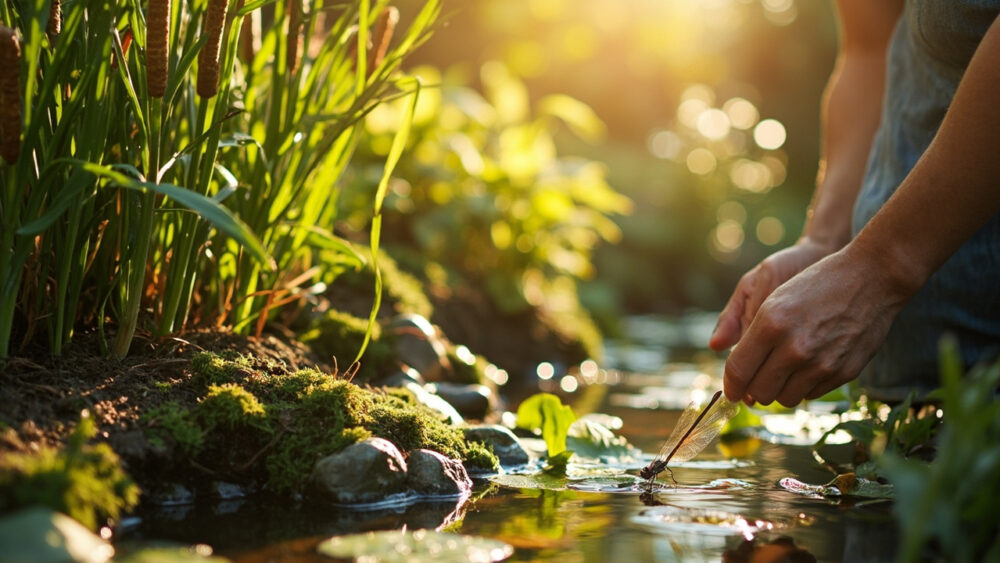
Dragonflies come for water and stay for food, and if you don’t have standing water within their flight range, nothing else you do will matter much. The fastest real fix is a still or slow-moving water feature at least 2 feet across with some submerged and emergent plants, placed in full or near-full sun. Get that right and you can have dragonflies patrolling your yard within a season, sometimes within weeks if there’s already a pond nearby feeding you strays.
Here’s what most people get wrong straight out of the gate: they plant “dragonfly flowers” and wait. Dragonflies don’t drink nectar and don’t visit blooms the way butterflies do, so that approach quietly wastes an entire summer.
There’s also a mistake with the water feature itself that undoes months of good work, a seasonal window where nymphs actually show up versus where adults just pass through, and an honest answer about how long this takes that most people don’t want to hear. All of it’s covered below, and the quick-reference card with every number you need is waiting at the bottom, worth saving to your phone before you head outside.
Why Water Is the Whole Game
Dragonflies spend most of their lives underwater, not in the air. Adults live for a few weeks to a couple of months, but the nymphs live submerged for anywhere from several months to two or three years depending on the species, hunting other insect larvae.
That means an adult dragonfly showing up in your yard is either passing through or is genuinely considering laying eggs there. Only standing water gives you the second, better outcome.
Moving water, chlorinated pools, and water that gets disturbed daily won’t hold nymphs. Calm, undisturbed, biologically active water is the entire draw.
Get the water right first, because everything else is decoration by comparison.
Building the Setup That Actually Works
Start with a pond or large tub at least 2 feet wide and 18 to 24 inches deep at some point, since nymphs need a deeper zone to overwinter if you’re in a colder climate. A pre-formed pond liner, a stock tank, or even a half whiskey barrel sunk partway into the ground all work fine.
Add a shallow shelf along one edge, only 4 to 8 inches deep, and plant it with emergent vegetation like sedges, rushes, or dwarf cattail. This shelf is where nymphs climb out to molt into adults, and skipping it is one of the quieter reasons a pond sits empty of dragonflies for years.
Include some submerged plants too, like hornwort or anacharis, since females lay eggs on or near this vegetation and nymphs hide in it.
Place the whole thing where it gets at least 6 hours of direct sun, since dragonflies are cold-blooded and won’t hang around shaded water.
The plants matter more than most people assume, and that’s the next thing worth getting straight.
Why “Dragonfly Flowers” Are the Wrong Plant List
If you assumed you needed nectar plants the way you would for butterflies or bees, that guess is understandable but it’s not how dragonflies feed. Adults are predators, hunting mosquitoes, gnats, and other flying insects in midair, so flowers don’t feed them at all.
What plants actually do for dragonflies is provide perching and hunting posts. Tall, upright stems near the water, like ornamental grasses, iris, or joe-pye weed, give adults a lookout to launch ambush flights from.
The pond vegetation itself matters far more than any flower bed, since it’s where eggs get laid and nymphs develop.
Skip the flower obsession and focus your planting effort at the water’s edge, and the food will follow because the mosquitoes it draws are the actual meal.
Timing: When Adults Show Up Versus When They Stay
Adult dragonflies start appearing as soon as air temperatures reach the 60s Fahrenheit consistently, which in most temperate regions is mid to late spring. That’s when you’ll see the first scouts checking out any open water in the area.
But scouts aren’t residents. A pond needs to run through at least one full season, sometimes two, with stable water and established vegetation before it develops the kind of aquatic insect life that makes females want to lay eggs there instead of just visiting.
If your pond is brand new this spring, expect visitors by early summer but don’t expect a real breeding population until next year or the year after. That’s the honest timeline, and it’s longer than most first-time pond builders expect.
Patience matters here, but so does not accidentally sabotaging the pond while you wait, which is where most people lose ground.
The Mistakes That Quietly Undo the Effort
Chemical mosquito treatments are the biggest one. Any product that kills mosquito larvae in your pond also kills the aquatic insects dragonfly nymphs eat, and often the nymphs themselves.
Stocking the pond with fish is the second common mistake. Goldfish and koi eat dragonfly nymphs and eggs readily, so a fish pond and a dragonfly pond are usually two different ponds.
Keeping the water too clean is a third one. A pond that’s algae-free, gravel-bottomed, and constantly filtered has nothing for nymphs to hunt or hide in.
- Skip mosquito dunks and larvicides in a pond meant for dragonflies
- Skip fish, or keep them in a separate feature entirely
- Leave some leaf litter and algae rather than scrubbing the pond clean
- Avoid daily disturbance like fountains that churn the whole surface
Fix those four things and most stalled dragonfly ponds turn around within a season.
Keeping It Working Year After Year
Once a pond is producing dragonflies, the job shifts from building to maintaining. Leave the pond alone through fall and winter rather than draining or cleaning it out, since overwintering nymphs are down in that mud and debris right now.
Divide and thin emergent plants every couple of years so the shelf doesn’t get overcrowded, but do it in early spring before nymphs are actively emerging.
Top off water during dry spells so levels don’t drop enough to expose the shallow shelf, and avoid tap water heavy with chlorine if you can use rain barrel water instead.
A pond that’s been left mostly alone for three or four years, with stable water and thick edge growth, is the single best predictor of a strong dragonfly population, better than any purchased plant or feature.
Wildlife at a Glance
- What attracts them: still, sunny, undisturbed water with submerged and emergent plants, not flowers.
- Minimum pond size: about 2 feet across, with at least one area 18 to 24 inches deep for overwintering nymphs.
- Shallow shelf depth: 4 to 8 inches, planted with sedges, rushes, or dwarf cattail for nymphs to emerge on.
- Sun needed: at least 6 hours of direct sun daily, since dragonflies are cold-blooded.
- Timing to see adults: consistent air temperatures in the 60s Fahrenheit, usually mid to late spring.
- Timing to see a breeding population: one to two full seasons after the pond is established.
- Biggest mistakes: mosquito larvicides, stocked fish, and over-cleaning the water.
Build the water first and leave it a little messy, and the dragonflies will find it on their own.
Everything else, the flowers, the ornaments, the perfect gravel, is just décor around the one thing that actually works.