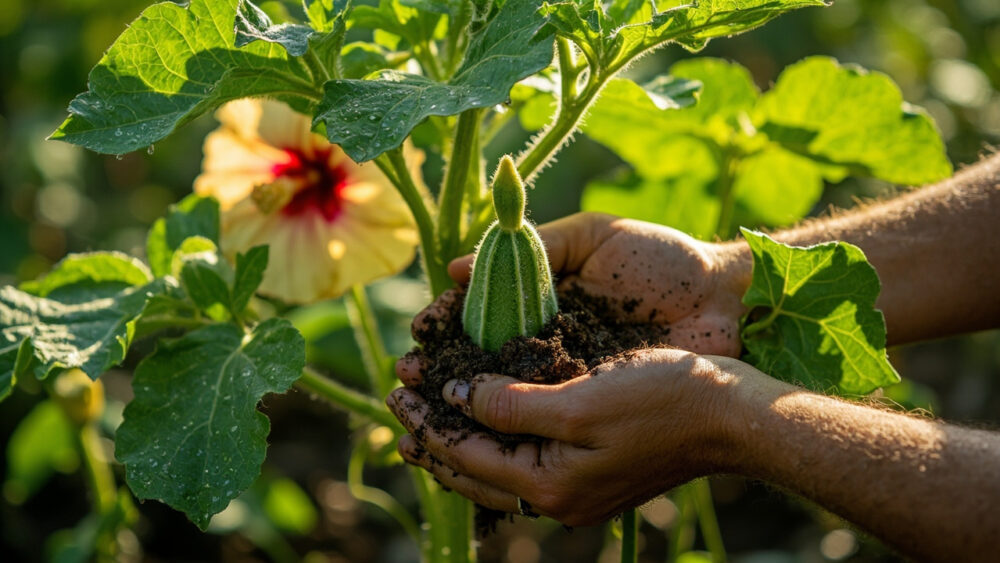
Okra runs through five distinct growing stages between seed and harvest: germination, seedling, vegetative growth, flowering, and pod production, and the whole cycle takes roughly 50 to 65 days from planting to first pick depending on the variety and how warm your season is. Knowing the okra growing stages matters because okra gives you almost no warning between “not ready” and “too tough to eat,” and each stage asks for something different from you.
Most first-time okra growers lose the season at one specific point, and it is not the stage you would guess. There is also a sign of trouble everyone misreads as a nutrient problem when it is actually a timing problem, and an honest answer to the question you are already thinking: why did my plant just stop growing for two weeks straight.
Stick with this to the end and save the Okra at a Glance card at the bottom, it has the numbers you will want again in about a month when you are standing in the garden trying to remember all of this.
Germination: Days 1 to 12
Okra seed is slow to sprout in cool soil and fast in warm soil, and this single fact causes more failed plantings than anything else. Soil needs to sit at 65 to 70 F or warmer before you plant, ideally closer to 75 to 85 F, which usually lands two to three weeks after your last frost date, not right on it.
Plant seed 0.5 to 1 inch deep, spaced 4 to 6 inches apart, and thin later to 12 to 18 inches. In warm soil you will see a cracked, hooked sprout push through in 5 to 7 days. In cool soil it can take 3 weeks or simply rot in the ground.
Soaking seed overnight before planting speeds things up but does not fix cold soil.
Seedling stage: Weeks 2 to 4
Once up, the seedling shows two rounded seed leaves followed by heart-shaped true leaves within about a week. Growth looks slow and low, often just 4 to 8 inches tall through this stretch, and that slowness is normal, not a stall.
This is the stage most people misjudge. A lot of gardeners assume small, pale-looking seedlings need more water or a dose of fertilizer right away. Usually what they actually need is heat and patience, okra seedlings barely move until nighttime temperatures stay reliably above 60 F.
Keep soil evenly moist but not soggy, and hold off on heavy feeding until the plant is established with 4 to 5 true leaves.
The next stage is where the plant finally starts acting like the okra you’re picturing.
Vegetative growth: Weeks 4 to 7
This is the growth spurt. Stems thicken, leaves get large and hand-shaped, and the plant can gain 6 to 12 inches in a single good week once soil is warm and days are long. Height at this point typically runs 2 to 4 feet depending on variety, with tall types like Cowhorn eventually reaching 6 to 8 feet.
This is also the stage that decides your whole harvest, because it is when the plant builds the root system and stem structure that everything later depends on. Underwater it now and you get a stunted plant that flowers early but produces small, tough pods all season.
Feed lightly with a balanced fertilizer once mid-stage, water about 1 inch per week, and thin crowded seedlings if you haven’t already, okra planted too close competes hard for light and stays spindly.
Once the plant is thick-stemmed and knee-high or better, watch the upper leaf joints, because that is where the next stage starts.
Flowering: Weeks 6 to 9
Okra flowers are pale yellow with a deep maroon or burgundy throat, roughly 2 to 3 inches across, and gorgeous enough that people are sometimes surprised okra is even in the hibiscus family. Each flower opens for about a day.
Here is the sign almost everyone misreads. If flowers open and drop without leaving a pod behind, the instinct is to blame the soil or add fertilizer. Most of the time the real cause is heat and pollination timing, extreme daytime heat above the mid-90s F or a lack of pollinator activity causes blossom drop, and it usually corrects itself within a week or two as conditions shift.
Keep watering consistent through flowering, inconsistent moisture right now is what causes curved, oddly shaped pods later.
Behind every flower that holds is a pod already starting, and this next part moves faster than people expect.
Pod formation and harvest: Weeks 7 onward
A pollinated flower becomes a visible pod within 2 to 3 days, and that pod goes from tiny to overgrown in about 4 to 6 days in warm weather. This speed is the real answer to why timing feels impossible: okra does not give you a slow ripening window like a tomato, it gives you a narrow one.
Harvest pods at 2 to 4 inches long, when they still snap easily off the stem with a light bend. Anything left past 5 to 6 inches on most standard varieties turns fibrous and stringy, good for seed saving, not eating.
Check plants every 1 to 2 days once pods start forming, missing even a few days means losing pods to toughness.
Regular picking is also what keeps the next flush coming, which is the part that surprises new growers most.
Telling healthy progress from a real stall
Okra naturally slows for short stretches, especially right after transplant shock, a cold snap, or a heavy rain, and that is not the same as a stalled plant. Healthy pause looks like steady green leaves and a plant that simply isn’t adding height for a week.
A real stall looks different: yellowing lower leaves, purplish stem discoloration in cool weather, or a plant that stops growing for over 2 weeks in warm conditions. That usually points to compacted soil, nutrient deficiency, or root stress rather than normal pacing.
If pods stop forming altogether on an otherwise green, actively growing plant, suspect heat stress or irregular watering before you suspect disease.
Once you can tell the difference between a pause and a real problem, the rest of the season gets a lot less stressful, and that’s exactly what the quick reference below is for.
Okra at a Glance
- When to plant: 2 to 3 weeks after last frost, once soil hits at least 65 to 70 F.
- Depth and spacing: plant seed 0.5 to 1 inch deep, 4 to 6 inches apart, thin to 12 to 18 inches.
- Germination time: 5 to 7 days in warm soil, up to 3 weeks or seed rot in cold soil.
- Days to first harvest: roughly 50 to 65 days from planting, variety dependent.
- Flower to pod: pollinated flowers form a visible pod in 2 to 3 days.
- Pod to harvest window: pods go from small to tough in about 4 to 6 days, pick at 2 to 4 inches.
- Watering: about 1 inch per week, kept consistent especially during flowering.
Okra rewards attention more than effort, most problems trace back to cold soil at planting or a missed picking window later on.
Get those two moments right and the rest of the season mostly takes care of itself.