The method that actually works is stem cuttings taken in warm weather, dried for several days until the cut end calluses over, then set in dry, fast-draining cactus mix and left almost untouched until roots form. That callus step is the part most people skip, and skipping it is why so many desert rose cuttings rot instead of root. Seed propagation works too, but it produces a plant with a thin, unremarkable base instead of the swollen caudex desert rose is grown for.
Before you cut anything, there are a few things worth knowing that most guides gloss over. There is a mistake in the first 48 hours that kills more cuttings than bad soil ever does. There is a sign people misread as failure that is actually the plant working exactly as it should. And there is an honest answer to the question you are about to ask, which is why your cutting looks fine but still has no roots after a month.
Stick with this and you will get all of it, including a save-able Desert Rose at a Glance card at the bottom with the numbers you will want on hand when you actually do this.
Why Cuttings Beat Seeds for This Plant
Desert rose, Adenium obesum, is grown as much for its thick, swollen base as for its flowers. Seed-grown plants take years to develop that caudex, and even then it often stays modest.
Cuttings skip that wait. Root a cutting from a plant with an already-forming base and the new plant tends to swell at the base faster than a seedling ever will, since it is not starting from scratch.
Division works too if your plant has multiple stems from the soil line, but true single-stem desert rose really only gives you the cutting route.
Here is exactly how to take that cutting without losing it to rot.
Step by Step
Taking the Cutting
Choose a stem 6 to 10 inches long, taken from healthy, semi-firm growth, not the soft new tips and not old woody stems near the base. Cut cleanly with a sharp, clean blade at an angle.
Let the sap dry before you do anything else. Desert rose sap is a milky latex that needs air exposure to seal, and setting a wet cut straight into soil is the single fastest way to lose the whole cutting to rot.
Set the cutting somewhere warm, dry, and out of direct sun for 3 to 7 days. You want the cut end to look dry, slightly shriveled, and callused over, almost like a scab, before it ever touches soil.
That waiting period feels like doing nothing, but it is the step that decides everything else.
Rooting Medium and Setup
Use a mix that drains fast and holds almost no standing moisture: a cactus or succulent blend cut with extra perlite or coarse sand works well, roughly half potting mix and half grit.
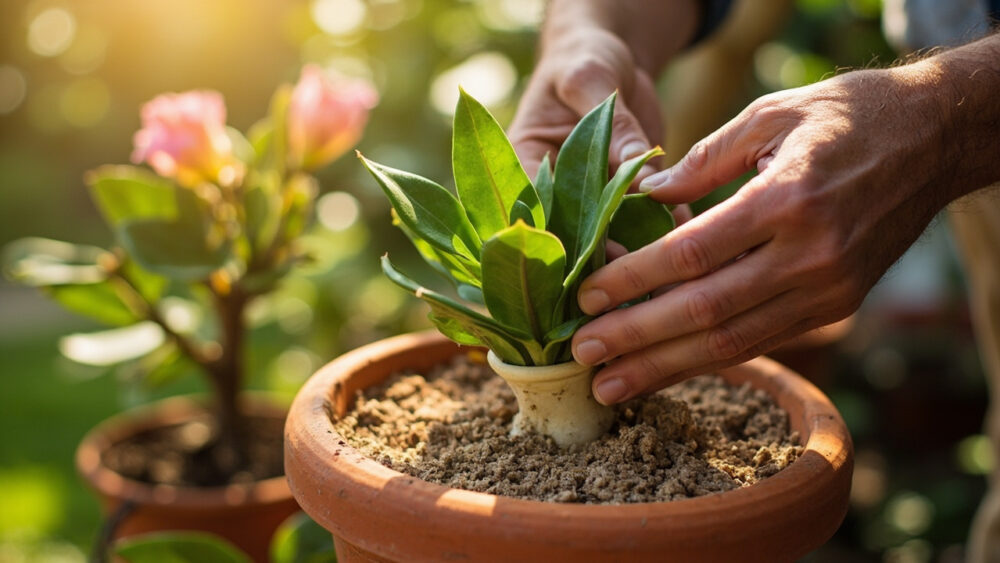
Insert the callused end just an inch or two into the mix, enough to hold the cutting upright without staking it in deep. Deep planting invites rot in exactly the tissue you just spent a week protecting.
Water lightly once at planting, then hold off. The mix should feel barely damp, never wet, for the first several weeks.
Now comes the part where nothing seems to happen, and that is normal.
Timeline: What to Expect Week by Week
In weeks 1 and 2, expect no visible change at all, and do not go digging around to check for roots, since disturbing the cut end now can undo the callus.
By weeks 3 to 4, a healthy cutting often pushes a few small leaves at the tip even before roots have formed. This is the sign everyone misreads.
New leaves feel like proof of success, but a cutting can leaf out on stored energy alone and still have zero roots underneath. Do not take leaf growth as your cue to pot up or increase watering yet.
The real test comes around week 5 to 8: a gentle, light tug at the base. Real resistance means roots have taken hold. If it lifts freely, leave it be and check again in another week or two rather than replanting it deeper out of impatience.
Warmth speeds all of this along, and cool conditions can stall a cutting for months without killing it.
When and How to Pot Up or Plant Out
Once you feel real root resistance and see steady new leaf growth, the cutting is ready to move into its own pot, typically 6 to 10 weeks after you first set it in the rooting mix, faster in consistent warmth above 75°F, slower below that.
Choose a shallow, wide pot over a deep one. Desert rose roots and caudex both develop better with room to spread sideways than with room to go down.
Use the same fast-draining cactus mix for the permanent pot, and resist the urge to size up dramatically. A pot only slightly larger than the root mass keeps the soil from staying wet longer than the roots can use.
Desert rose is not frost-hardy and will not tolerate a garden bed outdoors except in USDA zones 10 to 12; everywhere else it lives as a container plant that summers outside and comes in well before nighttime temperatures drop into the 40s.
Getting the pot right matters, but most failed propagations never even make it this far.
Why Most Attempts Fail, and the Honest Fix
The number one killer is rot from skipping or rushing the callus period. A cutting that goes into soil while the cut is still wet almost always blackens and softens within a couple of weeks.
The second most common mistake is overwatering out of anxiety once a cutting has been sitting untouched for weeks. Desert rose cuttings root better in mix that stays on the dry side of damp, not evenly moist like most houseplant advice assumes.
If your cutting looks fine on the outside but shows no roots after a month, the honest answer is usually temperature, not technique. Desert rose roots slowly, or not at all, below about 65°F, and a cutting sitting on a cool windowsill can simply stall rather than fail.
Move stalled cuttings somewhere warmer, ideally with bottom heat in the 75 to 85°F range, before assuming the attempt is dead.
All of that comes down to a short list of numbers worth keeping on hand.
Desert Rose at a Glance
- Best time to propagate: late spring through summer, when temperatures stay reliably above 70°F.
- Cutting length: 6 to 10 inches of semi-firm stem, cut with a clean, sharp blade.
- Callus time before planting: 3 to 7 days in a warm, dry, shaded spot until the cut end seals over.
- Rooting mix: roughly half cactus or succulent potting mix, half perlite or coarse sand.
- Planting depth: 1 to 2 inches into the mix, upright and unstaked.
- Time to root: 5 to 8 weeks on average, faster above 75°F, much slower below 65°F.
- Watering during rooting: keep barely damp, never wet, and check roots by feel, not by digging.
Get the callus right and keep it warm and dry, and the rest of this mostly takes care of itself.
Patience is the actual technique here, not any special product or trick.