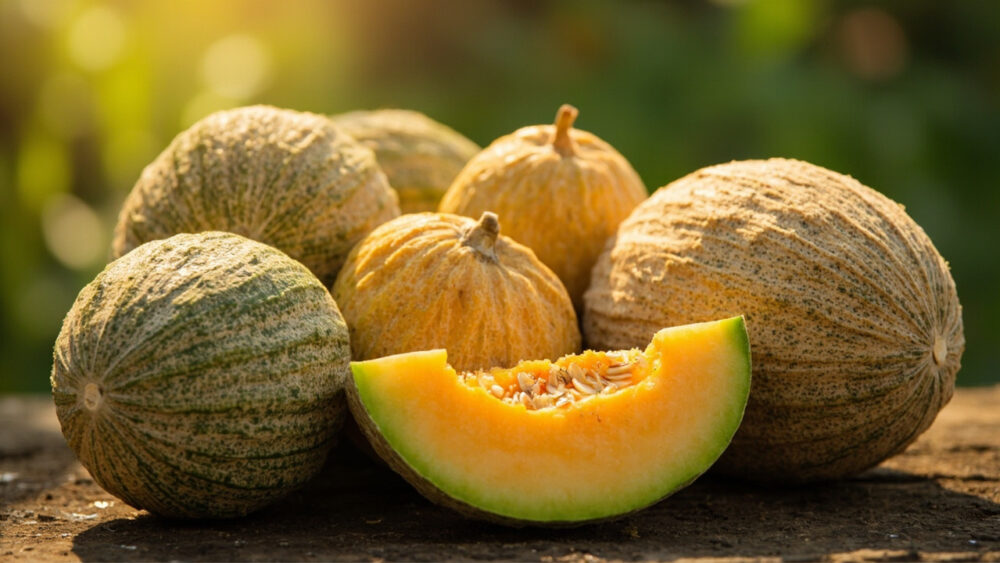
Here is the fact that sorts these fastest: cantaloupe splits into two families that barely taste alike, true muskmelons with netted rinds and soft orange flesh, and the smoother, denser Charentais-type melons that dominate French markets. Almost everything sold as “cantaloupe” in an American grocery store is the first kind. Most of the interesting types of cantaloupe a home gardener can actually grow are the second, and they taste like a different fruit entirely.
Most people pick a cantaloupe variety for the wrong reason: they want the biggest melon on the vine. Size and flavor are barely related in this crop, and some of the smallest melons on this list will out-sweeten anything the size of a basketball. There is also a sign almost everyone misreads at harvest time, and it has nothing to do with color.
Fifteen varieties are below, grouped by type, and number 13 is the one gardeners consistently get wrong at harvest because they trust their eyes over their nose. The last few entries and the actual method for choosing between all of them, based on space, climate, and how much fuss you want to put up with, are waiting at the bottom.
Classic American Muskmelons
These are the netted, salmon-fleshed melons most people picture when they hear the word cantaloupe.
1. Hale’s Best Jumbo
The standard against which most others get judged. It produces 4 to 5 pound oval melons with dense orange flesh and a heavy aroma, ready in 80 to 90 days, and it is forgiving enough for a first-time melon grower in almost any warm zone.
2. Ambrosia
Bred specifically to be sweeter than average, and it delivers, often testing several points higher in sugar than older heirlooms. The vines are vigorous and want real space, 4 to 6 feet between plants, and the fruit tends to slip clean off the vine at ripeness rather than needing to be cut.
3. Athena
The commercial workhorse you have almost certainly eaten without knowing its name. It is bred for a firm rind that ships and stores well, which makes it slightly less perfumed than a backyard-only variety, but it is reliable, disease resistant, and matures in about 75 to 80 days.
4. Iroquois
An older public variety that still holds up against modern hybrids, with thick orange flesh and good resistance to fusarium wilt, a soil disease that ends a lot of melon patches early. It runs 80 to 85 days and suits gardeners in the humid Midwest and Northeast where disease pressure is higher.
5. Rocky Ford
A name tied to a specific growing region in Colorado more than a single fixed variety, but seed sold under this name usually produces small, intensely sweet, heavily netted melons around 3 to 4 pounds. It needs a long hot season, 85 to 90 days, and rewards gardeners in dry climates with low humidity.
If you assumed bigger cantaloupe meant more flavor, the smaller melons on the next list will change your mind.
Charentais and French-Type Melons
Smooth gray-green skin, no netting, and flesh that is noticeably more floral than a standard muskmelon.
6. Charentais
The benchmark French melon, small at 2 to 3 pounds, with pale smooth rind faintly striped in green and flesh so aromatic you can smell a ripe one from a foot away. It is not a good shipper and bruises easily, which is exactly why you rarely see it in stores and why growing your own is the only reliable way to taste one at its peak.
7. Savor
A slightly hardier, more disease-resistant Charentais type bred for home gardens and small farms outside France’s ideal climate. It keeps the same dense, sweet, almost tropical flesh but tolerates cooler nights better than the classic strain.
8. Petit Gris de Rennes
An heirloom with rough, warty gray-green skin that looks unpromising right up until you cut it open onto deep orange, intensely sweet flesh. The vines are less vigorous than modern hybrids and yield fewer fruit per plant, so give it your best sun and richest soil rather than treating it as a filler crop.
9. Alvaro
A modern French hybrid built for earlier ripening, useful in shorter-season gardens that struggle to finish a full Charentais crop before fall. Expect 2 to 3 pound melons in roughly 75 days, faster than most others in this group.
These French types are demanding about heat, but the next group asks for almost nothing at all.
Compact and Container Types
Bred for small gardens, patios, and vertical growing rather than sprawling field rows.
10. Minnesota Midget
The go-to variety for gardeners without much space, with vines that stay under 3 to 4 feet and can be trained up a trellis. The melons themselves are small, 3 to 4 inches across, but the flavor punches well above what the size suggests, and it matures fast at around 70 to 75 days.
11. Tasty Bites
A single-serving hybrid that produces personal-sized melons around 2 pounds, bred for uniform sweetness and a compact vine that suits raised beds. It is a solid pick for a family that wants one melon per person instead of one giant melon to split.
12. Sarah’s Choice
An early, disease-resistant hybrid developed for shorter growing seasons and smaller garden footprints. It holds its sugar well even when the weather turns cool late in the season, which makes it a safer bet in zone 5 and cooler gardens than most Charentais types.
Space is rarely the real obstacle with cantaloupe, and the next entry explains why so many gardeners pick perfectly ripe-looking melons that turn out bland.
Specialty and Novelty Melons
These break the usual rules on color, size, or how you judge ripeness at all.
13. Galia
A cross between cantaloupe and honeydew that confuses almost everyone at harvest, because its rind turns yellow-green and netted while the flesh underneath is pale green, not orange. Gardeners who go by color alone pick it too early or let it overripen on the vine; the real test is smell, since a ripe Galia gives off a strong sweet aroma at the stem end days before the skin looks fully changed. It needs a long warm season, 80 to 90 days, and rewards patience over guesswork.
14. Golden Jenny
A compact hybrid with distinctly golden-yellow rind at full ripeness, unusual among muskmelon types, paired with sweet orange flesh on a manageable 3 to 4 foot vine. It is a good choice for gardeners who want an easy visual ripeness cue instead of relying on smell or a gentle tug at the vine.
15. Santa Claus (Christmas Melon)
A late-season oddity with mottled green and yellow rind that resembles a small striped watermelon more than a cantaloupe. Flesh is pale green and mild, less sweet than a Charentais but famous for keeping a month or more in storage, which suits gardeners who want melon on hand well past the main harvest window.
How to Choose the Right One
Match the melon to your actual growing conditions before you fall for a flavor description.
- Check your space: sprawling vines like Ambrosia and Rocky Ford need 4 to 6 feet per plant, while Minnesota Midget and Tasty Bites work in raised beds or large containers.
- Check your season length: French Charentais types generally want 85 days or more of real heat; Sarah’s Choice, Alvaro, and Minnesota Midget finish in 70 to 80 days for shorter or cooler seasons.
- Decide what you actually want from it: intense perfume and rich flesh point toward Charentais types, storage life points toward Santa Claus, and reliable shipping-grade flavor points toward Athena or Hale’s Best.
- Be honest about your care appetite: disease-resistant types like Iroquois and Sarah’s Choice tolerate a humid, imperfect season better than delicate heirlooms like Petit Gris de Rennes.
- Learn the ripeness cue for your type before harvest: netted muskmelons slip from the vine with light pressure, while smooth-skinned types like Galia and Charentais tell you through smell, not touch.
Pick based on what your season and your space can actually support, and the sweetness takes care of itself.
Grow one from each family this year and you will never look at a grocery store cantaloupe the same way again.