You grow an avocado tree from seed by suspending or planting a cleaned pit in warm, moist conditions until it sprouts, usually 2 to 8 weeks, then potting the seedling up and growing it indoors as a houseplant for years before it ever has a shot at fruiting. That is the honest, full answer to how to grow avocado tree from seed. What the ad didn’t tell you is that most seed-grown avocados never fruit at all, and the ones that do can take 5 to 15 years to get there.
That’s not a reason to skip it. It’s a reason to know what you’re actually signing up for before you skewer a pit with toothpicks.
The one mistake that kills most attempts happens before germination even starts, and it’s not what you’d guess. There’s also a sign at week three that panics almost everyone into pulling their seed out of the water, and a straight answer about whether that grocery-store pit will ever give you actual avocados. All of it, plus the save-able Avocado Tree From Seed at a Glance card, is waiting at the bottom. Keep scrolling.
When to Start an Avocado Seed
Avocado seeds don’t care about frost dates the way tomatoes or peppers do, because this is an indoor project from day one. Start any time of year, but late winter to early spring gives a seedling a full season of strong light before its first winter indoors, which matters more than you’d think for a tropical plant stuck on a windowsill.
There’s no direct-sowing option here outside USDA zones 9 through 11, and even there, a seed started indoors and transplanted out once it’s a foot tall does better than one planted straight in cold spring soil.
Get the timing right and you’re still not out of the woods, because how you prep the pit decides everything.
Sowing an Avocado Pit Step by Step
The mistake almost everyone makes happens right here: they rinse the pit, maybe scrub it a little, and stick it in water still wearing its brown papery skin. That skin can slow water absorption and rot before it sprouts. Peeling it off, at least partially, speeds germination noticeably.
Steps
- Clean the pit: wash off all fruit flesh, then peel away the thin brown skin without gouging the seed underneath.
- Find the ends: the flatter, slightly wider end is the bottom where roots emerge, the more pointed end is the top where the stem grows.
- Suspend or bury: either push three or four toothpicks into the middle of the seed and rest it on a glass of water with the bottom third submerged, or plant it directly in a 4 to 6 inch pot of moist, well-draining potting mix with the top third exposed above the soil.
- Warmth matters: keep it around 70 to 80 F, near a warm windowsill or on top of a refrigerator works.
- Light: bright indirect light is enough at this stage, direct hot sun through glass can overheat water in a jar.
- Water: change water every 3 to 5 days if suspending, or keep soil evenly moist, never soggy, if potting direct.
Both methods work about equally well, the water method just lets you watch the whole show.
Germination: What’s Normal and What’s a Warning Sign
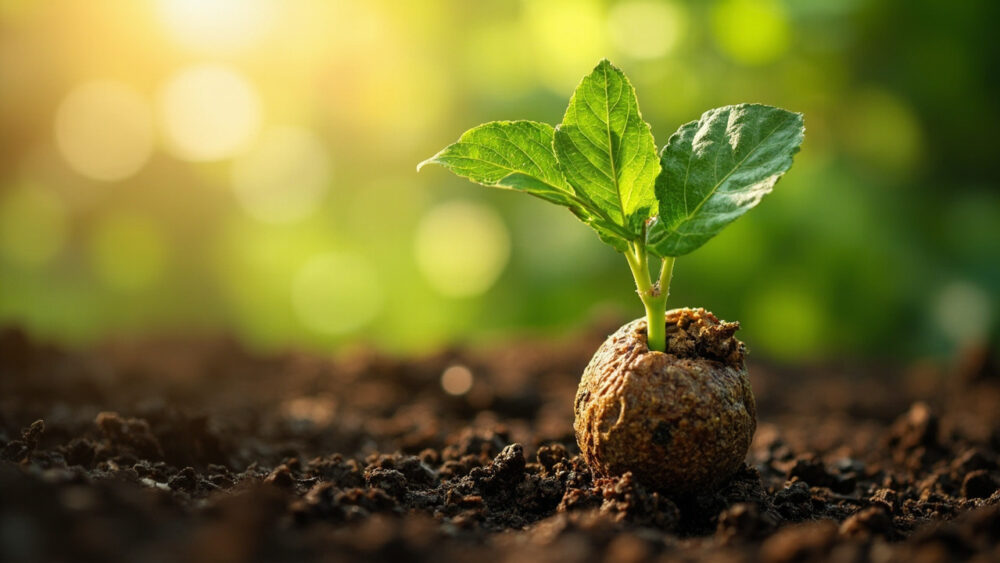
Here’s the sign that panics people around week two or three: the seed splits down the middle with a visible crack. That looks like damage. It’s actually the seed doing exactly what it’s supposed to do, cracking open to let a taproot push out the bottom.
If you assumed a cracked seed means it’s dying, that guess sends more good pits into the trash than actual rot does. Rot looks different: soft, mushy, discolored flesh with a genuinely bad smell, often with the whole seed collapsing rather than splitting cleanly.
Expect a taproot within 2 to 6 weeks, and a stem with the first leaves another 2 to 4 weeks after that. Total time to a real seedling runs 4 to 10 weeks depending on warmth.
Worry if nothing happens after 8 weeks with no crack, no root, and no softening, or if the seed smells off and feels slimy, that one’s done.
Once the stem is 6 to 7 inches tall, it’s time to think about soil.
Transplanting the Seedling
If you started in water, pot up once the stem hits 6 to 7 inches tall, and cut it back to about 3 inches first, which sounds brutal but forces a stronger, bushier plant instead of one tall spindly stalk.
Use a pot with drainage holes, 8 to 10 inches across, filled with a well-draining mix, a standard potting soil cut with perlite or coarse sand works fine. Plant with the top half of the seed still exposed above the soil line, root and stem fully buried.
There’s no real hardening off in the outdoor-garden sense unless you plan to move the pot outside for summer. If you do, transition it over 7 to 10 days, a few hours of outdoor shade the first days, building up to more sun, to avoid scorched leaves.
Skip that transition and a plant that looked perfectly healthy indoors can drop half its leaves in a week.
Caring for an Avocado Tree Through the Season
This is a plant that wants bright light, more than most windowsills give it. Six or more hours of direct or very bright light daily keeps growth compact instead of leggy and pale.
Water when the top 1 to 2 inches of soil feel dry, and let excess drain fully, avocados hate sitting in wet soil far more than they mind missing a watering. Yellowing lower leaves with soggy soil almost always means overwatering, not a nutrient problem.
Feed lightly with a balanced fertilizer during active spring and summer growth, skip it in winter when growth slows.
Pinch the growing tip once the plant reaches 12 inches, and again every time it puts on another 6 to 8 inches, this is what actually builds a full, branching tree instead of one bare stick with leaves on top.
Indoors, avocados tolerate normal room temperatures but sulk below 50 F and hate cold drafts near doors and windows.
All of that keeps the plant alive and growing, but the fruit question is a separate, harder conversation.
Will It Ever Actually Fruit?
Here’s the honest answer to the question you’re already forming: a seed grown from a grocery-store avocado can absolutely flower and fruit, but it usually takes 5 to 15 years, needs to reach a substantial size, often 6 to 10 feet or more, and frequently needs a second, genetically different avocado tree nearby for pollination.
Grafted nursery trees skip most of that wait and fruit in 3 to 5 years because they’re cuttings from mature, already-fruiting trees, not seedlings starting from zero. That’s the trade you’re making by growing from seed: it’s cheap, it’s satisfying, and it is genuinely a long game.
Outdoors, avocados only survive winters in USDA zones 9 through 11; everywhere else, this stays a container plant that summers outside and winters in.
None of that makes it not worth doing, it just means you’re growing a houseplant with a very long-term bonus, not a fruit tree on a schedule.
Avocado Tree From Seed at a Glance
- When to start: any time indoors, late winter to early spring gives the strongest first-year growth.
- Depth or placement: top third of the pit exposed above water or soil, root end down.
- Temperature: 70 to 80 F for fastest, most reliable germination.
- Germination time: 4 to 10 weeks from prep to a true seedling with leaves.
- Light needs: bright indirect light while sprouting, 6 or more hours of bright or direct light once potted.
- Watering: let the top 1 to 2 inches of soil dry between waterings, always allow drainage.
- Time to fruit: 5 to 15 years from seed, often needs a second tree nearby, only survives outdoors in USDA zones 9 through 11.
Grow this one for the plant, not the harvest date, and you’ll never be disappointed by it.
If fruit is the real goal, a grafted tree from a nursery gets you there years faster.