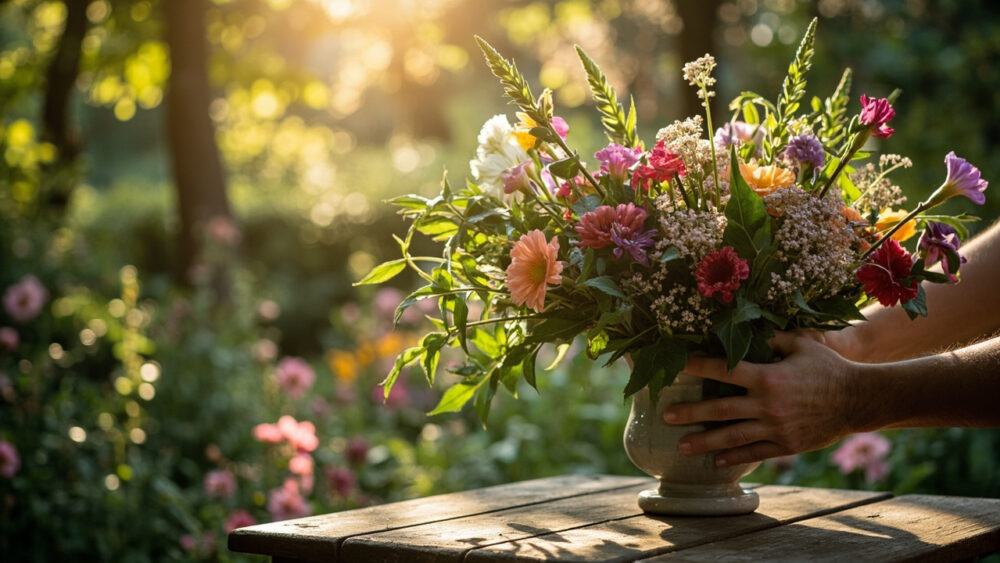
The fastest way to arrange flowers that actually look professional is to build in odd-numbered groups, work with three heights (tall, medium, filler) instead of one, and cut every stem at an angle underwater right before it goes in the vase. Get the ratio of stems to vase size right and the rest mostly falls into place. Most kitchen-table arrangements go wrong before a single flower is cut.
There is one sizing mistake that ruins the shape of almost every first attempt, and it has nothing to do with which flowers you picked. There is also a step with the scissors that people skip constantly, and it is the difference between flowers that last four days and flowers that last ten. And if you are wondering whether you need floral foam or a fancy frog to make this work, the honest answer surprises most beginners.
Stick around for the Arrange Flowers at a Glance card at the bottom. It is the short version worth saving to your phone before you touch a single stem.
Pick Your Vase Before You Pick Your Flowers
Choose the container first, not last. The vase dictates how many stems you need, how long to cut them, and what shape is even possible.
A good rule of thumb: your tallest flowers should stand about one and a half times the height of the vase. Shorter than that and the arrangement looks squat. Taller and it gets top-heavy and tips over.
Mouth width matters more than most people think. A narrow-necked vase holds stems in place for you, which is forgiving for beginners. A wide bowl or cylinder gives you no structural help at all, and that is where arrangements fall apart.
If you already grabbed flowers before thinking about the vase, that is fine, just work backward from here.
Now here is the sizing mistake that wrecks most arrangements before they even start.
The Mistake That Ruins Most Arrangements: Too Few Stems, Not Bad Flowers
If you assumed a sad-looking bouquet means you bought the wrong flowers, that guess is wrong almost every time. The real problem is usually volume. People buy one bunch of ten stems for a vase that needs twenty five to thirty to look full.
A good starting number is roughly three stems per inch of vase diameter. A vase with a four-inch mouth wants twelve to fifteen stems minimum before it reads as “arranged” instead of “a few flowers someone stuck in water.”
Mixing cheap filler flowers like statice, waxflower, or baby’s breath with a smaller number of focal flowers gets you there without spending on twenty roses.
Once you have volume sorted, the next question is how to actually place everything.
Work in Layers: Structure, Focal, Filler
Professional florists build arrangements in three passes, not one. Trying to place every stem perfectly on the first try is why home arrangements look flat.
Pass one: greenery and structure
Set the outer shape first with foliage or branch material. This defines the silhouette and gives later stems something to lean against.
Pass two: focal flowers
Place your biggest, showiest blooms (roses, dahlias, peonies, ranunculus) in a loose triangle or in odd-numbered clusters of three or five. Odd numbers avoid the stiff, symmetrical look even numbers tend to create.
Pass three: filler
Tuck smaller stems into the gaps last. This is what hides mechanics and stem crossings, and it is also the step most beginners rush or skip.
None of this holds together, though, if the stems underneath are not prepped right.
The Cutting Step Almost Everyone Skips
Here is the ten-second habit that adds days of vase life: cut every stem at a 45 degree angle, underwater, right before placing it. Cutting on a dry counter lets air into the stem, which forms a bubble that blocks water uptake almost immediately.
Recut stems even if they came pre-trimmed from the store. That old cut has likely already sealed itself shut in transit.
Strip any leaves that would sit below the waterline. Submerged foliage rots fast and clouds the water within a day or two, which feeds bacteria and shortens the life of every stem sharing that vase.
Change the water every two to three days, recutting stems each time you do. This single habit outperforms almost any flower food packet.
Speaking of which, that packet is not optional if you want the display to last.
Do You Actually Need Floral Foam?
No, and for most home arrangements skip it. Floral foam holds shapes rigidly, but it is genuinely bad for the environment, it does not biodegrade, and most kitchen or table arrangements do not need that level of structural control.
A simpler trick does the same job: crisscross clear tape across the vase opening in a grid, or ball up chicken wire and stuff it inside a wide vase. Both give stems something to grip without the foam.
For a narrow-mouth vase, you often need nothing at all. The neck itself holds stems upright.
Foam has its place in dense floral foam wreaths or structured event work, but that is a different job than the vase on your counter.
Once the stems are anchored, color and shape decisions are what separate “nice” from “wow.”
Color and Shape Choices That Actually Read as Intentional
Pick one dominant color, one secondary color, and one accent, roughly in a 60-30-10 split. Random equal amounts of five colors is what makes bouquets look chaotic rather than curated.
Vary flower shapes, not just colors. Combine a round shape (rose, dahlia, peony), a spike shape (snapdragon, delphinium, larkspur), and a airy filler shape (baby’s breath, gypsophila, wax-flower) and you get depth even in a single color palette.
Keep the tallest stems toward the back or center and let stems angle slightly outward as you work toward the edges. Rigid, straight-up stems look like a florist’s cooler display, not a hand-arranged bouquet.
Turn the vase as you work, not just at the end, so you catch the lopsided side before it’s finished.
Getting the shape right matters less than keeping it alive, so here is what actually extends vase life.
What Actually Makes Flowers Last Longer
Cool water, out of direct sun, away from heating vents and fruit bowls. Ripening fruit releases ethylene gas, which speeds up flower aging significantly.
Flower food packets work and are worth using; they balance sugar (food for the bloom), acidifier (adjusts water pH), and a mild biocide (slows bacterial growth). A DIY mix of a teaspoon of sugar, a few drops of bleach, and a splash of lemon juice per quart does a reasonable job if you have no packet on hand.
Pull any stem the moment it wilts or the water turns cloudy around it. One rotting stem speeds up decline for everything sharing that water.
Most cut arrangements hold for five to twelve days depending on flower type; tulips and ranunculus fade fastest, chrysanthemums and alstroemeria last longest.
If you’re arranging flowers you cut yourself from the garden, timing the cut matters just as much as anything you do afterward.
If You’re Cutting From Your Own Garden
Cut in the early morning or evening, never in the heat of midday when stems are already stressed for water. Choose stems where the bud is just starting to open rather than fully blown. They will open the rest of the way in the vase and last considerably longer.
Bring a bucket of water out with you and plunge stems in immediately rather than letting them sit dry in a basket.
Woody stems (hydrangea, lilac, roses) benefit from a second vertical slit up the cut end, about half an inch, which helps water uptake beyond what the angled cut alone provides.
Everything above comes together in the short version below.
Arrange Flowers at a Glance
- Vase size rule: tallest stems about one and a half times the vase height, roughly three stems per inch of vase mouth diameter.
- Stem count: when in doubt, buy more filler flowers rather than more focal flowers to hit full volume affordably.
- Cutting: recut every stem at a 45 degree angle underwater, even store-bought stems that arrived pre-trimmed.
- Structure: build in three passes, greenery first, focal flowers in odd-numbered clusters second, filler last.
- Color ratio: one dominant color, one secondary, one accent, roughly 60-30-10.
- Water care: change water every two to three days, recut stems each change, keep out of direct sun and away from fruit bowls.
- Foam: skip it for most home arrangements, tape grids or balled chicken wire anchor stems just as well.
Get the volume and the underwater cut right and almost everything else forgives itself.
Those two habits alone separate a bouquet that looks arranged from one that just looks purchased.