The best indoor plants for low light are the ones that evolved on a forest floor, not a windowsill: pothos, snake plant, ZZ plant, cast iron plant, and peace lily all thrive in a spot that gets no direct sun and still looks green in a room lit mostly by a lamp. These plants tolerate low light, they do not necessarily love total darkness, and that difference is where most people go wrong. If your room has no window at all, you still have options, but they come with an honest asterisk.
Here is what nobody tells you before you buy: the plant that dies in a dim corner almost never dies from lack of light directly. It dies because you kept watering it on the same schedule as a plant getting bright light, and low light slows everything down, including how fast roots drink.
There is also a sign everyone misreads. A plant stretching toward the window with long gaps between leaves looks like it is growing, but it is actually starving for light and about to get worse, not adjusting fine. Stick with this and by the bottom you will have a saveable card ranking the best low light plants by exactly how little light they can stand.
What “Low Light” Actually Means Indoors
Low light is not “no light.” It means no direct sun hits the leaves, but the room is bright enough to read a book comfortably during the day without turning on a lamp. Think a few feet back from a north-facing window, or a spot that gets bright light for an hour or two and shade the rest of the day.
True darkness, a windowless bathroom or an interior hallway, will not sustain any plant long term without supplemental grow lights. No plant on this list photosynthesizes off ambient room lighting alone forever.
If you’re not sure your spot qualifies, there’s a simple test for that.
The Shadow Test, and Why It Beats Guessing
Hold your hand about a foot off a piece of white paper at the spot where the plant will live, in the middle of the day. A sharp, dark shadow means you actually have medium or bright indirect light, not low light, and you have more options than this article covers. A faint, fuzzy shadow means true low light, the zone this guide is built for. No shadow at all means you’re in the too-dark category and need to plan around it.
This thirty-second test saves more plants than any fertilizer or moisture meter you could buy.
The Mistake That Kills Most Low-Light Plants
If you assumed the plant died from too little light, that guess kills more houseplants than darkness ever does. Overwatering is the real culprit almost every time. Low light means slower growth, slower growth means the roots pull up less water, and soil that would dry out in five days under a bright window can stay wet for two weeks in a dim corner.
Root rot from soggy, low-oxygen soil is what actually kills these plants, not the dim room itself. The fix is not a different plant, it’s a different finger test: push your finger two inches into the soil, and if it’s still damp, wait. Water on a schedule and you’re gambling; water on feel and you’re not.
Get the watering right and the light problem mostly takes care of itself.
The Stretching You Mistake for Growth
This is the sign everyone misreads. New leaves growing far apart on a long, thin stem, called etiolation, means the plant is stretching toward whatever light it can find because it isn’t getting enough. It is not thriving, it is coping, and coping has a limit.
Pale new leaves, leggy stems, and a plant that leans hard toward the window are all the same complaint. The honest fix is usually moving the plant a few feet closer to the light source, or accepting slower, sparser growth as the tradeoff for that spot. No fertilizer schedule fixes a light problem.
Which brings up the plant everyone assumes belongs on this list and mostly doesn’t.
Snake Plant, Pothos, and the Ones That Actually Deliver
Snake Plant (Sansevieria)
Snake plant tolerates the dimmest rooms on this list and forgives forgetting to water it for three or four weeks. Growth slows to a crawl in low light, but it won’t decline the way a peace lily will.
Pothos
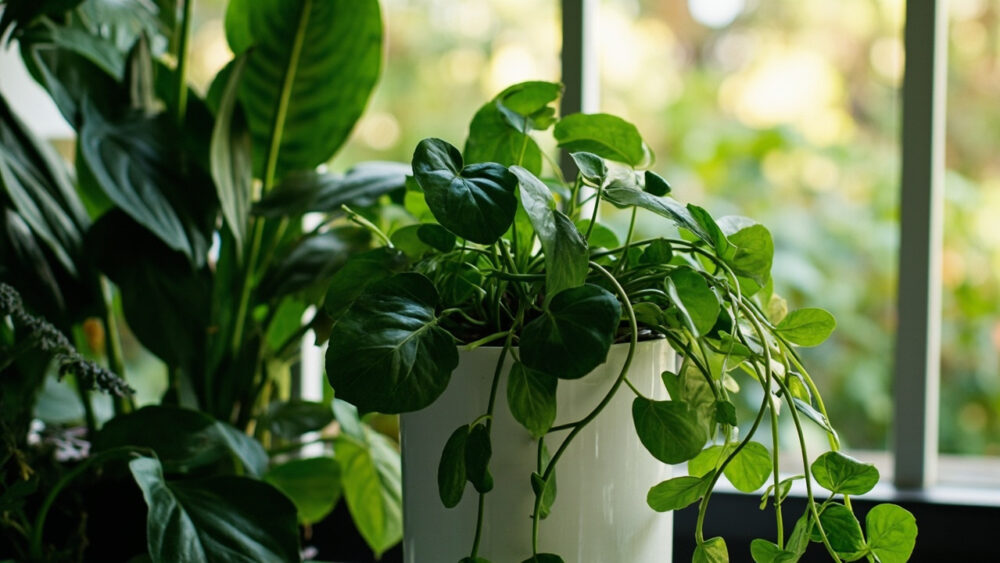
Pothos keeps its variegation and vining habit in medium light, but in true low light the leaves often go mostly green and growth slows. It still survives happily and trails beautifully off a shelf.
ZZ Plant (Zamioculcas)
Glossy, upright, and nearly indestructible in low light, ZZ plant grows from a rhizome that stores water, which is exactly why overwatering is the only real threat to it.
Cast Iron Plant (Aspidistra)
Genuinely built for shade, tolerating darker corners than pothos or peace lily without complaint, just slow and steady.
Peace Lily
The one exception that flowers in low light, though sparingly, and it dramatically droops when thirsty, which makes it the easiest plant on this list to read.
Every one of these has a limit, and the next section is about what happens when you cross it.
The Room That’s Simply Too Dark
Here is the honest answer to the question you were about to ask next: if your room has zero natural light, no plant will survive there indefinitely, full stop. Not snake plant, not ZZ plant, nothing photosynthesizes on lamp light alone unless that lamp is a proper grow light.
A basic full-spectrum grow light on a timer for 10 to 12 hours a day genuinely solves this, and it’s not expensive theater, it’s the actual fix for interior offices, basements, and windowless bathrooms.
Artificial light is not cheating, it is the difference between a plant that survives and one that slowly starves no matter how carefully you water it.
Assuming you do have some window light, here’s how to keep these plants alive for years, not months.
Feeding, Repotting, and Dust: The Slow-Growth Rules
Low-light plants grow slowly, so they need far less fertilizer than a bright-light plant of the same size. Feed at half strength, once a month during spring and summer, and skip it entirely in fall and winter.
Repot only every 2 to 3 years, since slow growth means slow root fill. And wipe the leaves with a damp cloth every month or so; dust blocks the little light these plants are already working hard to catch.
One more habit matters more than any of these, and it’s the one people skip.
Rotate the Pot or Watch It Lean
Every plant leans toward its light source over time, but in low light the effect is exaggerated because the plant is working harder for every photon. A quarter turn every couple of weeks keeps growth even on all sides instead of lopsided and reaching.
Skip this for six months and you’ll have a plant that looks fine from one angle and bare from the other.
With all that groundwork laid, here’s the card worth saving.
Best Indoor Plants for Low Light at a Glance
- Most light-tolerant, darkest spots: snake plant and ZZ plant handle the dimmest rooms and the most forgetting.
- Best for flowers in low light: peace lily, though blooms are fewer and smaller than in bright light.
- Best trailing or shelf plant: pothos, expect mostly green leaves instead of strong variegation.
- Best slow-and-steady classic: cast iron plant, built for shade, essentially unkillable once settled.
- Watering rule: check two inches down with a finger, water only when that’s dry, never on a fixed schedule.
- Feeding rule: half-strength fertilizer once a month in spring and summer only, none in fall or winter.
- When it’s too dark for any plant: no natural shadow test result on white paper means you need a grow light on a 10 to 12 hour timer.
Get the watering right and pick a plant that matches your actual light, not your hopeful guess. That’s the whole game, and it’s the part most people skip before they even bring the plant home.