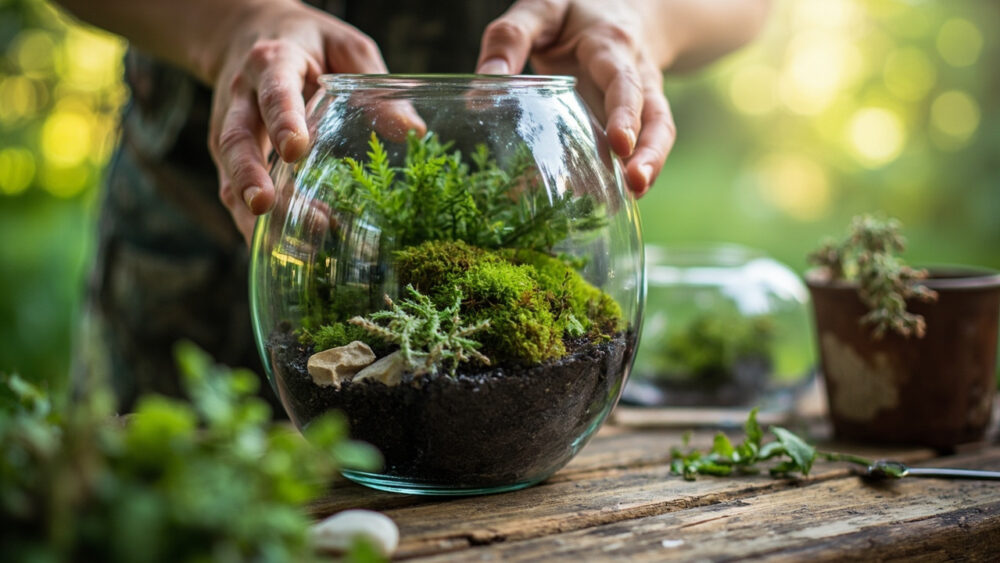
A good terrarium comes down to five layers done in order: drainage material, a charcoal or gravel barrier, potting mix, plants, and a topper, built inside any clear glass or plastic container with a lid or open top depending on what you’re growing. Get the layers and the watering right and it can run for years with almost no attention. How to make a terrarium is honestly less about the plants and more about managing water in a container that has nowhere for excess to go.
Here’s what trips people up almost every time: they treat it like potting a houseplant, dump in bagged soil, water it like normal, and watch it turn into a swamp within a month. There’s also a widely repeated rule about charcoal that half the people online get backwards, and a “closed versus open” decision that determines whether you’re growing ferns or succulents, not both.
I’ll walk through the build in the order you actually do it, cover which plants belong in which type, and flag the mistake that kills most terrariums before they hit the two-month mark. Save the Make a Terrarium at a Glance card at the bottom for the exact layer depths and watering schedule once yours is built.
Pick the Container First, Because It Decides Everything Else
Your container determines whether you’re building a closed, humid ecosystem or an open, dry one, and that choice comes before you pick a single plant. Closed containers with lids (jars, cloche domes, bottles) trap moisture and suit ferns, moss, mosses, pothos, fittonia, and other humidity-loving plants. Open containers (bowls, fishbowls, low glass boxes) let moisture escape and suit succulents, cacti, and air plants that rot in still, damp air.
Glass beats plastic for anything long-term because it doesn’t scratch, cloud, or off-gas, and clear glass lets you see the drainage layer to judge watering. Any size works, but under 6 inches across gets fussy to plant and maintain; a 10 to 12 inch vessel gives you room to actually arrange things.
Whatever you pick, it needs to be genuinely clean before soil goes in, since old residue breeds mold in a closed system fast.
The Drainage Layer: The Part That Actually Saves You
This is the fix for the swamp problem I mentioned above. Terrariums almost never have drainage holes, so excess water has nowhere to go unless you build a reservoir for it to sit in, away from the roots.
Add 1 to 2 inches of coarse material at the bottom, pea gravel, small lava rock, or clay pebbles all work. This is where water collects and slowly evaporates back up instead of pooling around roots and rotting them.
Bigger containers need proportionally more, up to 2.5 inches in anything over a foot tall. Skip this layer and no amount of careful watering will save you later.
Next comes the layer everyone argues about, and most people have the reasoning backwards.
Activated Charcoal: What It Actually Does (and Doesn’t)
If you assumed charcoal is mainly there to feed the plants or improve drainage, that’s the popular guess and it’s wrong. Its real job is filtering the water that sits in your drainage layer, absorbing the byproducts of decomposing organic matter so the terrarium doesn’t develop a sour, swampy smell.
Sprinkle a thin layer, about a quarter inchof activated charcoal (the horticultural kind, not briquettes) directly over the gravel. It’s most useful in closed terrariums where stagnant, humid air makes odor and mold more likely.
Open, dry setups can skip it without much consequence since airflow does some of that work for you.
With the base handled, the next decision is whether you even need a barrier layer above it.
The Barrier Layer: Skip It and Your Drainage Layer Fills With Mud
Without a barrier, potting mix washes down into your gravel over time, clogging the drainage layer until it stops working, usually within a few months of regular watering. A thin layer of sphagnum moss or landscape fabric between the charcoal and the soil stops this.
Press it in gently so it hugs the container’s shape with no big gaps. You don’t need much, just enough coverage that soil can’t sift through when you water.
This is a five-minute step that most rushed builds leave out entirely.
Now for the layer that actually feeds the plants.
Choosing and Adding the Soil
Generic bagged potting soil is too dense and water-retentive for most terrariums and is the second most common cause of rot after skipping drainage. Use a mix suited to what you’re growing: a well-draining succulent or cactus mix for open dry setups, and a light, peaty terrarium or African violet mix for closed humid ones with ferns and tropicals.
Add 2 to 3 inches of soil, more in larger containers, less in small jars where roots stay shallow. Don’t compact it hard, just settle it enough that plants have something to grip.
Leave the surface uneven on purpose; a flat, level layer looks unnatural once plants and decor go in.
Once soil’s down, the planting itself goes faster than most people expect.
Planting: Small, Slow-Growing, and Spaced for Years, Not Weeks
Pick plants that stay small at maturity, since a terrarium has no room for a plant that wants to be two feet tall. Good closed-terrarium choices include nerve plant (fittonia), moss, baby’s tears, small ferns like button fern, and creeping fig. Good open-terrarium choices include echeveria, haworthia, small cacti, and air plants that don’t need to be potted at all.
Space plants 1.5 to 3 inches apart depending on their mature spread, further apart than feels right on day one. Terrarium plants grow slowly but they do grow, and a densely packed jar looks great in month one and like a green fist by month six.
Dig a small hole with a spoon or chopstick, seat the roots, and firm soil around the base without burying the stem.
Getting the planting right doesn’t matter much if the watering that follows is wrong, and that’s where most terrariums actually fail.
Watering: The Single Mistake That Kills Most Terrariums
Here’s the honest answer to the question you’re about to ask next: how much water does this actually need. Far less than you think, and less than any houseplant you’ve grown in an open pot.
For a new closed terrarium, water lightly right after planting, just enough to dampen the soil evenly, then check the glass. Light, even condensation that clears by mid-morning is correct. Heavy, constant fog or streaming droplets means you’ve overwatered and need to remove the lid for a day or two to let it dry out.
Closed terrariums with the right cycle established can go 4 to 8 weeks between waterings, sometimes longer, because the water cycles inside the sealed environment instead of evaporating away. Open terrariums with succulents need water more like a normal potted plant, roughly every 1 to 2 weeksonly when the top inch of soil is fully dry.
Overwatering, not underwatering, is what ends most terrariums within the first couple of months, and it’s almost always because people water on a schedule instead of watching the glass.
Light: The Second-Biggest Killer, and It’s Not What You’d Guess
People assume more light is always safer, so they set a glass terrarium right on a sunny windowsill. That’s the second-fastest way to kill one.
Direct sun through glass acts like a magnifying lens and can cook plants alive inside a sealed container, sometimes within a single afternoon. Terrariums want bright, indirect lighta few feet back from a south or west window, or under grow lights for 8 to 10 hours a day if natural light is limited.
If leaves are bleaching pale or crisping at the edges, move it back from the window immediately. If growth is leggy and pale toward one side, it needs more light, just not direct sun.
Once light and water are dialed in, ongoing care is mostly about restraint.
Ongoing Care and the Maintenance Nobody Mentions
Wipe condensation off the inside glass occasionally so you can actually see your plants and check soil moisture. Trim anything that’s outgrowing its space before it crowds neighbors, since terrarium plants rarely recover well from being squeezed for months.
Pull yellowing leaves and any mold you spot immediately. In a closed system, decay spreads fast because airflow can’t dry things out on its own. Crack the lid for a few hours every couple of weeks on closed terrariums to refresh the air, even when everything looks fine.
Most terrariums fail from too much intervention early on, not too little, so once yours looks stable, leave it alone longer than instinct tells you to.
Make a Terrarium at a Glance
- Container choice: closed and lidded for ferns, moss and tropicals, open and shallow for succulents, cacti and air plants.
- Layer order: drainage gravel 1 to 2 inches, activated charcoal a quarter inch, barrier moss or fabric, potting soil 2 to 3 inches, then plants.
- Soil type: peaty terrarium mix for closed humid setups, gritty succulent or cactus mix for open dry setups.
- Plant spacing: 1.5 to 3 inches apart, sized for mature spread, not how it looks the day you plant.
- Watering: light misting to start, then every 4 to 8 weeks for closed terrariums, every 1 to 2 weeks for open ones, only when soil is dry on top.
- Light: bright, indirect light a few feet from a window, never direct sun through glass.
- Warning sign: heavy, constant fogging means overwatered, crack the lid and let it dry out for a day or two.
Get the drainage layer and the watering right and everything else is forgiving. Everything else is decoration on top of that one fact.