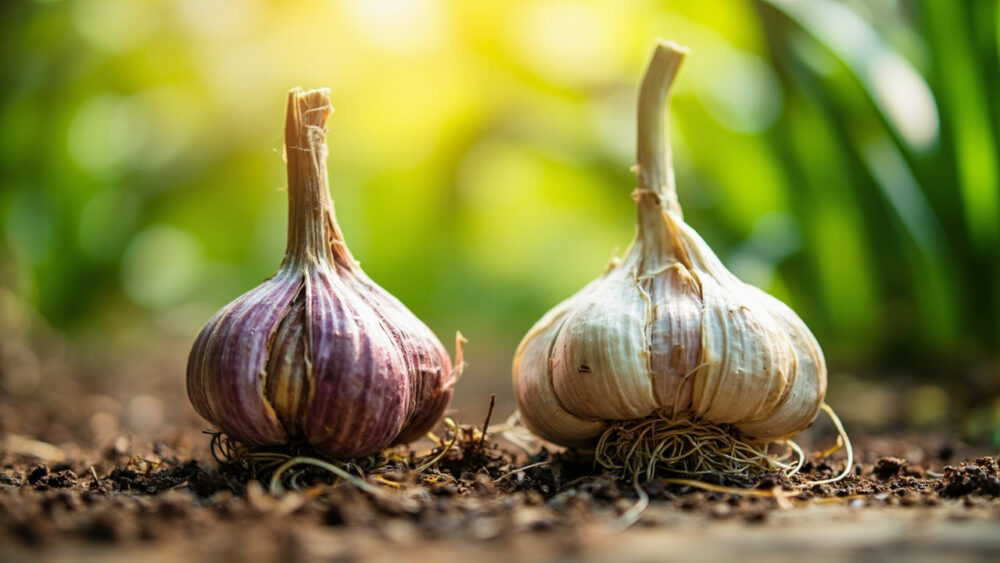
If you garden anywhere with real winters, plant hardneck. If you garden in a mild-winter climate or you cook the way most people actually cook, softneck usually serves you better. The hardneck vs softneck garlic decision comes down mostly to your climate and how you plan to store and use your harvest, not which one is “better” garlic, because that argument does not actually exist.
Here is what trips people up: the famous flavor difference gets oversold, and the thing that should decide it, cold exposure, barely gets mentioned in most nursery catalogs. There is also a storage number that surprises almost everyone the first time they grow hardneck and it rots by February. And there is a mixed-planting question that has a real, useful answer if you have room for both.
Stick around for the full breakdown, because the side-by-side card at the very bottom is the one worth screenshotting before you order bulbs.
The Key Differences
Growth Habit and the Scape
Hardneck garlic sends up a stiff central flower stalk, called a scape, that curls and eventually straightens if you let it go. Softneck never does this. That scape is not just a curiosity: it is edible, it is the thing chefs pay extra for at farmers markets in early summer, and cutting it off redirects the plant’s energy into a bigger bulb.
The scape is also your first real clue about which type you are already growing.
Climate and Cold Requirement
This is the one that actually decides it. Hardneck garlic wants a real winter chill, generally USDA zones 5 and colder, and performs best where the ground genuinely freezes. Softneck tolerates cold but does not need it, which is why it dominates commercial production in mild-winter regions.
Plant hardneck in a zone 8 or 9 climate and you will often get small, rough bulbs with poor clove differentiation.
Get the climate match wrong and nothing else on this list will save the harvest.
Clove Count and Peeling
Hardneck bulbs typically produce 4 to 12 large cloves arranged in a single ring around the stalk, each one easy to peel. Softneck bulbs pack in anywhere from 12 to 20+ smaller cloves in overlapping layers, which means more peeling time per bulb but more garlic per bulb overall.
If you cook in volume, that clove count matters more than any flavor debate.
Storage Life
Here is the number that surprises new growers: hardneck garlic stores for roughly 4 to 6 months under good conditions, while softneck routinely holds for 8 to 12 months, sometimes longer. That gap is the real reason softneck is what you see braided and sold in grocery stores.
If you assumed the tougher-looking neck meant tougher storage, that guess has it backwards.
That storage gap alone changes who each type is right for, which is the next question worth answering honestly.
Flavor and Heat
Hardneck varieties, especially Rocambole and Purple Stripe types, tend toward more complex, sometimes hotter flavor with more variation bulb to bulb. Softneck, including the common Silverskin and Artichoke types, runs milder and more consistent. Neither is objectively better; it is closer to the difference between a farmers-market heirloom tomato and a reliable grocery-store one.
Cost follows the same pattern: hardneck seed garlic usually costs more per pound than softneck, partly because it does not scale in warm climates the way softneck does.
Flavor is real but it is the smallest factor in this decision, and the next two sections show why.
When Hardneck Is the Right Call
Choose hardneck if you garden in zone 5 or colder and your ground freezes solid most winters. It is also the right call if you want scapes for cooking, you care more about flavor complexity than shelf life, and you are comfortable eating your way through the harvest within four to six months rather than stretching it to next spring.
Gardeners chasing specific heirloom flavor profiles, Rocambole’s rich taste or Porcelain’s big, easy-peel cloves, are also squarely in hardneck territory.
But climate that favors hardneck does not automatically rule out softneck, and here is where the usual advice sometimes flips.
When Softneck Garlic Is the Right Call
Choose softneck if you live in zone 7 or warmer with mild winters, since it tolerates that lack of deep chill far better than hardneck does. It is also the better pick for anyone who wants to braid garlic for storage or gifting, needs garlic to last through winter into the following summer, or just wants a forgiving, reliable crop without babysitting.
Cooks who go through a lot of garlic in everyday meals often prefer softneck’s higher clove count per bulb, even with the extra peeling.
None of this means you have to pick a permanent side, though.
Can You Grow or Use Both?
Yes, and plenty of experienced growers do. If your winters are cold enough for hardneck but not brutal, you can plant both types in the same bed with no conflict; they do not cross-pollinate in any way that affects this year’s bulbs, and garlic rarely sets true seed anyway.
In the kitchen, treat hardneck as your near-term, high-flavor garlic to use within a few months of harvest, and softneck as your pantry garlic for the long haul into late winter.
Growing both is less a compromise and more a genuinely good strategy if you have the row space.
The Verdict
If you had to walk away with one answer: match the garlic to your winter, not your taste preference, because taste differences are real but small while climate mismatch will flat-out fail the crop. Cold-winter gardeners should default to hardneck and accept the shorter storage window as the tradeoff for better scapes and bolder flavor. Mild-winter gardeners, or anyone who wants garlic that lasts until next year’s harvest comes in, should default to softneck without a second thought. Everyone with the space and a genuine cold winter should seriously consider growing a little of both.
Hardneck vs. Softneck Garlic at a Glance
- Climate: Hardneck needs a real winter chill and thrives in zone 5 and colder, Softneck Garlic tolerates mild winters and dominates in zone 7 and warmer.
- Growth habit: Hardneck sends up an edible flower scape, Softneck Garlic never produces a scape.
- Clove count: Hardneck yields 4 to 12 large, easy-peel cloves, Softneck Garlic packs in 12 to 20 or more smaller, layered cloves.
- Storage life: Hardneck keeps about 4 to 6 months, Softneck Garlic keeps 8 to 12 months or longer.
- Flavor: Hardneck offers bolder, more variable, sometimes hotter flavor, Softneck Garlic offers milder, more consistent flavor.
- Cost: Hardneck seed garlic generally costs more per pound, Softneck Garlic is usually cheaper and more widely available.
- Best use: Hardneck suits fresh eating, scapes, and near-term cooking, Softneck Garlic suits braiding, long storage, and everyday high-volume cooking.
Save that list before you order bulbs, because catalogs rarely lay it out this plainly.
Match it to your winter first and the rest of the decision makes itself.