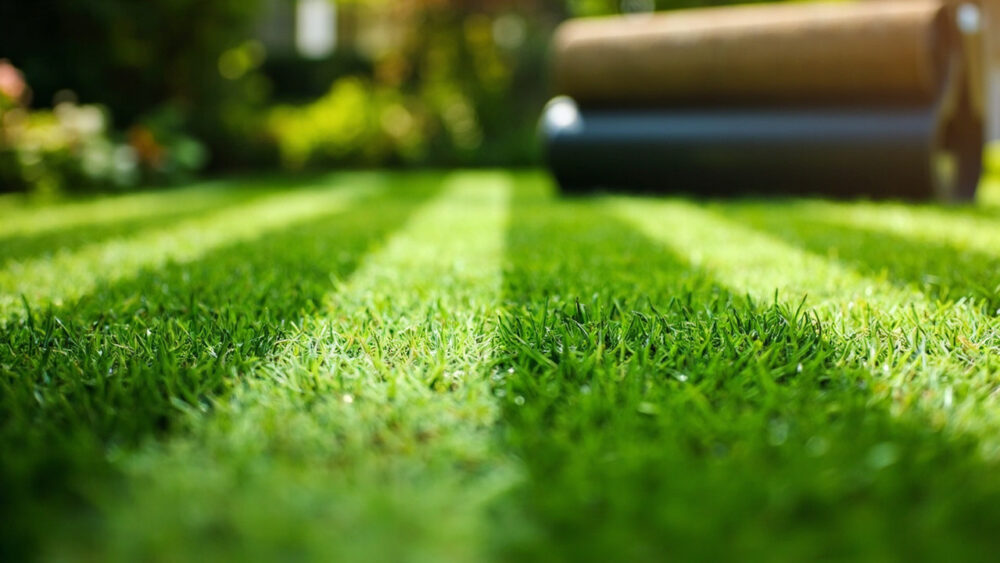
Lawn stripes come from bending grass blades in alternating directions so light hits them differently, not from mowing height, fertilizer, or some special grass variety. You do this with a striping roller or kit attached behind a mower, walking straight overlapping passes back and forth across the yard. That is the entire trick, and it works on almost any healthy lawn within one mowing session.
The part everyone gets wrong is assuming a striping kit alone makes clean lines. It does not, and your first attempt at how to stripe a lawn will look patchy if your passes wander or overlap wrong.
There is also a mistake that quietly ruins stripes for weeks after they look great: mowing too short, too often, in the same two directions. And there is a question you have not asked yet but will the moment your stripes fade after four days, which has an honest answer most guides skip. Stick around, because the save-able Lawn at a Glance card at the bottom has the mower settings and timing in one place.
What Actually Makes the Stripes
Grass blades are reflective on one side and duller on the other, depending on which way they lean. When you push a roller over the grass after cutting, it lays the blades down flat in the direction you walked.
Rows leaning toward you look dark. Rows leaning away look light. That is the whole optical effect, and it is temporary bending, not damage.
You do not need special grass. Cool season lawns like Kentucky bluegrass, tall fescue, and perennial ryegrass stripe beautifully because their blades are broad and stand upright. Bermuda and other fine, wiry warm season grasses will stripe too, just with a slightly less dramatic contrast.
Once you understand the mechanic, the equipment question answers itself.
The Equipment That Actually Matters
A dedicated striping kit, which is a roller that clips onto the back of a push mower or rides behind a riding mower, gives the cleanest lines. Some mowers ship with a rear roller built in for exactly this.
No kit? A push mower alone will still give faint stripes if you keep straight, disciplined lanes, because the deck and rear wheels lay some grass over. It just will not be as bold or long lasting as a rolled stripe.
Blade sharpness matters more than people think. A dull blade tears grass tips instead of slicing them, leaving a grayish, ragged look that undercuts even a perfect striping pattern. Sharpen or replace the blade every 20 to 25 hours of mowing.
Sharp blade, working roller or heavy rear deck, and you are ready for the pattern itself.
Step by Step: Laying Your First Stripes
Mow the lawn’s perimeter first, in a border loop around the whole area. This gives you a clean lane to turn around in later without scalping fresh stripes.
- Pick a straight reference line: a fence, driveway edge, or garden bed, and walk your first pass parallel to it.
- Overlap each return pass by about 2 to 3 inches over the previous wheel track so you do not leave an unstriped seam.
- Walk in straight, steady rows, turning around only in the perimeter border you already cut.
- Finish with a second perimeter pass to clean up the turns and tie the edges together visually.
Keep your eyes on a fixed point across the yard rather than the ground in front of the mower. That single habit fixes more wavy-line problems than any equipment upgrade.
Straight rows are only half the picture, because timing decides whether they even show up.
Timing: Why Some Lawns Just Won’t Stripe
If you assumed any mow job stripes fine as long as you use a roller, that guess is what leaves people with faint, disappointing lines. Stripes show up best on grass that is actively growing and at least 3 to 3.5 inches tall before the cut.
Short, stressed, or dormant grass has stiff, thin blades that spring back upright within hours instead of staying bent. That is the honest answer to why stripes on a drought stressed or freshly scalped lawn fade almost immediately.
Cool season lawns stripe best in spring and fall when soil temperatures sit in the 55 to 75 degree range and growth is steady. Warm season lawns stripe best from late spring through summer while actively growing, and go dull and stripe-resistant once they brown down for winter dormancy.
Get the timing right and the next question is simply how to keep the effect once you have it.
Watering and Aftercare That Keep Stripes Sharp
Water deeply and infrequently, about 1 to 1.5 inches per week including rainfall, rather than shallow daily sprinkles. Deep watering grows thicker, taller blades that hold a bend far better than thin, shallow-rooted grass.
Mow regularly enough that you never remove more than the top third of the blade in one cut. For most lawns that means every 5 to 7 days in peak growing season.
Stripes visibly fade within 3 to 5 days as new growth pushes the bent blades back upright. That is normal, not a sign anything went wrong, and it is exactly why the direction question in the next section matters so much.
Now the mistake that quietly wrecks stripes for the whole season.
The Mistake That Ruins Most Striped Lawns
Mowing the same two directions every single time trains the grass to lean permanently and can thin it out in visible ruts along your turning lanes. Over a season this shows up as pale streaking that has nothing to do with striping and everything to do with repeated stress in the same spots.
Rotate your mowing direction each cut, roughly 45 to 90 degrees from the last pass. Diagonal one week, the opposite diagonal the next, then a straight run parallel to a different edge.
This single habit prevents ruts, keeps the grass growing upright and even, and still gives you fresh stripes every time you mow. Skipping it is the single fastest way to turn a good-looking lawn patchy by midsummer.
With direction rotation handled, everything else about maintaining the look is just consistency.
Lawn at a Glance
- Best mowing height before striping: at least 3 to 3.5 inches tall, never scalped short.
- Best timing, cool season grass: spring and fall, soil temperature roughly 55 to 75 degrees, active growth.
- Best timing, warm season grass: late spring through summer while actively growing, not during dormancy.
- Overlap between passes: 2 to 3 inches over the previous wheel track.
- Mowing frequency: every 5 to 7 days in peak season, removing no more than the top third of the blade.
- Watering target: 1 to 1.5 inches per week total, deep and infrequent.
- Direction rule: rotate mowing angle 45 to 90 degrees each cut to prevent ruts and pale streaking.
Stripes are just bent grass, so the real skill is straight rows, a sharp blade, and never mowing the same direction twice in a row.
Get those three right and every cut looks like a groundskeeper’s lawn by the second or third mow.