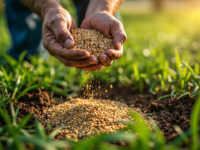
Good soil prep for grass seed comes down to five things: killing off what’s there now, loosening the top 4 to 6 inches, correcting the pH and fertility with a real soil test, grading it smooth, and raking a fine seedbed just before you sow. Skip any one of these and the grass you plant will struggle no matter how good the seed is. Most people who tell you grass seed “just didn’t work” actually never touched the soil at all, they just scattered seed on top of hard, compacted dirt and hoped.
Here’s the mistake that wastes an entire season: rushing to seed before checking soil temperature, then blaming the seed when nothing comes up. It’s also worth naming the sign most people misread completely, patchy germination that looks like a seed problem but is almost always a contact problem, seed sitting on top of soil it never touched.
Stick with this and by the bottom you’ll have the full “Lawn at a Glance” card, the exact numbers and dates worth saving to your phone before you touch a rake.
Start By Killing What’s Already Growing
You cannot rake new grass seed into an existing lawn of weeds, patchy turf, or thatch and expect it to compete. Clear the area first. For small patches, a hard rake or hoe works. For larger areas, a non-selective herbicide applied per the product label, or physically stripping the sod with a sod cutter, gets you back to bare dirt.
If you’re renovating an existing lawn rather than starting from scratch, dethatch and core-aerate instead of stripping everything. Either way, the goal is the same: seed needs direct contact with soil, not a mat of dead grass or living competition sitting between it and the ground.
The next problem is what’s underneath that cleared surface.
Loosen the Soil, Don’t Just Scratch It
Compacted soil is the single biggest reason grass seed fails even when everything else is done right. Push a screwdriver into the ground. If it stops within an inch or two, your soil is too hard for roots to push through.
Till or core-aerate to break up the top 4 to 6 inches. On heavy clay, work in 1 to 2 inches of compost across the surface while you till, it improves drainage and gives new roots something to grip. On sandy soil, compost helps too, mainly for water and nutrient holding.
Once the ground is loose, don’t walk on it more than you have to. Compaction comes back fast.
Test the Soil Before You Guess at Fertilizer
This is the step almost everyone skips, and it’s the honest answer to the question you’re about to ask anyway: how much fertilizer and lime do I actually need? A basic soil test, through a local extension office or a home kit, tells you your pH and nutrient levels instead of leaving you to guess.
Most turfgrass wants a pH between 6.0 and 7.0. Below 6.0, grass roots struggle to pull up nutrients even if they’re present in the soil. Lime raises pH, sulfur lowers it, and the bag will tell you the rate based on your test results.
Work lime, sulfur, or starter fertilizer into the top few inches now, before seeding, not after.
Amendments buried before seed goes down do far more good than anything sprinkled on top later.
Grade It Smooth and Rake a Fine Seedbed
Low spots collect water and drown seedlings, high spots dry out and starve them. Use a landscape rake or the back of a garden rake to level the surface, filling depressions with extra topsoil as you go.
Once it’s graded, rake the top inch into a fine, crumbly texture, no clods bigger than a marble. This is where that misread sign comes back into play: seed that lands on clumpy, uneven soil never makes real contact with it, and uneven contact is what produces those patchy strips of germination people blame on “bad seed.”
Lightly firm the surface with a lawn roller or the flat side of a rake so the seedbed isn’t fluffy, just loose enough for roots and firm enough to hold moisture.
With the bed ready, timing decides whether any of this prep pays off.
Timing: Soil Temperature Matters More Than the Calendar
For cool-season grasses (fescue, bluegrass, ryegrass), the best windows are late summer into early fall, when soil temperatures sit between 50 and 65°F, or early spring as a distant second choice. For warm-season grasses (bermuda, zoysia, centipede), wait until soil hits 65 to 70°F, usually several weeks after your last frost.
Guessing by the date on the calendar is exactly the mistake that ruins most attempts. A warm week in early spring can trick you into seeding cool-season grass too early, then a cold snap stalls germination for weeks and weeds move in first.
Check soil temperature with an inexpensive soil thermometer 2 inches down rather than trusting the air temperature or the date.
Once temperature and bed are both right, seeding itself is the easy part.
Sowing, Then the Watering Routine That Actually Matters
Spread seed at the rate listed on the bag for your grass type, then lightly rake again or drag a piece of chain-link fence over the area to work seed just under the surface, about 1/8 to 1/4 inch deep. Too deep and it won’t emerge, too shallow and birds or drying wind take it.
Water immediately after seeding, then keep the top inch of soil consistently damp, not soaked, for the next 2 to 3 weeks. That usually means light watering once or twice a day depending on heat and wind.
Once seedlings reach about an inch tall, cut back to deeper, less frequent watering, 2 to 3 times a week, to push roots downward instead of keeping them shallow.
Get through germination and the mowing decision comes next, and it trips up more new lawns than people expect.
The Mistakes That Cost an Entire Season
A few habits quietly ruin more lawns than bad luck ever does:
- Seeding on unbroken soil: scattering seed over hard or thatchy ground guarantees poor contact and patchy results.
- Skipping the soil test: guessing at lime and fertilizer either underfeeds the lawn or burns tender seedlings.
- Letting the seedbed dry out once germination starts: a single dry afternoon in the first week can kill a whole batch of sprouting seed.
- Mowing too soon: wait until grass reaches 3 to 3.5 inches before the first cut, and never remove more than a third of the blade.
- Walking on the new lawn: keep foot traffic off it for at least 3 to 4 weeks.
Every one of those is fixable if you catch it early, but none of them are fixable after the fact if the grass has already died back.
Lawn at a Glance
- When to plant: late summer to early fall for cool-season grass when soil is 50 to 65°F, early spring only as a backup, and after the last frost once soil hits 65 to 70°F for warm-season grass.
- Soil depth to prepare: loosen the top 4 to 6 inches, whether by tilling or core aeration.
- Target pH: 6.0 to 7.0 for most turfgrass, confirmed with an actual soil test, not a guess.
- Seeding depth: about 1/8 to 1/4 inch, raked or dragged in lightly after spreading.
- Watering schedule: light watering once or twice daily for the first 2 to 3 weeks, then 2 to 3 deeper waterings a week once grass reaches an inch tall.
- First mow: wait until grass is 3 to 3.5 inches tall, cut no more than a third of the blade length.
- Traffic: keep people and pets off the new seedbed for 3 to 4 weeks minimum.
If you only remember one thing, remember this: the seed is rarely the problem, the soil underneath it almost always is.
Prep it right once, and the grass does the rest of the work on its own.