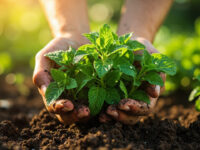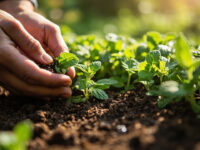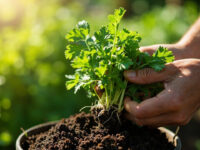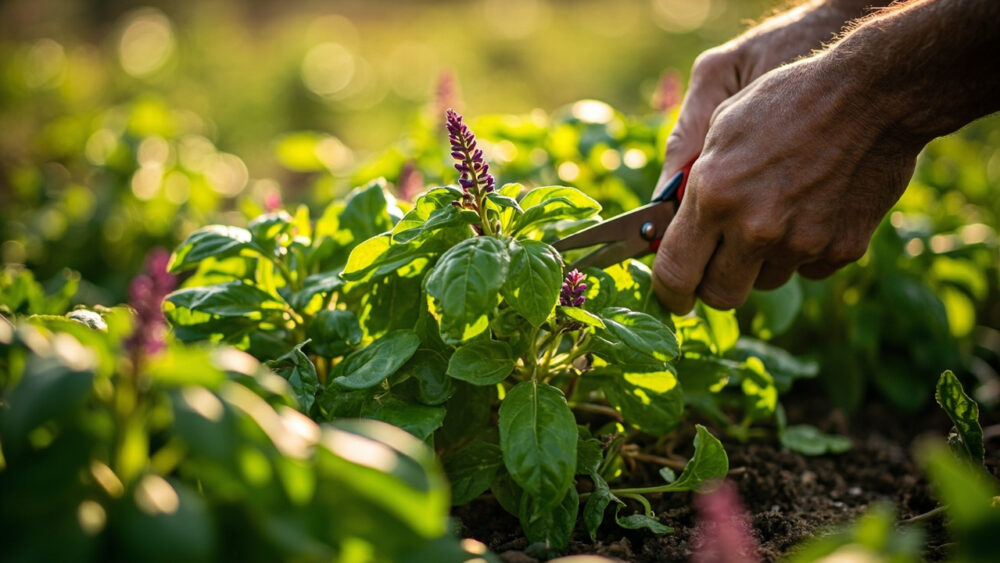
You can start harvesting Thai basil once a young plant has at least 6 to 8 sets of true leaves and stands about 6 inches tall, usually 5 to 6 weeks after transplanting. The method matters more than the timing: you cut just above a leaf node on a stem, never strip whole leaves off the plant, and you do it regularly whether you need basil that week or not. Get how to harvest Thai basil right and one plant will feed you all summer. Get it wrong and you’ll be buying more starts by July.
Most people ruin a Thai basil plant slowly, not suddenly. They pick a few leaves off the top here and there, the plant gets tall and leggy with all its energy going into one central stalk, and then it flowers and turns bitter before they’ve gotten a real harvest out of it.
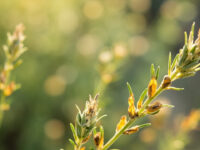
There’s also a sign almost everyone misreads, the purple flower spikes that show up midsummer look pretty enough that people leave them, and that single decision quietly ends the harvest. Stick around, because the exact fix for that, plus the save-able Thai Basil at a Glance card with every number you need, is waiting at the bottom of this page.
The Real Signs Your Thai Basil Is Ready
Forget counting days on a calendar alone. Look at the plant’s structure first. A Thai basil plant ready for its first real harvest has multiple branching stems, not just one central stalk, and each stem carries at least 4 to 6 leaf pairs.
The height check
Once the plant hits 6 to 8 inches tall, it can handle a real cut. Below that, you’re just nibbling and slowing it down.
The leaf color and feel check
Ready leaves are deep green to purple-tinged, glossy, and firm, not floppy or pale. Pale, thin leaves mean the plant needs more light or nitrogen before you take much off it.
Once you see branching stems and firm leaves, you’re not just allowed to harvest, you’re overdue.
The Timing Window, and What Happens If You Miss It
The best harvest window runs from that first cut in early summer right up until the first flower buds appear, which for most gardeners is anywhere from 8 to 12 weeks after transplant depending on heat and daylight. Thai basil is a warm-season plant that stalls below 50°F and gets sluggish once nights dip toward the mid 40s, so your harvest season is really bounded by your last frost on one end and your first fall cold snap on the other.
Harvest too early and you barely set the plant back, that’s a minor mistake, just slow down and let it bush out more before the next cut.
Harvest too late, meaning you let it flower and go to seed, and the leaves turn noticeably more bitter and the plant shifts its energy into seed production instead of new leaf growth. That’s the mistake that actually costs you the season, not the early cut everyone worries about.
Miss the flowering window and the fix isn’t complicated, but it does require you to be a little ruthless.
How to Harvest Without Stunting the Plant
Here’s the part almost everyone gets backwards. The instinct is to pluck a few outer leaves and leave the plant alone, but that’s exactly what makes it grow tall, thin, and floppy instead of full and bushy.
Cut stems, not leaves. Follow this instead:
- Find a stem with at least 4 to 6 leaf sets.
- Look about two-thirds of the way down the stem for a node where two small leaves are sprouting.
- Snip the stem cleanly just above that node using scissors or your fingernails.
- Never cut below the lowest set of leaves, the plant needs that base to regrow.
- Take no more than one third of the plant’s total growth in a single harvest.
Cutting above a node isn’t cosmetic. That node is where two new stems will branch out, so every proper cut doubles your future harvest instead of just taking one.
Do this correctly and the plant gets bushier every time you cut it, which is the opposite of what most people expect.
Right After the Cut: Don’t Let the Harvest Wilt
Thai basil wilts fast once cut, faster than a lot of other herbs, because the stems are soft and the leaves lose water quickly in heat. Get it out of the sun immediately.
Stand the cut stems in a glass of water like cut flowers if you’re not using them within the hour, and keep that glass on the counter, not in the fridge. Cold air actually browns basil leaves and makes them go slimy faster than room temperature does.
If you’re harvesting a large amount at once, rinse it gently, shake off excess water, and lay it loosely on a towel rather than piling it in a bowl where the bottom leaves bruise under the weight of the top ones.
Handled gently in the first ten minutes, your harvest stays crisp for days instead of wilting by dinner.
Keeping the Harvest Coming All Summer
This is where the flower spikes come back into the picture. The moment you see a small spike forming at the tip of any stem, pinch or cut it off immediately, even if you don’t need the basil that day.
Do not let it look pretty for even a week. That’s the guess that costs people their harvest, they see flowers and think the plant is thriving, when really it’s shutting down leaf production to make seeds.
Pinching flower buds the moment they appear, combined with regular stem harvesting every 1 to 2 weeks, is what actually keeps a Thai basil plant productive for months instead of weeks. A plant that’s cut back hard and often will consistently out-produce one that’s left alone and only picked at occasionally.
Feed it lightly with a balanced fertilizer every 3 to 4 weeks during heavy harvesting, since all that regrowth costs the plant real energy.
Keep pinching those flower spikes and there’s really only one thing left to nail down, the numbers themselves.
Thai Basil at a Glance
- When to start harvesting: once the plant is 6 to 8 inches tall with branching stems, usually 5 to 6 weeks after transplanting.
- How to cut: snip stems just above a leaf node, never strip individual leaves, taking no more than one third of the plant per harvest.
- How often: every 1 to 2 weeks during the growing season to keep new branching going.
- Harvest window: from first cut through the first sign of flower buds, roughly 8 to 12 weeks after transplant depending on heat and daylight.
- The critical maintenance step: pinch off flower spikes the moment they appear, or the leaves turn bitter and growth slows.
- After cutting: get stems out of direct sun fast, stand in room-temperature water like cut flowers if not using right away.
- Cold tolerance: growth stalls below 50°F, so your season ends with the first real cold snap in fall.
Cut stems above the node, not leaves off the top, and pinch every flower spike the second you see it. Do those two things and one Thai basil plant will genuinely outproduce what most people get from three.