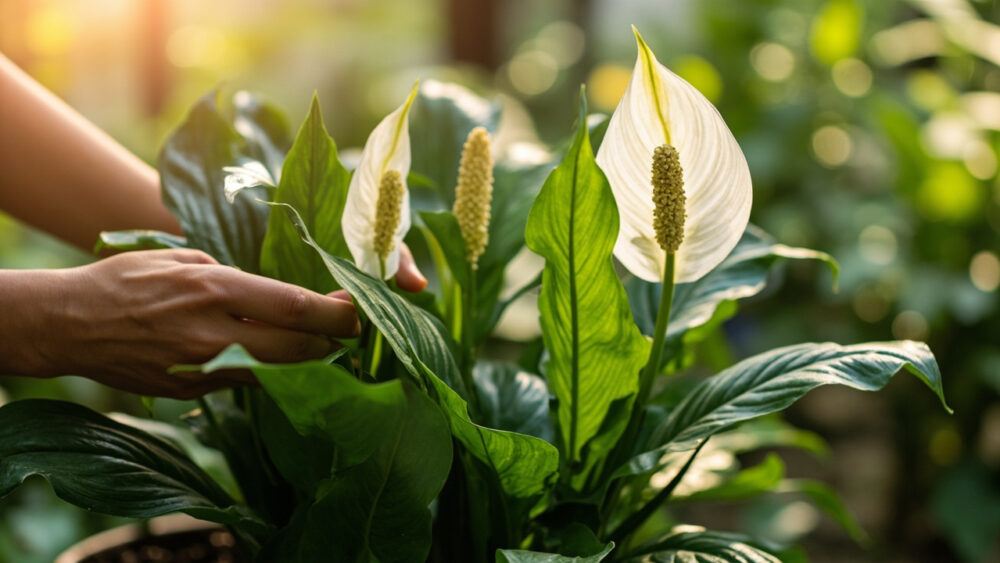
Peace lily light requirements boil down to one simple range: medium to bright indirect light, no direct sun on the leaves. Think a spot a few feet back from an east or north window, or several feet in from a bright south or west one with a sheer curtain between the plant and the glass. Too little light and it survives but never blooms; too much direct sun and you get bleached, scorched patches that never turn back green.
That part is easy. What trips people up is everything downstream of it.
Most people misread the plant’s biggest warning sign and water when they should be moving the pot instead. There is also a seasonal shift almost nobody adjusts for, and a fix for dim apartments that does not involve buying a grow light or hauling the plant to a sunroom you do not have. Stick with me through those, and grab the Peace Lily at a Glance card at the very bottom, it is built to save straight to your phone.
The Plain Answer: Medium to Bright Indirect Light
Peace lilies evolved under a forest canopy, not in open sun. In the home, that translates to bright, filtered light for most of the day, with zero hours of direct sun hitting the foliage.
They will tolerate lower light better than almost any houseplant you own. That is the trap. Tolerate is not the same as thrive.
A peace lily in low light lives for years, stays a dull, uniform green, and never sends up a single white bloom. A peace lily in the right light blooms on and off for months and pushes out new glossy leaves regularly.
If you want foliage only, low light is survivable. If you want the flowers you bought it for, it needs real brightness, just not direct rays.
The next question is what “bright indirect” actually looks like in your specific room.
What the Right Spot Actually Looks Like
East-facing windows are close to ideal. Morning sun is gentle enough that the plant can sit within two to three feet of the glass without burning.
North-facing windows work too, but push the plant closer, within a foot or two, since north light is weaker and more even all day.
South and west windows carry strong, hot, direct sun for part of the day. Here the peace lily needs distance, four to eight feet back, or a sheer curtain, or placement to the side of the window rather than directly in the light path.
A rough test that works without measuring anything: hold your hand where the plant sits during the brightest part of the day. A soft, fuzzy-edged shadow means good indirect light. A sharp, dark shadow means direct sun is landing there and the plant is too close.
Get the spot right and the leaves will tell you within a couple of weeks, but only if you know what to look for.
The Warning Sign Everyone Reads Wrong
If you assumed drooping leaves mean the plant needs water, that guess is right often enough to be dangerous. Peace lilies do droop dramatically when thirsty, and they bounce back fast once watered, which is exactly why people trust that read every time.
But a peace lily also droops, more subtly and without the crispy soil, when it is getting too much direct light and drying out faster than its roots can keep up with. Water it again and again in that spot, and you are treating a light problem with a watering fix. The soil stays soggy, roots start to rot, and now you have two problems instead of one.
The real tell is the leaf tissue itself. Thirst-drooped leaves are still deep green and perk back up within hours of watering. Light-stressed leaves develop pale, washed-out patches or straw-colored scorch marks that do not go away no matter how much you water. Check the leaf color before you check the soil.
Once you can tell those two apart, the rest of the troubleshooting gets a lot easier.
Too Little Light vs. Too Much: The Full Signs
Too little light shows up slowly. Leaves stay small, growth stalls, the whole plant looks flat and dull rather than glossy, and blooms simply stop showing up, sometimes for a year or more. New leaves may come in smaller than the ones before them.
Too much direct light shows up faster and looks different:
- Pale yellow or bleached patches on leaves facing the window
- Brown, papery, crispy edges or tips, especially on the sun-facing side
- Leaves curling or folding as if trying to shade themselves
- Faster-than-normal soil drying between waterings
Neither problem kills the plant outright in a week. Low light just stalls it; too much sun scars the leaves it touches, and those scarred leaves stay scarred. You can only prevent more damage going forward, not undo what already happened.
Both problems get worse or better with the seasons, which most people never account for.
The Seasonal Shift Nobody Adjusts For
The sun’s angle changes a lot between winter and summer, and a spot that was perfectly indirect in January can be scorching by June.
Winter sun sits lower in the sky and travels a shorter, weaker path, so a south or west window that felt too intense in summer often becomes genuinely good light in winter. Many peace lilies actually do better pulled a little closer to south windows once the days shorten.
Come spring and summer, that same window turns harsh again as the sun climbs higher and the days get longer. This is the single most common cause of sudden leaf scorch that seems to appear “out of nowhere” in late spring: nothing changed except the sun’s position, and the plant was never moved back.
Treat your peace lily’s placement as a twice-a-year adjustment, not a one-time decision.
Fixing a Dim Room Without a Greenhouse
If your only window is north-facing, small, or blocked by a building, you do not need to buy special equipment to fix it. A few low-effort moves close most of the gap:
- Move the plant as close to the window as it can go without touching the glass in winter
- Wipe dust off the leaves monthly. Dusty foliage blocks a surprising amount of light and cuts photosynthesis noticeably
- Paint or use a light-colored wall or surface behind the plant to bounce more ambient light onto it
- Rotate the pot a quarter turn every week or two so growth does not lean permanently toward the light source
- Accept fewer blooms as the honest trade-off. A peace lily in true low light will still live for years, just mostly in foliage-only mode
A basic full-spectrum grow light on a timer for eight to ten hours a day is a real fix if blooms matter to you and your only window is genuinely dim. It does not need to be expensive or elaborate, just consistent.
Get the placement and the seasonal check right, and the rest of peace lily care is close to foolproof.
Peace Lily at a Glance
- Ideal light: bright, indirect light all day, such as a few feet back from an east window or several feet from a south or west window with a sheer curtain.
- Lowest tolerable light: low to medium indirect light, where the plant survives and stays green but rarely or never blooms.
- Never do this: place it where direct sun hits the leaves for more than a few minutes, especially midday summer sun.
- Sign of too little light: dull, small leaves, slow growth, and no blooms for a year or more.
- Sign of too much light: pale bleached patches or brown crispy edges on the sun-facing leaves, plus faster soil drying.
- Seasonal move: shift closer to bright windows in winter, then pull back a few feet as spring and summer sun intensifies.
- No good window fix: a full-spectrum grow light for eight to ten hours a day if blooms matter and natural light is limited.
Get the light right and this plant will remind you constantly, through blooms, glossy leaves, and steady new growth.
Everything else about peace lily care gets easier once that one variable is dialed in.