Growing pecan trees from seed starts with a nut that has never dried out, planted 2 to 3 inches deep in fall or cold-stratified for 90 to 120 days and planted in early spring once soil hits about 50°F. From there you are looking at 5 to 10 years before you see a single nut, and that tree needs a second, genetically different pecan tree nearby to actually produce, because pecans do not reliably pollinate themselves. This is a real commitment, not a weekend project, and it rewards patience more than effort.
Here is what trips people up before they even get a seedling out of the ground. Most first attempts fail at the nut itself, not the planting, because a pecan that has been shelled, roasted, or sitting in a grocery bin for months is already dead inside. There is also a sign of a healthy young pecan taproot that almost everyone misreads as a problem and yanks the seedling out over, which we will get to. And there is the honest answer to the question you are already forming: no, that seedling will not be “just like” the parent tree, and whether that matters depends entirely on what you are growing it for.
Stick with this to the end and you will get a save-able Pecan Trees at a Glance card with the exact numbers for timing, spacing, and feeding, the kind of thing worth screenshotting before you head out to plant.
When to Plant Pecan Seeds
Pecans need a cold, damp period before they will germinate, so timing runs one of two ways. In USDA zones 6 through 9, where pecans grow best, you can plant nuts directly in the ground in fall, 2 to 3 weeks before your ground typically freezes, and let winter do the stratifying for you.
The alternative is refrigerator stratification: seal nuts in slightly damp sand or peat inside a plastic bag, hold them at 34 to 40°F for 90 to 120 days, then plant outdoors in early spring once soil has warmed to around 50°F and the danger of a hard freeze has passed.
Skip the stratification and plant a fresh nut in spring with no cold treatment, and it may sit in the ground doing nothing for a year or simply rot.
Get the timing right and the next decision is where that seed actually goes.
Choosing the Spot and Prepping the Soil
Pecans grow into genuinely large trees, 70 to 100 feet tall with a canopy spread nearly as wide, so this is not a corner-of-the-yard decision. Give each tree full sun and at least 40 to 60 feet of clearance from buildings, power lines, septic systems, and other trees.
Soil depth matters more than soil richness. Pecans send down a taproot that can reach several feet in the first year alone, so they need deep, well-drained soil free of hardpan or heavy clay layers. A slightly acidic to neutral pH, roughly 6.0 to 7.0, suits them well.
Work the planting area 2 to 3 feet down if you can, breaking up compacted soil, since a taproot that hits a wall of clay will deform and the tree never fully recovers from it.
Poorly drained ground is the other dealbreaker. If water stands in the planting hole an hour after a hard rain, pick a different spot or build up a raised mound.
Once the site is right, the planting itself is simple, but a few details decide whether that seed becomes a tree.
Planting Pecan Seeds Step by Step
- Test the nut first. Drop it in water. Sinkers are viable, floaters are usually hollow or dried out and should be discarded.
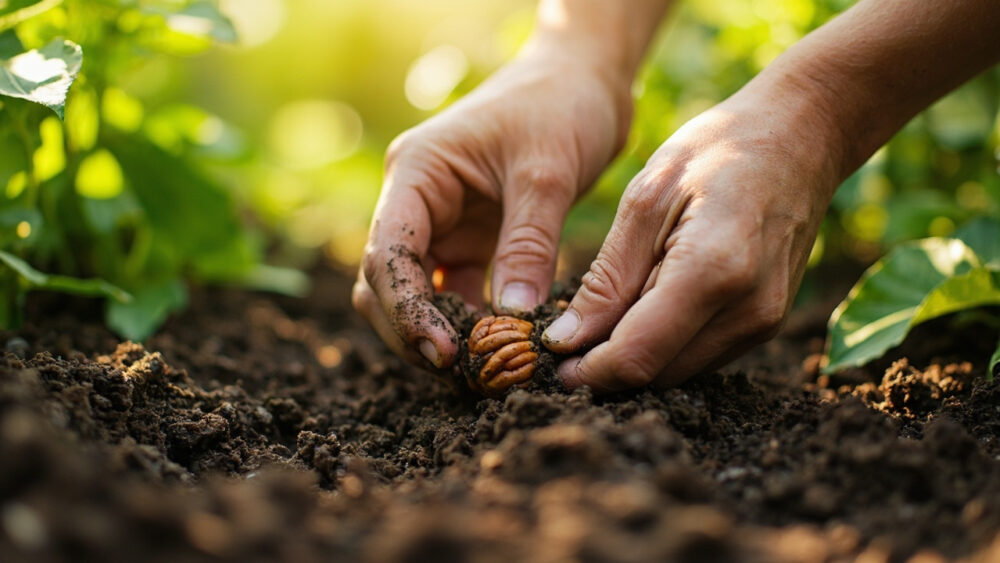
- Dig a hole or furrow 2 to 3 inches deep. Any shallower and squirrels or freeze-thaw cycles will heave the nut right out.
- Space seeds 3 to 4 feet apart if you are planting several to select the strongest seedlings later, though final tree spacing needs 40 to 60 feet.
- Lay the nut on its side, cover with soil, and water in well to settle the soil around it.
- Mulch 2 to 3 inches deep over the planting site to buffer soil temperature and hold moisture through winter or early spring.
- Cage or screen the spot. Squirrels, deer, and rodents will dig up a newly planted pecan faster than almost anything else in the yard.
Now for the part almost everyone gets wrong once the seedling actually emerges.
The Taproot Mistake That Kills More Seedlings Than Anything Else
A young pecan seedling puts nearly all its early energy into that taproot, often growing it a foot or more deep before much happens above ground. If you assumed a seedling that looks stalled with barely 4 inches of top growth is struggling, that guess is exactly backward.
It is usually doing fine, just investing underground first.
The real mistake is transplanting or disturbing that seedling in its first year. The taproot does not branch and recover from damage the way a fibrous root system does. Snap or bend it while moving the seedling and you have likely set the tree back years, sometimes for good.
Plant pecans exactly where you want the mature tree. If you started seeds in pots to protect them from rodents, use deep tree pots or root-training containers and get them into the ground within their first year, before the taproot circles or hits the bottom.
Get the roots settled and undisturbed, and the next job is simply keeping the tree fed through its first several summers.
Watering and Feeding Through the Season
Young pecan trees need consistent moisture, not soggy soil. Water deeply once a week through the first two growing seasons whenever the top 2 to 3 inches of soil feel dry, more often during summer heat above 90°F.
Established trees, three years and older, tolerate short dry spells but still produce better nuts with regular deep watering through summer, especially as nuts fill out in late summer.
Hold off on fertilizer the first year and let the tree establish. Starting the second year, feed in early spring with a balanced tree fertilizer or one formulated for nut trees, following the label rate for the trunk diameter.
Pecans are notably heavy nitrogen and zinc users, and a zinc deficiency shows up as small, crinkled, mottled leaves, a common enough problem that many pecan-specific fertilizers already include it.
Feed a young tree well and it grows fast, but fast growth also makes it a target.
Problems That Actually Show Up on Pecan Trees
The single most common disease is pecan scab, which shows up as dark, sunken lesions on leaves, nut shucks, and shoots, especially in humid climates with wet springs. Good airflow from proper spacing and pruning helps, and where scab is a recurring problem in your area, a fungicide labeled for pecan scab applied on the schedule the label recommends is the standard approach.
Pecan weevils and aphids are the most common insect trouble, weevils drilling into developing nuts and aphids clustering on new growth and leaving a sticky residue. Both are manageable with an insecticide labeled for the specific pest, applied per the label, and healthy, well-watered trees shrug off minor infestations better than stressed ones.
The most frustrating non-problem is a tree that grows well for years and simply will not set nuts. That is almost always a pollination issue, not a disease.
Which brings up the pollination question you were probably already wondering about.
Why One Pecan Tree Almost Never Produces Nuts
Pecan trees are wind-pollinated, and a single tree typically sheds its male and female flowers at different times, a trait called dichogamy. That means one isolated tree usually cannot pollinate itself reliably, even if it flowers heavily every spring.
You need at least two trees, ideally two different varieties with complementary bloom timing, planted within a few hundred feet of each other for wind to carry pollen between them. A seedling-grown tree also will not produce nuts identical to its parent, since pecans do not come true from seed the way a grafted cultivar does.
If you want a known nut size or flavor, grafting a named cultivar onto your seedling later is the only reliable path, and many pecan growers do exactly that once the seedling trunk reaches pencil to finger thickness.
Once pollination is sorted and the tree is old enough, the wait is nearly over.
When and How to Harvest
A seedling-grown pecan tree typically needs 5 to 10 years before its first real crop, sometimes longer, and won’t hit full production until 10 to 15 years in. Grafted trees bear sooner, often in 4 to 6 years, which is another reason many growers graft rather than wait on straight seedlings.
Harvest time is easy to read. The outer green shuck splits open and turns brown, and nuts begin dropping on their own, usually in the mid to late fall depending on your climate and variety.
Once shucks split, shake limbs or use a long pole to knock nuts loose onto a tarp, then gather promptly since nuts left on wet ground mold fast.
Cure them in a single layer in a cool, dry, ventilated spot for 1 to 2 weeks before storing, which improves flavor and shelf life considerably.
That first harvest, whenever it finally comes, is the payoff for everything above, so keep the numbers that got you there within reach.
Pecan Trees at a Glance
- When to plant: fall directly in the ground, 2 to 3 weeks before typical ground freeze, or early spring after 90 to 120 days of cold stratification once soil hits about 50°F.
- Planting depth and spacing: 2 to 3 inches deep, seedlings 3 to 4 feet apart for selection, mature trees need 40 to 60 feet of clearance.
- Site needs: full sun, deep well-drained soil worked 2 to 3 feet down, pH 6.0 to 7.0, no standing water after rain.
- Watering: weekly deep watering the first two seasons, more in heat above 90°F, regular watering during nut fill even on mature trees.
- Feeding: skip year one, then balanced or nut-tree fertilizer with zinc each early spring from year two on.
- Pollination: plant at least two trees, ideally different varieties, since one tree rarely pollinates itself.
- Time to harvest: 5 to 10 years for seedlings, 4 to 6 for grafted trees, when shucks split and turn brown in mid to late fall.
The one thing worth remembering above everything else: plant that nut exactly where the tree will live, because a disturbed taproot never fully forgives you.
Everything else, timing, feeding, pests, is manageable. That decision is not.